
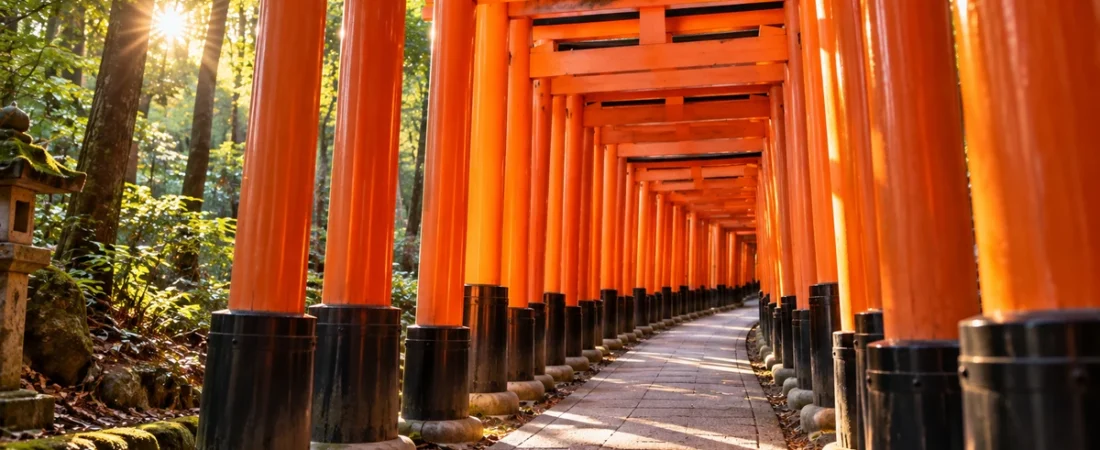
Finding the best free things to do in Kyoto is surprisingly easy. Although some of Kyoto’s famous temples charge admission, many of the city’s most memorable experiences—including historic shrines, traditional neighbourhoods, riverside walks, parks and scenic trails—can be enjoyed without paying an entrance fee.
You can walk beneath thousands of vermilion torii gates at Fushimi Inari, explore the atmospheric streets of Gion, wander through Kyoto Gyoen National Garden and watch the sunset beside the Kamo River without spending anything on admission.
This guide covers 22 excellent free experiences for travellers who want to discover Kyoto while keeping sightseeing costs under control.
For broader planning advice, attractions and transport information, read our complete Kyoto Travel Guide.
1. Walk Through Fushimi Inari Taisha
Fushimi Inari Taisha is one of Kyoto’s most recognisable attractions and one of its best free experiences.
The shrine is famous for the thousands of vermilion torii gates that form pathways up Mount Inari. You can explore the main shrine area, walk through the celebrated Senbon Torii sections and continue farther into the forested mountain.
You do not have to complete the entire route. Even a relatively short walk beyond the entrance provides the classic torii-gate experience.
Visit early in the morning if you want a quieter atmosphere. Fushimi Inari becomes extremely popular later in the day.
2. Explore Yasaka Shrine
Located between Gion and Maruyama Park, Yasaka Shrine is easy to include while exploring eastern Kyoto.
The main shrine grounds are free to enter, making this an excellent stop while walking through the surrounding historic districts.
The shrine is particularly atmospheric in the evening when its lanterns are illuminated.
Because of its convenient location, you can combine Yasaka Shrine with several other free attractions without paying for additional transport between each one.
3. Walk Through Gion
You do not need to book an expensive cultural experience to appreciate the atmosphere of Gion.
Simply walking through the district is free.
Traditional wooden machiya buildings, narrow streets and historic architecture make Gion one of Kyoto’s most distinctive neighbourhoods.
Hanamikoji is among the best-known streets, but visitors should remember that Gion is also a working residential and entertainment district.
Follow local signs, avoid entering private property and never obstruct or chase geiko or maiko for photographs.
4. Explore Kyoto Gyoen National Garden
Kyoto Gyoen National Garden is a vast green space surrounding Kyoto Imperial Palace.
The garden measures approximately 700 metres east to west and 1,300 metres north to south, giving you plenty of space for walking and relaxing.
Admission to the national garden itself is free.
Seasonal attractions include plum blossoms, cherry blossoms and autumn colours, while the lawns and wooded areas make it enjoyable even outside the famous flowering seasons.
It is one of central Kyoto’s best places for an inexpensive break from crowded sightseeing streets.
5. Walk the Philosopher’s Path
The Philosopher’s Path is a peaceful canal-side walking route in eastern Kyoto.
It stretches between the area near Ginkaku-ji and Nyakuoji Bridge and is especially famous during cherry-blossom season.
Walking the path costs nothing.
Small bridges, residential streets, cafés and temple approaches line the route, making it an enjoyable way to experience a quieter side of Kyoto.
Some temples along the route charge admission, but simply walking the Philosopher’s Path remains free.
6. Relax in Maruyama Park
Maruyama Park sits immediately behind Yasaka Shrine and is one of Kyoto’s most convenient free green spaces.
It is especially popular during cherry-blossom season, when its famous weeping cherry tree attracts large numbers of visitors.
Outside sakura season, the park remains a pleasant place to rest between sightseeing stops.
Combining Gion, Yasaka Shrine and Maruyama Park creates an excellent free walking route through eastern Kyoto.
7. Walk Along the Kamo River
Few free experiences show everyday Kyoto as naturally as a walk beside the Kamo River.
The river runs through the city and is popular with residents for walking, running, cycling and relaxing.
You can sit beside the water, watch birds and enjoy the city skyline without buying anything.
Evenings can be particularly pleasant when temperatures cool and people gather along the riverbanks.
Bring a convenience-store snack or picnic and you have one of Kyoto’s simplest low-cost experiences.
8. Visit the Kamogawa Delta
At the meeting point of the Kamo and Takano rivers, the Kamogawa Delta is a popular open space.
Large stepping stones cross sections of the river, while the banks provide space to sit and watch local life.
Families, students and visitors gather here when the weather is pleasant.
It costs nothing and provides a refreshing contrast to Kyoto’s busy temple districts.
9. See the Togetsukyo Bridge
Togetsukyo Bridge is one of Arashiyama’s signature landmarks.
Walking across the bridge and exploring the riverside area is free.
The surrounding mountain scenery changes throughout the year, with cherry blossoms, summer greenery and autumn foliage each creating a different landscape.
Some attractions around Arashiyama charge admission, but the bridge and public riverside areas provide plenty to enjoy without purchasing a ticket.
10. Walk Through the Arashiyama Bamboo Area
Kyoto’s famous bamboo scenery can be experienced without an entrance ticket on the public paths through the Arashiyama bamboo area.
Towering bamboo creates one of Kyoto’s most recognisable landscapes.
The area can become extremely crowded, so early morning is usually the best time for a calmer walk.
Nearby temples and private gardens may charge admission, so check signs before entering individual properties.
Our 3 Days in Kyoto Itinerary shows how to combine Arashiyama with other major Kyoto attractions efficiently.
11. Explore Nishiki Market
Walking through Nishiki Market itself does not require an admission ticket.
The narrow covered shopping street is filled with shops selling seafood, pickles, sweets, tea, spices and other Kyoto specialities.
Of course, food and souvenirs cost money, but simply exploring the market atmosphere is free.
Avoid eating food while walking where businesses request otherwise, and respect individual shop photography rules.
12. Explore Kyoto Station
Kyoto Station is far more than a transport hub.
Its dramatic modern architecture provides an interesting contrast with Kyoto’s historic image.
Walk through the enormous central atrium, explore the upper levels and climb the famous Grand Staircase.
You can enjoy elevated views from public areas without paying an admission fee.
This is also a useful free activity during poor weather.
13. Walk Through Pontocho
Pontocho is a narrow historic lane running parallel to the Kamo River.
It is known for restaurants, traditional architecture and evening atmosphere.
Dining here can be expensive, but walking through the lane costs nothing.
Visit around dusk when lanterns begin appearing and the surrounding streets become especially atmospheric.
From Pontocho, you can easily continue towards the Kamo River or central shopping streets.
14. Visit Higashi Hongan-ji
Higashi Hongan-ji is a major Buddhist temple close to Kyoto Station.
Its enormous wooden structures make a striking impression, particularly when viewed after arriving in Kyoto by train.
The main temple precinct provides an opportunity to appreciate impressive traditional architecture without the admission fees associated with some of Kyoto’s better-known temples.
Check current visitor arrangements before your visit because access to particular buildings or areas can occasionally change.
15. Explore the Streets of Higashiyama
The preserved streets of Higashiyama are among Kyoto’s most atmospheric areas.
Sannenzaka and Ninenzaka are especially well known for traditional architecture, shops and sloping stone-paved lanes.
Walking through the neighbourhood costs nothing.
You only pay if you enter a ticketed attraction, buy food or shop for souvenirs.
Early morning provides a dramatically different experience from the busy middle of the day.
16. See Hokan-ji Pagoda from the Historic Streets
The Yasaka Pagoda of Hokan-ji is one of the defining landmarks of the Higashiyama skyline.
You can enjoy classic exterior views of the pagoda from the surrounding public streets without purchasing admission.
The combination of the pagoda and traditional wooden buildings creates one of Kyoto’s most photographed street scenes.
Remember that these streets are also used by residents and local businesses, so avoid blocking roads or entrances while taking photographs.
17. Explore Okazaki Park
Okazaki is Kyoto’s major cultural district and contains museums, performance venues, canals and the enormous torii gate associated with Heian Jingu.
Walking around Okazaki Park and the surrounding public areas is free.
It is an excellent neighbourhood to combine with the Philosopher’s Path and nearby temple districts.
Individual museums, exhibitions and gardens may charge admission, so treat those as optional extras.
18. Visit Heian Jingu’s Main Shrine Area
Heian Jingu is immediately recognisable because of its vivid vermilion architecture.
The main shrine area can be visited without paying an entrance fee.
Its large open courtyard and colourful buildings make it worthwhile even if you do not enter the separate paid garden.
This is an important distinction for budget travellers: the shrine visit can be free while the garden is a separate ticketed attraction.
19. Explore Fushimi’s Historic Streets
Fushimi offers more than its famous Inari shrine.
The district developed around water transport and sake production and still contains historic streets, canals and traditional brewery architecture.
Walking around these public areas is free.
Museums, tastings and specific attractions may charge fees, but simply exploring the neighbourhood provides another side of Kyoto without an admission cost.
20. Hike Part of the Kyoto Trail
Travellers who enjoy walking can explore sections of the Kyoto Trail.
The trail network passes through the mountains and neighbourhoods surrounding the city, providing forest scenery and elevated viewpoints.
You do not have to complete a long-distance hike.
Choose a manageable section based on your fitness, daylight hours and weather conditions.
Take water, wear suitable footwear and avoid unfamiliar mountain routes after dark.
21. Explore the Kyoto Imperial Palace Area
Kyoto Gyoen National Garden surrounds Kyoto Imperial Palace and provides one of the city’s largest historical landscapes.
You can spend considerable time exploring the broad gravel paths, wooded sections and former aristocratic residential sites around the palace.
The open setting is particularly pleasant when you need a break from tightly packed sightseeing districts.
Access arrangements for individual imperial facilities can differ from simply entering the surrounding national garden, so check current official information before planning to enter specific palace buildings or compounds.
22. Watch Kyoto Change at Sunset
One of Kyoto’s simplest free experiences is also one of the best: slow down at the end of the day.
Walk beside the Kamo River, explore Gion as lanterns begin glowing, watch the light change around Higashiyama or enjoy the evening atmosphere around Kyoto Station.
Kyoto does not require constant ticketed sightseeing.
Some of the city’s most memorable moments happen while walking between attractions rather than inside them.
Book Your Kyoto Experiences
Ready to start planning? Compare popular Kyoto tours and activities, check current prices and availability, and book the experiences that suit your trip.
Affiliate disclosure: If you book through these links, we may earn a commission from Viator. This does not increase the price you pay.
How to Spend a Free Day in Kyoto
It is entirely possible to create a sightseeing day with no attraction admission fees.
Start early at Fushimi Inari Taisha and explore the torii-gate trails.
Later, travel to central Kyoto and walk through Kyoto Gyoen National Garden.
Continue towards the Kamo River, then explore Gion, Yasaka Shrine and Maruyama Park.
Finish the evening around Pontocho or beside the river.
You would still need to budget for transport and food, but the attractions themselves could be enjoyed without admission fees.
For realistic daily spending estimates, see our Kyoto Travel Budget.
Free Does Not Always Mean Everything Is Free
This distinction is important in Kyoto.
A shrine complex may offer free access to its main grounds while charging for a special garden, exhibition or seasonal event.
Similarly, you may be able to walk around a temple neighbourhood or see an important building from a public street even though entering the temple itself requires a ticket.
Always check signs at the entrance rather than assuming every part of a site is free.
This guide focuses on experiences that can genuinely be enjoyed without paying admission, while clearly treating optional paid sections separately.
Tips for Exploring Kyoto for Free
Walking is one of the easiest ways to reduce sightseeing costs, but Kyoto is larger than it initially appears.
Group nearby places together rather than crossing the city repeatedly.
For example, combine Gion, Yasaka Shrine, Maruyama Park and Higashiyama on one outing. On another day, combine Arashiyama Bamboo Grove, Togetsukyo Bridge and the surrounding public streets.
Public transport will still cost money, but good route planning reduces unnecessary journeys.
If you are deciding where to base yourself, our guide to where to stay in Kyoto explains the advantages of Kyoto Station, Downtown Kyoto, Gion, Higashiyama and other areas.
When to Enjoy Kyoto’s Free Attractions
The city’s free attractions change dramatically with the seasons.
Spring brings cherry blossoms to places such as Maruyama Park and the Philosopher’s Path.
Summer produces intensely green landscapes but also hot and humid conditions.
Autumn transforms parks, mountain areas and riverside scenery.
Winter offers a quieter atmosphere, and occasional snow can completely change familiar landscapes.
Our guide to the best time to visit Kyoto compares the seasons, weather and busiest periods in more detail.
Are Kyoto’s Free Attractions Worth Visiting?
Absolutely.
Some of Kyoto’s defining experiences cost nothing.
Fushimi Inari’s torii gates, Gion’s historic streets, the Kamo River, Kyoto Gyoen National Garden and the Philosopher’s Path are not merely substitutes for paid attractions. They are major Kyoto experiences in their own right.
A good itinerary therefore does not need to choose between only free attractions or only ticketed temples.
Mix both.
Spend money on a few places that genuinely interest you, then use Kyoto’s extensive collection of free shrines, walks, neighbourhoods and landscapes to fill out the rest of your trip.
Final Thoughts
The best free things to do in Kyoto include some of the city’s most memorable experiences. You can walk beneath Fushimi Inari’s vermilion torii gates, explore Gion and Higashiyama, wander through Kyoto Gyoen National Garden, stroll along the Philosopher’s Path and spend an evening beside the Kamo River without paying admission.
Free sightseeing is also an excellent way to slow down. Instead of rushing from one ticketed attraction to another, you have more time to notice Kyoto’s traditional streets, neighbourhoods, rivers and everyday life.
Combine these free experiences with a handful of paid temples and cultural attractions, and you can build a varied Kyoto itinerary without allowing sightseeing costs to dominate your travel budget.
Explore more places through our destinations page or browse our complete collection of itineraries.