
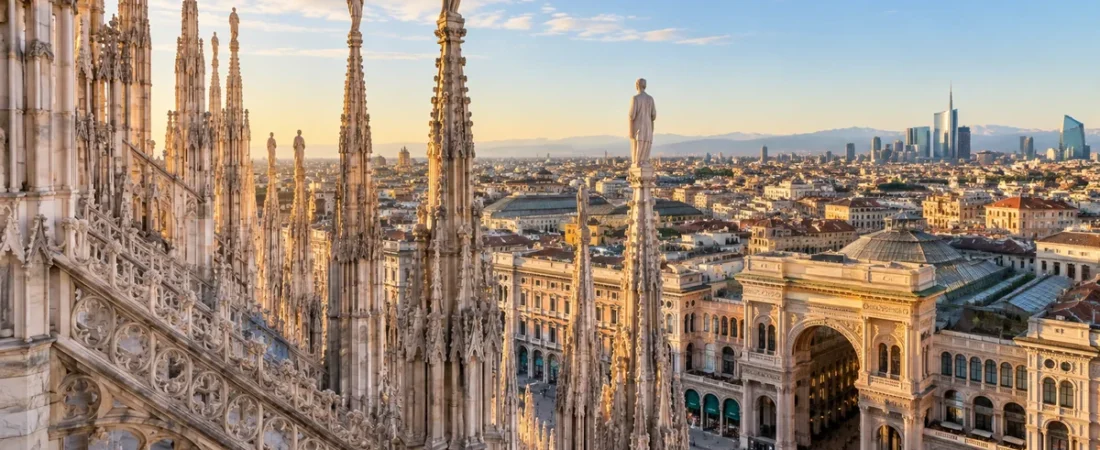
Milan combines magnificent architecture, world-famous art, Italian fashion, historic neighbourhoods and one of the country’s most energetic food and nightlife scenes. Although many travellers know it primarily as Italy’s business and fashion capital, the city rewards visitors who look beyond the shopping streets.
This Milan travel guide covers the essential attractions, neighbourhoods, transport, food, costs and practical information you need for a first visit. From the soaring Duomo and Leonardo da Vinci’s The Last Supper to Navigli’s canals and the elegant Brera district, Milan offers plenty to fill several days.
Price note: All prices in this article are approximate and were checked at the time of publication. Prices may change.
Why Visit Milan?
Milan feels noticeably different from many of Italy’s historic destinations. It is faster paced, more contemporary and strongly connected with design, business and fashion, yet centuries of history remain visible throughout the centre.
The Duomo dominates the city’s main square, while the nearby Galleria Vittorio Emanuele II represents Milanese elegance at its most theatrical. A short distance away, Brera combines cobbled streets with galleries, restaurants and traditional buildings.
Milan is also home to The Last Supper, one of Leonardo da Vinci’s most celebrated works.
For travellers exploring several European cities, Milan’s extensive rail connections also make it a useful stop between Italy, Switzerland and other parts of Europe. If you enjoy grand European architecture and cultural attractions, you may also find inspiration in our Vienna travel guide.
Top Tours & Experiences in Milan
Discover popular Milan tours and experiences. Check current availability, ratings and prices before you book.
Affiliate disclosure: If you book through these links, we may earn a commission from Viator. This does not increase the price you pay.
Top Things to Do in Milan
Visit the Duomo di Milano
The Duomo is Milan’s defining landmark and one of Europe’s most impressive Gothic cathedrals.
Construction began in the 14th century and continued for centuries, producing an extraordinary exterior covered with pinnacles, statues and elaborate stonework.
Visitors can explore the cathedral interior and, depending on their ticket, climb or take a lift to the rooftops. The terraces provide close-up views of the cathedral’s architecture as well as broad views across central Milan.
The cathedral and museum ticket currently costs around €10 for a standard adult admission, while separate rooftop tickets cost approximately €16 using the stairs or €18 using the lift.
Opening arrangements can change for religious celebrations and special events, so confirm the latest schedule before visiting.
Walk Through Galleria Vittorio Emanuele II
Immediately beside Piazza del Duomo is Galleria Vittorio Emanuele II, an elegant 19th-century shopping arcade.
Its glass-and-iron roof, mosaics and grand façades make it worth visiting even if luxury shopping is not part of your plans.
The gallery connects Piazza del Duomo with Piazza della Scala, making it a natural part of a walking route through the historic centre.
Access to the main arcade is free, and early morning is particularly pleasant if you want to appreciate its architecture before the busiest part of the day.
See Leonardo da Vinci’s The Last Supper
Leonardo da Vinci’s The Last Supper is preserved inside the former Dominican convent of Santa Maria delle Grazie.
Access is carefully controlled because of the painting’s fragile condition, and visitors normally enter in timed groups.
Tickets can sell out well in advance, especially during popular travel periods. If seeing the painting is important to you, make the reservation one of the first things you organise after confirming your Milan dates.
Do not rely on arriving at the site and finding same-day availability.
Explore Brera
Brera is one of the most atmospheric parts of central Milan.
Its narrow streets contain restaurants, cafés, independent boutiques and attractive historic buildings. The neighbourhood feels noticeably more intimate than the busy streets surrounding the Duomo.
The Pinacoteca di Brera is the district’s major cultural attraction and contains an important collection of Italian art.
Even if you do not enter the gallery, Brera is worth exploring on foot, particularly from late afternoon into the evening.
Visit Sforza Castle
Castello Sforzesco stands northwest of the historic centre and provides an impressive contrast to Milan’s commercial districts.
The fortress developed under the Visconti and Sforza families and later underwent major changes under different rulers.
Today, the complex contains several museums and cultural collections. Visitors can also walk through its courtyards and continue directly into Parco Sempione.
The castle exterior and surrounding public spaces make this a worthwhile stop even for travellers who do not plan to visit the museums.
Relax in Parco Sempione
Behind Sforza Castle, Parco Sempione provides one of central Milan’s most convenient green spaces.
Walking paths, lawns and trees make it a useful place to rest between attractions.
At the opposite side of the park stands the Arco della Pace, a monumental triumphal arch that creates another attractive photography stop.
Combining Sforza Castle, Parco Sempione and the Arco della Pace creates an easy half-day route without requiring additional transport.
Discover the Navigli Canals
Navigli provides a completely different atmosphere from Piazza del Duomo.
The neighbourhood developed around Milan’s historic canal system and is now particularly known for restaurants, bars, cafés and evening activity.
Naviglio Grande is the principal canal for visitors. Walking along the water is free and is especially pleasant around sunset.
The district becomes considerably busier in the evening, when people arrive for dinner and aperitivo.
Visit Teatro alla Scala
Teatro alla Scala is one of the world’s best-known opera houses.
The building’s relatively understated exterior hides an ornate auditorium associated with many important composers, singers and productions.
Travellers interested in opera or ballet can check the performance programme well before their visit. A museum also introduces the history of La Scala and Italian theatre.
Even without attending a performance, Piazza della Scala fits naturally into a central walking route between Brera and the Galleria Vittorio Emanuele II.
Best Areas of Milan to Explore
Centro Storico
Milan’s historic centre contains the Duomo, Galleria Vittorio Emanuele II and many of the city’s busiest shopping streets.
It is ideal for sightseeing and short visits because several major attractions are within walking distance.
The trade-off is cost: accommodation, restaurants and cafés around the most famous landmarks can be considerably more expensive.
Brera
Brera combines central convenience with more neighbourhood character.
It suits travellers who enjoy galleries, attractive streets, restaurants and evening walks. Its location also makes it easy to reach the Duomo, Sforza Castle and Parco Sempione.
Navigli
Navigli is a good choice for travellers interested in restaurants, aperitivo and nightlife.
The canals give the neighbourhood a distinctive atmosphere, but some streets can remain noisy late into the evening.
Porta Nuova
Porta Nuova represents modern Milan.
The area around Piazza Gae Aulenti contains contemporary towers and major developments, including the distinctive Bosco Verticale residential towers.
It is an interesting place to see the contrast between historic and modern Milan.
Getting Around Milan
Milan has an extensive public transport network of metro lines, trams and buses.
For most visitors, the combination of walking and the metro is sufficient. Trams are also useful and can be an enjoyable way to see more of the streets between attractions.
A standard Mi1–Mi3 ticket currently costs €2.20 and is valid for 90 minutes. A 24-hour ticket costs €7.60, while a 3-day ticket costs €15.50.
Contactless payment is available across the network. When using contactless, follow the correct tapping procedure, including at exit gates where required.
Central Milan is highly walkable. The Duomo, La Scala, Brera, Sforza Castle and several other attractions can be connected on foot.
Getting from Milan Malpensa Airport to the City
Malpensa Airport is Milan’s largest international airport and lies well outside the city centre.
The Malpensa Express provides direct rail connections to Milan stations including Milano Centrale and Milano Cadorna.
The standard adult fare between Milan and Malpensa is currently €15 one way.
Journey times depend on the route. Services between Malpensa and Milano Centrale take around 50 minutes, while some services between the airport and Cadorna are faster.
Milan is also served by Linate Airport, which is much closer to the centre, and Bergamo Orio al Serio Airport, which is frequently used by low-cost airlines.
Always check which airport appears on your booking before organising your transfer.
What to Eat in Milan
Milan has its own strong culinary traditions, so leave time for local food rather than treating meals simply as breaks between attractions.
Risotto alla Milanese
This famous risotto receives its distinctive golden colour from saffron. It is rich, creamy and one of the dishes most closely associated with Milan.
Cotoletta alla Milanese
Cotoletta is a breaded veal cutlet traditionally cooked until crisp and golden. Versions vary considerably in thickness and presentation.
Ossobuco
Ossobuco consists of slow-cooked veal shank and is often paired with risotto alla Milanese.
Panettone
Although now eaten internationally, panettone has strong Milanese origins. Bakeries and pastry shops are particularly well stocked around Christmas, but some specialist establishments offer it for longer periods.
Aperitivo
Aperitivo is an important part of Milan’s social culture. In the early evening, bars serve drinks accompanied by snacks or small dishes.
Navigli, Brera and Porta Venezia are popular areas for experiencing it.
Shopping in Milan
Fashion is an important part of Milan’s international identity.
The Quadrilatero della Moda around Via Montenapoleone contains many of the world’s best-known luxury brands.
Corso Vittorio Emanuele II offers more mainstream shopping close to the Duomo, while Corso Buenos Aires provides a long stretch of shops farther northeast.
Travellers who prefer independent stores and smaller boutiques may enjoy exploring Brera and other neighbourhood shopping streets instead.
Best Time to Visit Milan
Spring and autumn are popular periods for exploring Milan because temperatures are generally more comfortable for walking than during the hottest part of summer.
April, May, September and October can be particularly appealing, although major exhibitions, fashion events and holidays may significantly affect accommodation availability and prices.
Summer can be hot and humid. August also brings a different rhythm as some local businesses reduce hours or close for holidays.
Winter is colder and days are shorter, but Christmas decorations and seasonal shopping bring additional atmosphere to the centre.
Whatever season you choose, check Milan’s major event calendar before booking accommodation. Fashion weeks, trade fairs and major sporting or cultural events can increase demand substantially.
How Many Days Do You Need in Milan?
Two full days allow first-time visitors to cover many of Milan’s principal attractions.
3 days provide a more comfortable visit, allowing time for the Duomo, The Last Supper, Brera, Sforza Castle, Navigli and additional museums without rushing.
With four or more days, Milan can also serve as a base for excursions to destinations such as Lake Como or nearby Lombardy towns.
If Milan forms part of a wider European trip, our Paris travel guide and Rome travel guide can help you plan other major city stops.
Milan Tourist Tax
Visitors staying overnight should account for Milan’s municipal tourist tax.
The amount varies according to accommodation type and category. From April 2026, examples include approximately €7 per person per night at 3-star hotels, €10 at 4-star hotels and €12 at 5-star hotels.
Many B&Bs, holiday apartments and short-term rentals are charged at €9.50 per person per night, while youth hostels have a lower rate.
Exemptions may apply in specific circumstances. Check the amount shown by your accommodation and the latest municipal rules before travelling.
Essential Milan Travel Tips
Reserve The Last Supper as early as possible if it is a priority.
Book major timed attractions before arriving during busy periods.
Wear comfortable shoes because exploring central Milan involves considerable walking.
Use the metro for longer journeys rather than relying on taxis.
Check restaurant menus before sitting down in highly visited areas around Piazza del Duomo.
Visit the Duomo area early in the morning if you prefer fewer crowds.
Keep valuables secure on crowded public transport and around major tourist locations.
Confirm whether your hotel price includes Milan’s tourist tax.
Avoid trying to fit every museum into a short stay. Milan is more enjoyable when you leave time for Brera, Navigli, cafés and neighbourhood walks.
Is Milan Expensive?
Milan can be one of Italy’s more expensive destinations, particularly for accommodation during major events.
You can control costs by staying near a metro station outside the most expensive central streets, walking between nearby attractions and balancing paid museums with free neighbourhood exploration.
Public transport is reasonably priced for a major European city, and many memorable experiences—including Piazza del Duomo, Galleria Vittorio Emanuele II, Navigli, Brera’s streets, Parco Sempione and the castle courtyards—can be enjoyed without paying admission.
Is Milan Worth Visiting?
Milan is well worth considering for travellers interested in architecture, art, fashion, food and modern Italian city life.
The Duomo and The Last Supper alone are internationally important attractions, but Milan becomes more rewarding when you also explore Brera, spend time around Sforza Castle, walk beside the Navigli canals and experience the city’s evening aperitivo culture.
It also works particularly well as part of a wider Italian journey because of its strong rail connections.
For a first visit, allow around 3 days if your schedule permits. That provides enough time to see the principal attractions while still experiencing Milan beyond its most famous landmarks.
Book Your Milan Experiences
Ready to start planning? Compare popular Milan tours and activities, check current prices and availability, and book the experiences that suit your trip.
Affiliate disclosure: If you book through these links, we may earn a commission from Viator. This does not increase the price you pay.
Explore more places through our destinations page or browse our complete collection of itineraries.