
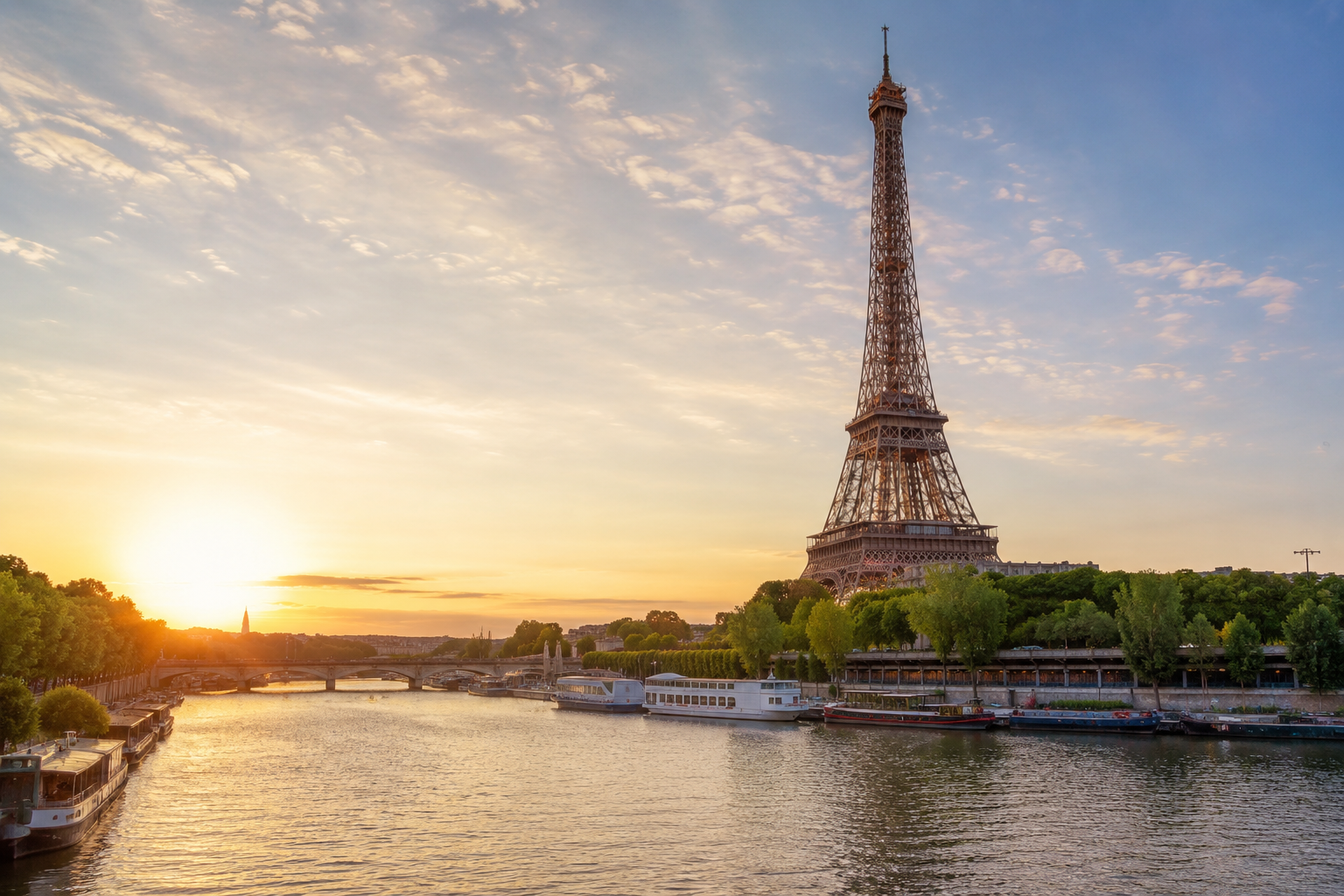
Paris combines celebrated landmarks, world-class museums, elegant neighborhoods, atmospheric cafés and beautiful public spaces within a city that rewards both careful planning and spontaneous exploration. First-time visitors can see the Eiffel Tower, Louvre Museum and Notre-Dame Cathedral while still leaving time to wander beside the Seine or settle into a neighborhood café.
This Paris travel guide explains where to stay, what to see, how to use public transport, what meals and attractions may cost, and how to organize your time without rushing between sights.
Price note: All prices in this article are approximate and were checked at the time of publication. Prices may change.
Paris at a Glance
- Country: France
- Language: French
- Currency: Euro (€)
- Time zone: Central European Time
- Typical visit: Three to five days
- Best for: Art, architecture, history, food, fashion and romantic city breaks
- Main airports: Paris Charles de Gaulle and Paris Orly
- Public transport: Métro, RER trains, suburban trains, buses and trams
- Best months for mild weather: April to June and September to October
- Emergency number: 112
Paris is divided into 20 administrative districts called arrondissements. They spiral outward clockwise from the historic center and appear in postal codes, addresses and accommodation listings. Knowing an arrondissement number makes it easier to understand where a hotel, restaurant or attraction is located.
Top Tours & Experiences in Paris
Discover popular Paris tours and experiences. Check current availability, ratings and prices before you book.
Affiliate disclosure: If you book through these links, we may earn a commission from Viator. This does not increase the price you pay.
Why Visit Paris?
Paris offers much more than a checklist of famous monuments. Its appeal comes from the way grand architecture, neighborhood life and cultural history overlap.
You can spend the morning examining Renaissance paintings at the Louvre, walk through a formal garden in the afternoon and finish the day in a small restaurant on a residential street. Another day might revolve around Montmartre’s steep lanes, a market lunch and sunset beside the Seine.
The city is especially rewarding for travelers interested in:
- Major museums and influential works of art
- Gothic churches and historic architecture
- French food, wine, pastries and café culture
- Fashion, design and luxury shopping
- Parks, gardens and river walks
- Historic neighborhoods with distinct identities
- Easy day trips, including Versailles
Paris can be expensive, but many of its most memorable experiences—walking beside the Seine, exploring Montmartre, visiting public gardens and viewing the Eiffel Tower from Trocadéro—cost nothing.
How Many Days Do You Need in Paris?
Three days provide enough time for the principal landmarks and several atmospheric neighborhoods. Four or five days allow you to visit more museums, slow down over meals and take a day trip without sacrificing central Paris.
A sensible first visit might include:
- Day one: Historic center, Notre-Dame, the Latin Quarter and the Seine
- Day two: Louvre Museum, Tuileries Garden, Champs-Élysées and Arc de Triomphe
- Day three: Eiffel Tower, Musée d’Orsay and Montmartre
- Day four: Le Marais, Canal Saint-Martin or additional museums
- Day five: Versailles or another excursion outside central Paris
For a detailed hour-by-hour route, use our 3 days in Paris itinerary.
Top Attractions in Paris
Eiffel Tower
The Eiffel Tower is Paris’s most recognizable landmark and one of the city’s busiest attractions. Visitors can choose the second floor or summit and travel by elevator, stairs or a combination of both, depending on ticket availability.
Official 2026 adult rates include approximately:
- €23.50 for an elevator ticket to the second floor
- €36.70 for an elevator ticket to the summit
- €14.80 for stairs to the second floor
- €28 for stairs to the second floor followed by an elevator to the summit
Book through the official Eiffel Tower ticket office when possible. Timed tickets can sell out, particularly for sunsets, weekends and summer dates. Even with a reservation, allow time for security checks.
The summit may close temporarily because of weather, maintenance or crowding. If summit tickets are unavailable, the second floor still provides an excellent panorama.
For free views of the tower, visit Trocadéro, Champ de Mars or the banks of the Seine. After dark, the tower’s sparkling illumination generally appears for several minutes at the beginning of each hour, although operating arrangements can change.
Louvre Museum
The Louvre is the world’s largest and most famous art museum, occupying a former royal palace in the center of Paris. Its collection extends far beyond the Mona Lisa and includes ancient Egyptian objects, Greek and Roman sculpture, Islamic art, decorative arts and monumental European paintings.
The museum is normally open from 9:00 a.m. to 6:00 p.m., with evening opening until 9:00 p.m. on Wednesdays and Fridays. It is closed on Tuesdays. Last admission is one hour before closing.
Admission in 2026 is €22 for citizens or residents of the European Economic Area and €32 for visitors who are neither citizens nor residents of the EEA. Entry remains free for eligible groups, including visitors under 18 and qualifying EEA residents under 26. Timed reservations are recommended even when admission is free.
Trying to see the entire museum in one visit is exhausting. Choose two or three departments in advance and allow approximately three hours. Entering with a short priority list creates a much better experience than moving hurriedly between famous works.
Notre-Dame Cathedral
Notre-Dame reopened to visitors following its extensive restoration. General admission to the cathedral is free.
A free online reservation is optional for individuals, but reserving a time can reduce waiting during busy periods. Visitors without reservations may still join the admission line. Only use Notre-Dame’s official reservation service; legitimate cathedral reservations are free.
Notre-Dame remains an active place of worship, so services can affect access and visitor movement. Dress respectfully, keep voices low and expect security screening. The cathedral treasury and certain special activities may have separate charges.
After visiting the interior, walk around Île de la Cité to see the cathedral from the east and continue to Square du Vert-Galant at the island’s western tip.
Sainte-Chapelle
Sainte-Chapelle was built in the 13th century to house sacred relics for King Louis IX. Its upper chapel contains towering stained-glass windows that become especially vivid on bright days.
The chapel is compact, but entry can take time because it sits within the Palais de Justice security zone. Reserving a timed ticket is worthwhile. Combining Sainte-Chapelle with Notre-Dame and the Latin Quarter makes geographical sense.
Musée d’Orsay
The Musée d’Orsay occupies a converted railway station beside the Seine and contains an exceptional collection of 19th- and early-20th-century art. It is particularly strong in Impressionist and Post-Impressionist works.
The museum is normally open Tuesday through Sunday from 9:30 a.m. to 6:00 p.m., remaining open until 9:45 p.m. on Thursdays. It closes on Mondays, May 1 and December 25.
Current general admission is approximately €16 online or €14 when purchased at the museum, subject to availability. A reduced Thursday evening ticket is also offered. The museum is free to eligible visitors, including people under 18 and qualifying EEA residents under 26.
Allow two to three hours for the main collection. The large clock faces on the upper level also provide memorable views toward Montmartre.
Arc de Triomphe
The Arc de Triomphe stands at the center of Place Charles de Gaulle, where 12 avenues meet. Never attempt to cross the traffic circle at street level; use the pedestrian underpass.
Access to the Tomb of the Unknown Soldier beneath the monument is free. A ticket is required for the interior exhibition and rooftop terrace.
During the April-to-September high season, standard admission can reach €22, with a lower €16 price on Wednesdays. From October through March, admission is approximately €16. Seasonal pricing and closures connected with national ceremonies make advance checking important.
The terrace offers one of Paris’s finest views because the Eiffel Tower, Champs-Élysées and modern La Défense skyline are all visible. Sunset reservations are particularly popular.
Montmartre and Sacré-Cœur
Montmartre retains traces of the former hilltop village that became part of Paris in the 19th century. The neighborhood’s best-known sights include Place du Tertre, Rue de l’Abreuvoir, the Moulin de la Galette and the Sacré-Cœur Basilica.
Entry to the main basilica is free, while the dome is a separate paid attraction. The steps outside Sacré-Cœur provide broad city views, but the streets behind the basilica are generally calmer and more atmospheric.
Arrive early in the morning if you want quiet lanes and uncrowded photographs. Be alert around the busiest approaches to Sacré-Cœur, where persistent street solicitations can occur.
Tuileries Garden and Place de la Concorde
The Tuileries Garden connects the Louvre area with Place de la Concorde. Its central paths, ponds and movable green chairs make it an excellent place to rest between attractions.
Walking through the garden is free. Seasonal amusement rides and food kiosks are optional paid extras.
At the western end, Place de la Concorde opens toward the Champs-Élysées. From here, travelers can continue toward the Arc de Triomphe or cross the Seine to reach the Musée de l’Orangerie and Left Bank.
Luxembourg Garden
The Luxembourg Garden is one of the best places to experience a slower side of Paris. It includes formal flowerbeds, shaded paths, fountains, sculptures and the Luxembourg Palace.
Admission to the public garden is free. Opening and closing times change with daylight and season, so avoid planning a late-evening visit without checking the daily schedule.
Seine River
Walking beside the Seine provides continuously changing views of bridges, monuments, bookstalls and historic façades. Useful stretches include:
- Île Saint-Louis to the Louvre
- Musée d’Orsay to the Eiffel Tower
- Pont Alexandre III to Pont de l’Alma
- The riverbanks around Île de la Cité
A sightseeing cruise is an optional paid activity rather than an essential expense. Standard cruises commonly last about one hour, while lunch and dinner cruises cost considerably more.
Best Neighborhoods to Explore
Le Marais
Le Marais combines medieval streets, grand private mansions, Jewish heritage, museums, boutiques and a lively restaurant scene. Highlights include Place des Vosges, Rue des Rosiers and the courtyards of several historic mansions.
The neighborhood is central and highly walkable. It becomes especially busy on weekends, so weekday mornings are best for relaxed exploration.
Latin Quarter
The Latin Quarter developed around the Sorbonne and remains associated with academic life. Its lanes contain bookshops, cinemas, cafés, churches and small restaurants.
Worthwhile stops include the Panthéon, Rue Mouffetard, Shakespeare and Company’s exterior and the streets around the Sorbonne. Some restaurants close to the busiest tourist routes prioritize volume over quality, so compare recent menus before sitting down.
Saint-Germain-des-Prés
Saint-Germain-des-Prés is known for literary history, galleries, fashion boutiques and famous cafés. Prices around the most celebrated establishments can be high, but simply walking the neighborhood is free.
It combines naturally with the Luxembourg Garden, Musée d’Orsay or a Seine walk.
Canal Saint-Martin
Canal Saint-Martin offers a more local atmosphere than the central monument district. Tree-lined waterways, footbridges, independent shops and casual restaurants make it a pleasant place for an unhurried afternoon.
Covered Passages
Paris’s surviving covered passages contain vintage shops, bookstores, cafés and ornate architectural details. Galerie Vivienne and Passage des Panoramas are among the most accessible examples.
Entry is generally free during opening hours, although individual businesses keep their own schedules.
Where to Stay in Paris
The best area depends on budget, nightlife preferences and how much time you want to spend commuting.
- 1st arrondissement: Exceptionally central for the Louvre and Seine, but usually expensive
- 4th arrondissement: Convenient for Le Marais, Notre-Dame and evening walks
- 5th arrondissement: Good for the Latin Quarter and travelers wanting a historic atmosphere
- 6th arrondissement: Elegant, central and convenient, with premium accommodation prices
- 7th arrondissement: Quiet and close to the Eiffel Tower, though less lively at night
- 9th arrondissement: Good access to shopping, theaters and several Métro lines
- 11th arrondissement: Strong restaurant and nightlife scene with more local character
- 18th arrondissement: Atmospheric around Montmartre, but quality and convenience vary by street
Staying beside a useful Métro station can matter more than staying within walking distance of one landmark. Before booking, inspect the exact address, recent guest reviews and late-night route from the nearest station.
Our detailed where to stay in Paris guide compares the most practical neighborhoods for different budgets and travel styles.
Getting Around Paris
Métro
The Métro is usually the fastest way to travel between central neighborhoods. Stations are closely spaced, and entrances display a large “M” or distinctive Métropolitain sign.
A single Metro–Train–RER ticket costs €2.55 in 2026 and covers eligible travel throughout the Île-de-France network, excluding airport stations. A separate Bus–Tram ticket costs €2.05.
Tickets can be loaded onto a Navigo Easy pass or compatible smartphone. Paper tickets from the older fare system are being phased out, so follow current instructions at ticket machines.
Keep your validated fare media until you have completely left the system. Inspections occur, and inability to present a valid ticket can result in a fine.
RER Trains
RER trains travel longer distances and make fewer central stops than the Métro. They are useful for destinations such as Versailles and Disneyland Paris and for certain airport journeys.
Unlike the Métro, RER lines have multiple branches. Check the train’s destination before boarding, particularly outside central Paris.
Buses
Buses are slower in traffic but provide street-level views and can reduce the number of stairs involved in a journey. A single Bus–Tram ticket is €2.05 in 2026.
Board through the front when required, validate immediately and press the stop button before your destination. The ticket used for buses and trams is different from the Metro–Train–RER ticket.
Navigo Day and Week Passes
The all-zone Navigo Day pass costs €12.30 in 2026 and does not include airport travel. It may save money if you plan at least five separate Métro, train or RER journeys in one day.
The all-zone Navigo Week pass costs €32.40. Its validity follows a fixed Monday-to-Sunday calendar rather than any consecutive seven-day period, which makes the day of arrival important.
Paris Visite is designed for visitors and includes airport services, but it is substantially more expensive: approximately €30.60 for one day, €45.40 for two days, €63.80 for three days and €78 for five days for an adult. Compare the pass cost with the trips you will realistically take.
Walking
Walking is essential to the Paris experience. Many apparently separate attractions form practical clusters:
- Louvre, Tuileries and Place de la Concorde
- Notre-Dame, Sainte-Chapelle and the Latin Quarter
- Eiffel Tower, Champ de Mars and Trocadéro
- Sacré-Cœur and Montmartre
- Le Marais, Place des Vosges and the Seine
Comfortable shoes are more useful than an ambitious daily schedule. Cobblestones, stairs and long museum corridors add considerably to the distance shown on a map.
Taxis and Ride-Hailing
Official taxis use a roof sign and meter. Fixed airport-to-Paris taxi fares may apply, but the amount depends on the airport and whether the destination is on the Right Bank or Left Bank. Confirm the currently regulated fare before traveling.
At airports and major stations, ignore anyone approaching inside the terminal to offer an unofficial ride. Follow signs to the designated taxi rank.
Traveling from Paris Airports
Charles de Gaulle Airport
Charles de Gaulle is northeast of Paris. The RER B provides a direct rail connection to central stations, including Gare du Nord, Châtelet–Les Halles and Saint-Michel–Notre-Dame.
The Paris Region–Airports ticket costs €14 in 2026. Allow extra time during engineering work, service interruptions or peak commuting periods.
Orly Airport
Metro Line 14 connects Orly Airport with central Paris. Airport journeys require the separate €14 Paris Region–Airports ticket rather than a normal Metro–Train–RER ticket.
Orlyval remains another option for connections through Antony and also costs €14 under the 2026 fare structure. Compare the route to your accommodation before choosing.
Beauvais Airport
Beauvais is much farther from central Paris and mainly serves budget airlines. Dedicated shuttle arrangements vary according to flight schedules and Paris terminal operations.
A cheap fare to Beauvais can be less convenient once shuttle cost and travel time are included. Check the complete journey before booking a flight.
Best Time to Visit Paris
Paris is a year-round destination, but every season involves trade-offs.
Spring: March to May
Spring brings flowering gardens, longer days and generally comfortable walking weather. Rain and sudden temperature changes remain possible.
April and May are popular, so book major attractions and accommodation early.
Summer: June to August
Summer offers long daylight hours, outdoor events and lively riverbanks. It also brings the largest crowds, higher accommodation prices and possible heat waves.
Air-conditioning is not universal in older Paris hotels. If visiting in July or August, confirm that your room has it rather than assuming.
Autumn: September to November
September and early October often combine mild weather with excellent cultural programming. Later autumn brings cooler temperatures, shorter days and changing foliage.
This is an attractive period for museum-focused trips, although trade fairs and fashion events can raise hotel rates on specific dates.
Winter: December to February
Winter is colder and darker but can offer lower accommodation prices outside the Christmas and New Year period. Museums, passages and cafés provide plenty of indoor options.
Some attractions conduct maintenance during quieter months, and daylight is limited, so check current schedules before finalizing an itinerary.
For a full month-by-month comparison, read our guide to the best time to visit Paris.
What to Eat in Paris
Parisian food experiences range from inexpensive bakery breakfasts to elaborate tasting menus.
Croissants and Pastries
A fresh croissant from a neighborhood bakery is usually better value than a hotel breakfast. Look for the word boulangerie, which indicates that bread is baked on the premises.
Other classics include pain au chocolat, chausson aux pommes, éclairs and seasonal fruit tarts.
Baguette Sandwiches
Bakeries often sell baguette sandwiches, quiches and savory pastries at lunchtime. These provide an affordable alternative to a seated restaurant meal.
A bakery lunch commonly costs around €7–€15, depending on the neighborhood and whether a drink or dessert is included.
Crêpes
Crêpes are widely available as both sweet snacks and savory meals. Tourist-zone stalls vary considerably in quality, while dedicated Breton crêperies generally offer a more complete experience.
Cheese and Markets
Food markets make it easy to sample cheese, fruit, bread and prepared dishes. Popular options include Marché d’Aligre, Marché Bastille and the market along Rue Mouffetard.
Market schedules vary by day, and many vendors finish shortly after lunchtime.
Traditional Bistro Food
Classic dishes include onion soup, steak-frites, duck confit, beef bourguignon and croque-monsieur. Menus change by region, season and restaurant style.
A set lunch menu can offer better value than ordering à la carte. Always check whether drinks are included.
Vegetarian and Dietary Needs
Vegetarian and vegan choices are now widely available, especially in Le Marais, the 10th and 11th arrondissements and other restaurant-rich districts.
Travelers with allergies should carry a clearly translated explanation of their restrictions. Do not rely solely on a menu icon when cross-contamination could be dangerous.
How Much Does a Trip to Paris Cost?
Actual spending depends heavily on accommodation and the number of paid attractions.
Approximate daily costs per person, excluding flights, might be:
- Budget traveler: €80–€140
- Mid-range traveler: €170–€300
- Comfort or luxury traveler: €350 and above
These estimates assume two people share accommodation. Solo travelers may spend more per person because hotel rooms are rarely priced at half the double rate.
Typical expenses include:
- Hostel bed: approximately €35–€80
- Budget double room: approximately €100–€180
- Mid-range double room: approximately €180–€350
- Bakery breakfast: approximately €5–€12
- Casual lunch: approximately €12–€25
- Bistro dinner: approximately €25–€55
- Coffee at the counter: approximately €2–€4
- Single Metro–Train–RER ticket: €2.55
- Single Bus–Tram ticket: €2.05
- Major paid attraction: approximately €14–€37
Accommodation prices can rise sharply during holidays, major exhibitions, fashion events and peak summer weeks. See our complete Paris travel budget for a more detailed breakdown.
Free Things to Do in Paris
Paris offers enough free experiences to fill several days. Good options include:
- Entering Notre-Dame Cathedral
- Visiting Sacré-Cœur Basilica
- Walking through the Tuileries Garden
- Relaxing in the Luxembourg Garden
- Exploring Le Marais
- Walking beside the Seine
- Watching sunset from Trocadéro
- Seeing the Arc de Triomphe and Tomb of the Unknown Soldier from ground level
- Exploring Montmartre’s lanes
- Visiting Place des Vosges
- Browsing the covered passages
- Walking along Canal Saint-Martin
- Exploring Île Saint-Louis
- Seeing the exterior of the Louvre and its glass pyramid
- Walking the Champs-Élysées
- Visiting Père Lachaise Cemetery
- Exploring Parc des Buttes-Chaumont
- Walking through Parc Monceau
- Browsing neighborhood food markets
- Viewing Paris from the terrace of Galeries Lafayette when accessible
Some national museums and monuments offer free admission to eligible age groups or on selected dates. Reservations may still be required, and temporary exhibitions can follow different rules.
Our guide to the best free things to do in Paris provides more ideas and explains which optional activities require payment.
Shopping in Paris
Paris offers everything from luxury fashion to flea-market discoveries.
For designer stores, explore Avenue Montaigne, Rue Saint-Honoré and the major department stores around Boulevard Haussmann. Le Marais is better for independent boutiques, vintage clothing and smaller labels.
Book lovers can browse the Seine’s green bouquiniste boxes, independent Left Bank bookshops and the covered passages. For antiques and vintage objects, Marché aux Puces de Saint-Ouen is enormous and requires time to navigate.
Non-EU residents may qualify for a VAT refund when purchases meet current requirements. Ask the retailer before paying and keep all necessary documents.
Practical Paris Travel Tips
Reserve Major Attractions
Book the Eiffel Tower, Louvre, Sainte-Chapelle and other high-demand attractions in advance. Use official ticket offices whenever possible and be wary of websites charging inflated prices for ordinary admission.
Avoid Scheduling Too Much
Two major ticketed attractions in one day are usually enough. Museums involve security lines, walking and visual fatigue, while crossing Paris takes longer than expected.
Group Nearby Sights
Organizing days by neighborhood reduces transport time and creates space for discoveries between scheduled attractions.
Learn a Few French Phrases
Beginning an interaction with bonjour is important. Useful expressions include:
- Bonjour — Hello
- Bonsoir — Good evening
- S’il vous plaît — Please
- Merci — Thank you
- L’addition, s’il vous plaît — The bill, please
- Parlez-vous anglais? — Do you speak English?
Request Tap Water
At restaurants, ask for une carafe d’eau if you want complimentary tap water. Ordering bottled mineral water will be charged.
Protect Valuables
Pickpocketing can occur in crowded trains, stations and tourist areas. Keep phones and wallets secured, close bags properly and avoid placing valuables in outer backpack pockets.
Common distractions include petitions, friendship-bracelet approaches and unsolicited help at ticket machines. A firm refusal and continued movement are usually best.
Check Restaurant Days
Independent restaurants may close one or two days each week, and some pause between lunch and dinner. Confirm hours before making a special trip.
Carry a Payment Alternative
Cards are widely accepted, but a backup card and a modest amount of cash remain useful. Decline dynamic currency conversion when a terminal offers to charge you in your home currency; paying in euros normally provides a better exchange rate through your card issuer.
Expect Stairs
Many Métro stations have limited step-free access. Travelers with large luggage, strollers or mobility needs should examine accessible routes in advance and consider buses or taxis where appropriate.
Day Trip to Versailles
The Palace of Versailles is the most popular excursion from Paris. The palace normally opens at 9:00 a.m. Tuesday through Sunday and closes on Mondays. The Trianon Estate generally opens at noon.
A timed reservation is required to visit the palace, including for many travelers eligible for free admission. Ticket options depend on the season and whether musical fountain or garden events are operating.
RER C is a common route from central Paris, but verify the exact branch and current engineering schedule. From Versailles Château–Rive Gauche station, the palace is approximately a ten-minute walk.
A Versailles trip typically requires most of a day once transport, security, the palace, gardens and Trianon are included. Travelers with only three days in Paris may prefer to save it for a future visit.
Suggested Three-Day Paris Plan
Day One: Historic Paris
Begin at Notre-Dame, explore Île de la Cité and visit Sainte-Chapelle. Cross into the Latin Quarter for lunch, continue through the Luxembourg Garden and finish with an evening walk beside the Seine.
Day Two: Louvre to Arc de Triomphe
Reserve a morning entry at the Louvre. Afterward, rest in the Tuileries Garden and walk through Place de la Concorde. Continue along or parallel to the Champs-Élysées and visit the Arc de Triomphe near sunset.
Day Three: Eiffel Tower, Musée d’Orsay and Montmartre
Visit the Eiffel Tower in the morning, then walk or take public transport to the Musée d’Orsay. Spend the late afternoon and evening exploring Montmartre and Sacré-Cœur.
This plan is deliberately selective. It leaves room for meals, transport delays and neighborhood wandering instead of treating Paris as a race between monuments.
Frequently Asked Questions
Is Paris expensive?
Paris can be expensive, particularly for centrally located hotels and major attractions. However, bakery meals, public transport, free churches, gardens and neighborhood walks make it possible to control daily spending.
Is Paris walkable?
Yes. Central Paris is highly walkable, but distances accumulate quickly. Combining walking with the Métro is usually the most efficient approach.
Is three days enough for Paris?
Three days are enough for a strong introduction, including several major attractions and neighborhoods. Four or five days provide a more relaxed experience.
Do I need to speak French?
Fluency is not necessary in major visitor areas, but basic greetings and polite phrases improve everyday interactions.
Should I buy a Paris transport pass?
It depends on the number of trips, arrival day and airport plans. Compare individual tickets with Navigo Day, Navigo Week and Paris Visite rather than assuming a visitor pass is automatically cheaper.
Is the Paris Museum Pass worth buying?
It can be worthwhile for travelers visiting several included monuments in a short period. Calculate the standard admission prices first, confirm which places require timed reservations and avoid packing in extra attractions merely to justify the pass.
Is tap water safe to drink?
Yes, tap water in Paris is safe to drink. Public drinking fountains are also available across the city.
Are shops and attractions open on Sundays?
Many major attractions and central shops open on Sundays, but schedules vary. Some museums close on Monday, while others—including the Louvre—close on Tuesday. Always verify the specific day before arranging your itinerary.
Final Thoughts
Paris deserves more than a hurried tour of famous sights. Reserve the attractions that matter most, organize each day around one part of the city and leave time for gardens, markets, side streets and unplanned café stops.
With a realistic itinerary, secure transport plan and balanced budget, a first visit can include Paris’s great monuments without losing the quieter neighborhood experiences that make the city memorable.
Book Your Paris Experiences
Ready to start planning? Compare popular Paris tours and activities, check current prices and availability, and book the experiences that suit your trip.
Affiliate disclosure: If you book through these links, we may earn a commission from Viator. This does not increase the price you pay.
Explore more places through our destinations page or browse our complete collection of itineraries.