
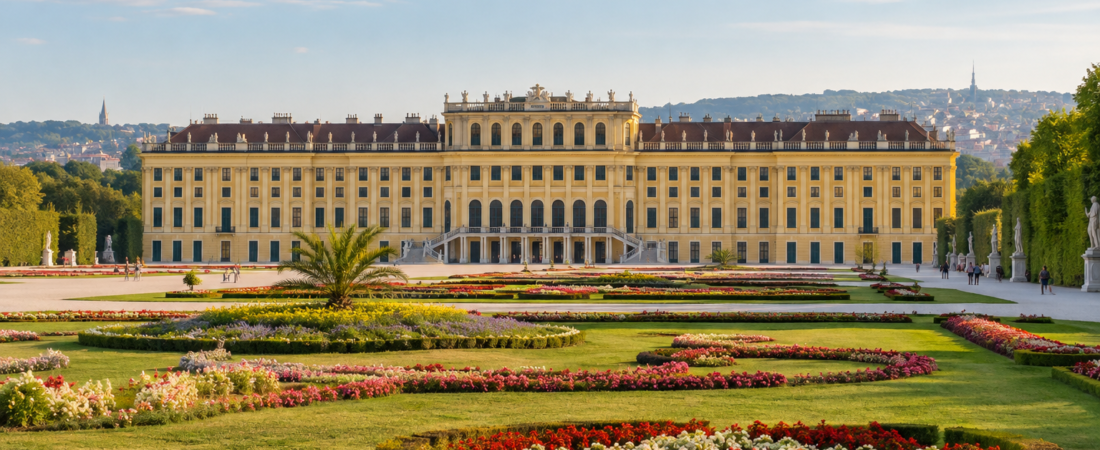
Vienna combines imperial architecture, internationally recognised museums, classical music and elegant public spaces with an efficient modern transport system.
Austria’s capital is known for Schönbrunn Palace, St Stephen’s Cathedral, the Hofburg, Belvedere Palace and the grand buildings lining the Ringstrasse. Beyond these famous landmarks, visitors can explore neighbourhood markets, traditional coffee houses, vineyards, parks and the banks of the Danube.
This Vienna travel guide explains the principal attractions, neighbourhoods, food, transport and practical information needed to plan a first visit.
Why Visit Vienna?
Vienna offers an unusually broad range of experiences within a relatively compact and organised city.
Former imperial residences illustrate the history of the Habsburg monarchy, while museums contain important collections of European art, decorative objects and historical artefacts. Classical music remains central to the city through its concert halls, opera houses and associations with composers including Mozart, Beethoven, Haydn and Schubert.
Vienna also has a less formal side. Public parks, local markets, contemporary cultural districts and riverside recreational areas provide alternatives to palaces and museums.
Reliable public transport makes it possible to move between the historic centre and outlying attractions without hiring a car.
Top Tours & Experiences in Vienna
Discover popular Vienna tours and experiences. Check current availability, ratings and prices before you book.
Affiliate disclosure: If you book through these links, we may earn a commission from Viator. This does not increase the price you pay.
Top Attractions in Vienna
Schönbrunn Palace
Schönbrunn Palace served as the summer residence of the Habsburg rulers and is one of Vienna’s most important attractions.
Visitors can tour selected imperial rooms to learn about figures such as Maria Theresa, Emperor Franz Joseph and Empress Elisabeth. Different ticket options provide access to different sections of the palace, so compare the available routes before booking.
The extensive grounds contain formal gardens, fountains, monuments and the Gloriette, which stands on a hill overlooking the palace.
General access to much of the park is free, but the palace interiors and several special garden attractions require tickets.
Arrive early because Schönbrunn receives large numbers of visitors throughout the year.
St Stephen’s Cathedral
St Stephen’s Cathedral stands at the centre of Vienna’s historic district and is one of the city’s most recognisable landmarks.
Its Gothic architecture, tall south tower and patterned roof dominate Stephansplatz. Visitors can enter part of the cathedral, while separate tickets may be required for towers, catacombs, guided areas or other experiences.
The surrounding pedestrian streets connect the cathedral with many Old Town attractions, shops and restaurants.
Early morning is usually the quietest time to appreciate the square and exterior.
The Hofburg
The Hofburg developed over several centuries as the principal residence of the Habsburg dynasty.
Today, the large complex contains museums, ceremonial rooms, government offices and cultural institutions. Major attractions include the Imperial Apartments, the Sisi Museum, the Imperial Treasury and the Spanish Riding School.
Because the complex is extensive, visitors should decide which sections interest them most instead of trying to see everything during one visit.
The courtyards and surrounding streets can be explored without admission, while individual museums and performances require tickets.
Belvedere Palace
The Belvedere consists of two Baroque palaces connected by formal gardens.
Upper Belvedere houses an important collection of Austrian and European art, including works by Gustav Klimt, Egon Schiele and Oskar Kokoschka. Klimt’s The Kiss is its most famous painting.
Lower Belvedere hosts exhibitions and provides access to additional historic spaces, depending on the chosen ticket.
The landscaped grounds create impressive views between the two palaces and can be enjoyed independently of the museum collections.
Reserve a timed ticket if seeing the main art collection is a priority.
Vienna State Opera
The Vienna State Opera is among the city’s most important cultural institutions.
Its programme includes opera and ballet performances, while guided tours provide access to selected interior areas when rehearsals and events permit.
Visitors who do not attend a performance can still admire the building from Opernring or view it from the terrace of the nearby Albertina.
Performance tickets vary considerably in price. Limited standing places may offer a less expensive way to experience a production, subject to current availability and procedures.
MuseumsQuartier
MuseumsQuartier combines major museums, cultural venues, restaurants and public courtyards within a former imperial stable complex.
The Leopold Museum is particularly known for Austrian modernism, including works by Egon Schiele and Gustav Klimt. The mumok focuses on modern and contemporary art.
The outdoor courtyards are free to enter and provide a relaxed meeting place, especially during warmer months.
MuseumsQuartier can be combined with the adjacent Maria-Theresien-Platz and the Kunsthistorisches Museum.
Kunsthistorisches Museum
The Kunsthistorisches Museum occupies a monumental building on the Ringstrasse.
Its collection includes paintings by European masters, antiquities, coins, sculptures and decorative objects assembled through centuries of Habsburg patronage.
The building’s grand staircase, dome and interior decoration form part of the experience.
Allow at least two or three hours for a focused visit. Travellers with a strong interest in art could spend considerably longer inside.
Albertina
The Albertina is located near the Vienna State Opera and holds an extensive graphic-art collection.
Its exhibitions can include drawings, prints, photography and paintings by major international artists. Visitors can also explore restored Habsburg State Rooms.
The museum’s elevated terrace provides an attractive view over the surrounding historic buildings.
Exhibitions change regularly, so check the current programme before deciding how much time to reserve.
Prater and the Giant Ferris Wheel
The Prater is a large public recreational area east of Vienna’s historic centre.
Its amusement park contains the famous Giant Ferris Wheel, along with rides, games and food outlets. Entry to the amusement area itself is generally free, but visitors pay separately for individual attractions.
Beyond the rides, the wider Prater includes long walking and cycling routes, lawns and wooded areas.
The atmosphere becomes livelier during evenings and weekends.
Naschmarkt
Naschmarkt is Vienna’s best-known market and extends between Karlsplatz and Kettenbrückengasse.
Its stalls and restaurants sell produce, spices, baked goods and international foods. Walking through the market is free, although prices vary between vendors.
The area is liveliest during normal market hours. A flea market is also held on selected days.
Check prices before ordering at restaurants or purchasing prepared foods.
Explore Vienna’s Historic Centre
Vienna’s historic centre is enclosed by the Ringstrasse and is compact enough to explore on foot.
A practical walking route can begin at St Stephen’s Cathedral and continue along Graben and Kohlmarkt towards the Hofburg. From there, visitors can walk past the Austrian Parliament, Vienna City Hall, Burgtheater and the university.
The Ringstrasse contains many of the city’s grand nineteenth-century public buildings. Walking part of the route provides a useful introduction, while trams make it easier to cover longer sections.
Pedestrian streets can become crowded during afternoons, particularly around Stephansplatz and Kärntner Strasse.
Best Neighbourhoods to Explore
Innere Stadt
The Innere Stadt is Vienna’s central district and contains many principal landmarks.
It offers the greatest convenience for first-time visitors but generally has higher accommodation and restaurant prices. Its compact layout is particularly useful for short stays.
Neubau
Neubau surrounds part of MuseumsQuartier and is known for independent shops, restaurants and creative businesses.
It provides quick access to the centre while offering a more contemporary atmosphere than the principal historic streets.
Mariahilf
Mariahilf contains the major shopping street Mariahilfer Strasse and lies close to Naschmarkt.
The neighbourhood has good transport connections and a broad selection of restaurants and accommodation.
Leopoldstadt
Leopoldstadt lies across the Danube Canal from the historic centre.
It includes the Prater, Augarten and residential streets with convenient underground connections. The area can suit families and travellers seeking more space outside the busiest tourist zone.
Wieden
Wieden is located south of the centre near Karlsplatz and Belvedere Palace.
The district combines handsome residential streets, cafés and convenient access to several major attractions.
Viennese Food to Try
Vienna’s traditional cooking reflects influences from across the former Habsburg Empire.
Popular dishes and specialities include:
- Wiener schnitzel
- Tafelspitz, or boiled beef
- Goulash
- Sausages from a Würstelstand
- Apple strudel
- Kaiserschmarrn
- Sachertorte
- Seasonal apricot dumplings
Traditional coffee houses are an important part of Viennese culture. Visitors commonly spend time over coffee, cake and newspapers rather than treating them as quick refreshment stops.
Restaurants in highly visited central locations may be more expensive. Check menus and service arrangements before ordering.
Getting Around Vienna
Vienna has an integrated public transport network consisting of underground trains, trams and buses.
The U-Bahn is useful for travelling quickly between districts, while trams provide convenient connections and views of the city at street level. Night buses and selected overnight services operate when regular daytime networks are reduced.
Tickets generally need to be valid before or at the beginning of a journey. The exact process depends on whether the ticket is printed, purchased through an application or already time-stamped.
Short-term travel passes may provide better value than individual tickets for visitors taking several journeys each day.
Walking remains the best way to explore the historic centre, but comfortable footwear is important because many streets are paved with stone.
Travelling from Vienna Airport
Vienna International Airport is located outside the city centre but has several public transport connections.
The S7 suburban railway connects the airport with stations including Wien Mitte. Railjet services provide connections to Vienna Central Station and other destinations.
The City Airport Train also operates between the airport and Wien Mitte. It is designed as a dedicated airport service and is usually more expensive than standard public transport alternatives.
Airport buses and taxis are also available.
Compare your destination, arrival time, journey duration and fare before selecting a service. Travellers arriving late should confirm the final departure time in advance.
Best Time to Visit Vienna
Vienna can be visited throughout the year, but each season produces a different experience.
Spring brings milder conditions, flowers and attractive public gardens. It is a comfortable period for sightseeing on foot, although occasional rain remains possible.
Summer offers long daylight hours, outdoor events and active public spaces. Temperatures can become hot, and major attractions receive larger crowds.
Autumn generally provides pleasant walking conditions and seasonal colour. Cultural programmes become increasingly active as the main performance season develops.
Winter is cold and daylight hours are shorter, but Christmas markets and decorated streets create a particularly atmospheric experience. Accommodation prices may rise during major festive periods and New Year celebrations.
Late spring and early autumn offer a good balance of weather and manageable visitor numbers for many travellers.
How Many Days Do You Need in Vienna?
Three days provide enough time for Vienna’s principal attractions.
A first day can focus on St Stephen’s Cathedral, the historic centre, the Hofburg and the Ringstrasse. A second day can include Schönbrunn Palace and MuseumsQuartier. The third day can combine Belvedere Palace, Naschmarkt, the Prater or another museum.
Four or five days allow visitors to explore at a slower pace, spend longer in major museums and visit neighbourhoods beyond the historic centre.
Longer stays also create opportunities for excursions to the Wachau Valley, Bratislava or other Austrian destinations.
Suggested Three-Day Vienna Itinerary
Day One: Historic Vienna
Begin at St Stephen’s Cathedral before walking along Graben and Kohlmarkt.
Continue through the Hofburg courtyards and visit one imperial attraction. Afterwards, walk along the Ringstrasse to see the Parliament, City Hall, Burgtheater and Vienna State Opera.
Finish the day with dinner in the historic centre or at a traditional Viennese restaurant in a nearby district.
Day Two: Schönbrunn and Museums
Spend the morning at Schönbrunn Palace and its gardens.
Return towards the centre during the afternoon and visit MuseumsQuartier, the Kunsthistorisches Museum or the Albertina.
Reserve the evening for a concert, opera performance or relaxed coffee-house visit.
Day Three: Belvedere and the Prater
Visit Upper Belvedere in the morning before continuing to Karlskirche and Naschmarkt.
During the afternoon, travel to the Prater for a walk and a view of the Giant Ferris Wheel.
Alternatively, replace the Prater with another museum or a longer exploration of Vienna’s neighbourhoods.
Approximate Travel Costs
Vienna is not usually considered a cheap European destination, but expenses can be controlled through careful planning.
Accommodation in the historic centre normally costs more than rooms in outer districts. Public transport connections make it practical to stay farther away while retaining easy access to the main attractions.
Museums and palaces can form a significant part of the daily budget. Choose attractions according to personal interests instead of buying tickets for every famous site.
Supermarkets, bakeries, markets and casual restaurants help reduce food expenses. Free activities include exploring public parks, walking along the Ringstrasse and visiting the grounds of Schönbrunn.
Compare the cost of city cards and attraction passes against the places you genuinely intend to visit.
Practical Vienna Travel Tips
Use these tips when planning your visit:
- Reserve timed admission for priority attractions.
- Visit Schönbrunn and major museums early.
- Use public transport instead of hiring a car.
- Validate or activate transport tickets correctly.
- Carry comfortable shoes for walking.
- Check restaurant menus and prices before ordering.
- Confirm performance schedules in advance.
- Keep valuables secure in crowded tourist areas.
- Check public holidays because opening hours may change.
- Carry a reusable water bottle during warm weather.
- Allow extra time at large palace and museum complexes.
- Avoid planning too many major museums on the same day.
Language and Currency
German is Austria’s official language, although English is widely understood in hotels, attractions and many restaurants.
Learning a few basic German greetings can still be useful and is generally appreciated.
Austria uses the euro. Cards are widely accepted, but carrying a modest amount of cash is helpful for smaller businesses, markets and certain public facilities.
Check whether your bank charges foreign transaction or cash-withdrawal fees before travelling.
Safety in Vienna
Vienna is generally straightforward for visitors, but normal city precautions remain important.
Keep wallets, phones and passports secure around crowded stations, public transport and major attractions. Avoid leaving bags unattended in cafés or public places.
Use licensed taxis or established transport applications and check the estimated fare before beginning a journey.
Emergency services can be contacted through the European emergency number 112.
Accessibility
Vienna’s public transport and major attractions provide a range of accessibility facilities, but conditions vary between locations.
Many underground stations have lifts, and low-floor vehicles operate on numerous routes. Historic buildings may have entrances or interior areas that are more difficult to navigate.
Check the official accessibility information for each attraction and transport stop before travelling. Contact venues directly when assistance or step-free access is essential.
Day Trips from Vienna
Vienna can be used as a base for several excursions.
Popular possibilities include Bratislava in Slovakia, the vineyards and towns of the Wachau Valley, Melk Abbey and destinations around Lake Neusiedl.
Travel times and border requirements should be checked before departure. Visitors with only three days should generally prioritise Vienna itself before adding a day trip.
Final Thoughts
Vienna combines imperial history, fine art, music and café culture with efficient transport and attractive public spaces.
First-time visitors should prioritise Schönbrunn Palace, St Stephen’s Cathedral, the Hofburg, Belvedere Palace and a walk through the historic centre. Museums, markets and neighbourhoods can then be added according to individual interests.
Three days provide a useful introduction, while a longer visit allows more time for major collections, concerts and relaxed exploration.
Book Your Vienna Experiences
Ready to start planning? Compare popular Vienna tours and activities, check current prices and availability, and book the experiences that suit your trip.
Affiliate disclosure: If you book through these links, we may earn a commission from Viator. This does not increase the price you pay.
Continue planning future journeys through our complete collection of city travel guides.