
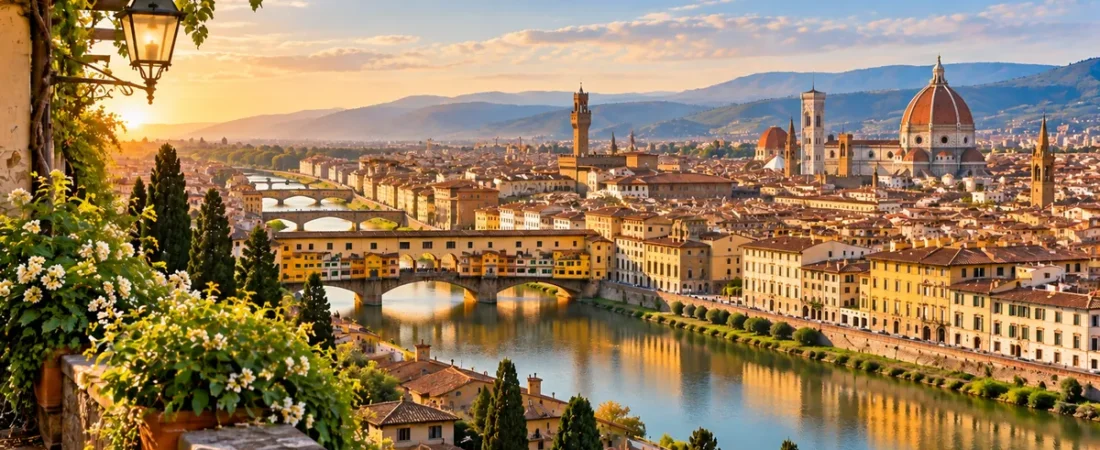
Florence is one of Italy’s great cultural destinations, combining Renaissance masterpieces, magnificent churches, historic streets, beautiful piazzas and Tuscan food within a remarkably walkable city centre. Whether you are visiting for a weekend or making Florence part of a longer journey through Italy, the city rewards travellers who leave enough time for both its famous museums and its quieter streets.
This Florence travel guide covers the essential attractions, neighbourhoods, transport, food and practical information you need for a first visit. From Brunelleschi’s enormous cathedral dome and Michelangelo’s David to the Uffizi Gallery, Ponte Vecchio and sunset views from Piazzale Michelangelo, Florence can easily fill several memorable days.
Price note: All prices in this article are approximate and were checked at the time of publication. Prices may change.
Why Visit Florence?
Florence played a central role in the Renaissance, and its artistic legacy remains visible almost everywhere in the historic centre.
Works associated with Michelangelo, Botticelli, Leonardo da Vinci and other influential artists can be found in the city’s museums and churches, while buildings designed by architects such as Brunelleschi helped transform European architecture.
Yet Florence is more than a collection of famous artworks.
Walking through Piazza della Signoria, crossing the Arno on Ponte Vecchio, browsing the streets of Oltrarno and stopping for a coffee or gelato are equally important parts of experiencing the city.
Its relatively compact centre is another major advantage. Many of Florence’s principal sights can be reached on foot, making it easy to combine several attractions without spending much of your day on transport.
If you are planning a wider Italian journey, our Rome travel guide and Milan travel guide can help you compare other major Italian destinations.
Top Tours & Experiences in Florence
Discover popular Florence tours and experiences. Check current availability, ratings and prices before you book.
Affiliate disclosure: If you book through these links, we may earn a commission from Viator. This does not increase the price you pay.
Top Things to Do in Florence
Visit Florence Cathedral and Piazza del Duomo
The Cathedral of Santa Maria del Fiore dominates central Florence with its enormous red-tiled dome designed by Filippo Brunelleschi.
The cathedral complex includes the cathedral itself, Brunelleschi’s Dome, Giotto’s Bell Tower, the Baptistery, the Opera del Duomo Museum and the archaeological remains of Santa Reparata.
Entry to the cathedral itself is free, but the other monuments require a pass.
The Brunelleschi Pass currently costs €30 for adults and includes the Dome, Bell Tower, Baptistery, museum and Santa Reparata. The Giotto Pass costs €20 and excludes the Dome, while the Ghiberti Pass costs €15 and covers the Baptistery, museum and Santa Reparata.
If climbing the Dome is a priority, book ahead. The Brunelleschi Pass requires a specific Dome time slot, and the reservation cannot normally be changed or cancelled after purchase.
Remember that the cathedral is an active place of worship. Appropriate clothing is required, including covered shoulders and knees.
Explore the Uffizi Gallery
The Uffizi is one of Florence’s most important museums and contains an extraordinary collection of Renaissance art.
Its galleries include works by Botticelli, Leonardo da Vinci, Michelangelo, Raphael, Caravaggio and many other artists.
A standard Uffizi ticket currently costs €25 when purchased on the day of entry or €29 when purchased in advance.
The museum can become extremely busy, particularly during spring, summer and holiday periods. Reserving in advance is sensible if the Uffizi is one of the main reasons for your Florence trip.
Allow at least two or three hours rather than trying to rush through every room.
See Michelangelo’s David at the Accademia
The Galleria dell’Accademia is best known as the home of Michelangelo’s David.
Seeing the enormous marble sculpture in person is considerably different from seeing photographs or replicas elsewhere in Florence.
Regular admission is currently €20, with reservations strongly recommended because visitors without bookings may face long waits.
The Accademia is smaller than the Uffizi, so many visitors can comfortably combine it with other central attractions on the same day.
Walk Across Ponte Vecchio
Ponte Vecchio is Florence’s most recognisable bridge.
Spanning the Arno River, the medieval bridge is lined with shops, many of which specialise in jewellery and gold.
Crossing the bridge is free, and it is worth seeing at different times of day. The bridge itself can become crowded, so for photographs of Ponte Vecchio rather than from it, walk along the river or use one of the neighbouring bridges.
Continue across the Arno and you enter Oltrarno, one of the most enjoyable areas of Florence to explore on foot.
Explore Piazza della Signoria
Piazza della Signoria has been at the centre of Florentine civic life for centuries.
The square is dominated by Palazzo Vecchio and contains numerous sculptures and monuments. The open-air Loggia dei Lanzi displays important statues and can be viewed without admission.
A replica of Michelangelo’s David stands near the entrance to Palazzo Vecchio, while the original is protected inside the Accademia.
The square is particularly atmospheric in the evening when many daytime groups have departed.
Visit Palazzo Pitti and Boboli Gardens
Across the Arno from the historic centre, Palazzo Pitti was once the principal residence of Florence’s powerful ruling families.
Today it contains several museum collections.
Behind the palace, Boboli Gardens spreads across a large landscaped area containing paths, statues, fountains and elevated viewpoints.
Current standard admission purchased on the day is €16 for Pitti Palace and €10 for Boboli Gardens, while a combined Pitti Palace and Boboli Gardens ticket costs €22. Advance-purchase prices are higher.
This part of Florence works particularly well when combined with an exploration of Oltrarno.
Watch Sunset from Piazzale Michelangelo
For one of the classic panoramic views of Florence, head to Piazzale Michelangelo.
From the terrace you can see the Duomo, Palazzo Vecchio, Ponte Vecchio, the Arno and much of the historic skyline.
Access to the viewpoint itself is free.
Sunset is the most popular time, so arrive earlier if you want a good position. Morning can be much quieter and offers a different atmosphere.
The climb from the river is uphill, but visitors who prefer not to walk the entire way can use public transport for part of the journey.
Discover the Basilica of Santa Croce
Santa Croce is one of Florence’s most significant churches.
It is particularly known for the tombs and memorials associated with major Italian figures including Michelangelo, Galileo and Machiavelli.
The surrounding Piazza Santa Croce is also worth visiting even if you do not enter the basilica. Cafés, historic buildings and the broad pedestrian space make it a pleasant area for an evening walk.
Best Areas of Florence to Explore
Historic Centre and Duomo
The streets surrounding Piazza del Duomo form the heart of Florence sightseeing.
Staying or spending time here puts the cathedral, Accademia, Piazza della Signoria and Uffizi within easy walking distance.
The disadvantage is crowds. Streets immediately surrounding the most famous attractions can become extremely busy during the middle of the day.
Santa Maria Novella
The area around Firenze Santa Maria Novella railway station is practical for travellers arriving by train or planning day trips.
It is still within walking distance of the Duomo and historic centre, making it particularly convenient for short stays.
Santa Croce
Santa Croce combines historic architecture with restaurants, bars and attractive streets.
It feels lively without being far from the principal sights and is particularly pleasant in the evening.
Oltrarno
Oltrarno lies on the opposite side of the Arno from most of Florence’s headline attractions.
The district includes Santo Spirito, artisan workshops, restaurants and quieter residential streets, while Palazzo Pitti and Boboli Gardens are nearby.
It is a good area to explore when you want a break from the busiest streets around the Duomo.
Getting Around Florence
Florence is one of Europe’s easiest major cultural destinations to explore on foot.
The Duomo, Accademia, Piazza della Signoria, Uffizi and Ponte Vecchio are all relatively close together, and walking is often faster than trying to use transport within the historic centre.
Buses and trams become more useful for longer journeys, including connections to areas outside the centre.
As of August 2026, the standard Florence urban ticket costs €2 and is valid for 90 minutes. Tickets can be purchased through official ticket machines, authorised sellers and supported digital or contactless methods.
Always ensure your ticket is correctly activated or validated according to the method used.
Getting from Florence Airport to the City Centre
Florence Airport, also known as Amerigo Vespucci Airport or Peretola, is conveniently connected to the city by tram.
The T2 tram provides a straightforward connection between the airport and central Florence.
The standard urban fare is currently €2, making the tram one of the simplest and most economical airport-transfer options.
Travellers arriving in Florence by train will usually arrive at Firenze Santa Maria Novella, which is within easy walking distance of much of the historic centre.
What to Eat in Florence
Florence has a strong Tuscan food tradition, so leave room in your itinerary for meals rather than treating food simply as a break between museums.
Bistecca alla Fiorentina
Florence’s most famous dish is a thick Tuscan-style steak traditionally cooked rare.
Portions are often large and may be priced by weight, so check the menu carefully before ordering.
Ribollita
Ribollita is a traditional Tuscan soup made with vegetables, beans and bread.
It is filling, simple and particularly appealing during cooler weather.
Pappa al Pomodoro
Another classic Tuscan dish, pappa al pomodoro combines tomatoes, bread, olive oil and herbs.
Its simplicity is part of its appeal.
Lampredotto
Lampredotto is a traditional Florentine street food made from the fourth stomach of a cow, typically served in a sandwich with sauce.
It may not appeal to everyone, but adventurous food travellers can find specialist stalls around the city.
Gelato
Florence has a long association with gelato.
Rather than automatically choosing the shops closest to the biggest landmarks, explore side streets and look for places where flavours and presentation appear natural rather than excessively bright or piled unusually high.
Best Time to Visit Florence
Spring and autumn are generally excellent periods for sightseeing because temperatures are usually more comfortable for long days of walking.
April, May, September and October can be particularly attractive, although Florence remains busy during these periods.
Summer brings long daylight hours but also heat and substantial visitor numbers. Museums, Piazza del Duomo and Ponte Vecchio can feel particularly crowded during the busiest parts of the day.
Winter is quieter and cooler. Shorter days require more planning, but reduced crowds can make museums and historic streets more enjoyable.
Whenever you visit, reserve high-demand attractions such as the Uffizi, Accademia and Brunelleschi’s Dome ahead of time when they are priorities.
How Many Days Do You Need in Florence?
3 days is a comfortable amount of time for a first visit.
One day can focus on the Duomo complex and historic centre, another on the Uffizi and the streets around Piazza della Signoria, and a third on the Accademia, Oltrarno, Palazzo Pitti or additional churches and museums.
With four or five days, you can explore at a slower pace or use Florence as a base for seeing more of Tuscany.
Trying to experience Florence in a single day is possible, but you will need to be selective about museums and timed attractions.
Florence Tourist Tax
Visitors staying overnight in Florence should account for the municipal tourist tax.
The tax depends on the type and category of accommodation and applies to non-residents staying in Florence for up to seven consecutive nights. Children under 12 and certain other categories are exempt under municipal rules.
Rates were revised from February 2025, so check the current amount shown by your accommodation when booking rather than assuming it is included in the advertised room price.
Essential Florence Travel Tips
Book the Uffizi, Accademia and Dome climb in advance when they are priorities.
Wear comfortable shoes because Florence is best explored on foot and many streets have uneven historic surfaces.
Carry appropriate clothing for churches, where shoulders and knees may need to be covered.
Start sightseeing early if you want to experience Piazza del Duomo and Ponte Vecchio before peak crowds.
Do not schedule too many major museums on the same day. Florence becomes more enjoyable when you leave time for neighbourhood walks and piazzas.
Keep valuables secure in crowded tourist areas and on busy public transport.
Check whether tourist tax is included in your accommodation total.
Allow extra time for the Duomo complex because its individual monuments can easily occupy several hours.
Is Florence Expensive?
Florence can become expensive if you stay directly beside the major attractions, eat every meal in the busiest tourist areas and visit several paid museums.
However, many memorable experiences cost nothing.
You can walk through Piazza della Signoria, cross Ponte Vecchio, explore Oltrarno, see the cathedral exterior, visit public squares and enjoy the panorama from Piazzale Michelangelo without paying admission.
Walking also keeps transport costs low because the historic centre is compact.
A sensible approach is to choose the paid attractions that matter most and balance them with Florence’s excellent free streets, squares and viewpoints.
Is Florence Worth Visiting?
Florence is an exceptional destination for travellers interested in art, architecture, history, food and walkable historic cities.
Its greatest strength is the concentration of important sights within a relatively small area. In the space of a single day, you can walk beneath Brunelleschi’s Dome, see Renaissance sculpture, cross a medieval bridge and finish with a panoramic view across the Tuscan capital.
For a first visit, around 3 days provides a good balance between major attractions and time to enjoy Florence beyond its museums.
If Florence forms part of a longer Italian trip, consider combining it with Rome for ancient history or Milan for a contrasting experience of modern Italian city life.
Top Tours & Experiences in Florence
Discover popular Florence tours and experiences. Check current availability, ratings and prices before you book.
Affiliate disclosure: If you book through these links, we may earn a commission from Viator. This does not increase the price you pay.
Explore more places through our destinations page or browse our complete collection of itineraries.