
Vienna may be known for imperial palaces, art museums and classical concerts, but many memorable experiences cost nothing.
The best free things to do in Vienna include exploring Schönbrunn Palace Park, walking through Hofburg courtyards, following the Ringstrasse, relaxing in public gardens and viewing the city from Kahlenberg.
Visitors can also explore markets, historic neighbourhoods, riverside paths and seasonal cultural events without paying admission.
Some free locations contain optional paid attractions. Opening hours and access conditions may also change because of weather, maintenance or public events.
Read our complete Vienna travel guide for advice about transport, food and the city’s principal landmarks.
1. Explore Vienna’s Historic Centre
Vienna’s historic centre contains an impressive collection of churches, palaces, monuments and pedestrian streets.
Begin at Stephansplatz before walking along Graben, Kohlmarkt and Kärntner Strasse. Architectural details, historic courtyards and public monuments can be enjoyed without purchasing a ticket.
The centre becomes busy during afternoons, weekends and the festive season. Visit early in the morning for quieter streets and clearer photographs.
Shops, museums and organised tours cost extra, but exploring the public streets is free.
2. See St Stephen’s Cathedral
St Stephen’s Cathedral stands at the geographical and historic centre of Vienna.
Its tall Gothic south tower and colourful patterned roof make it one of the city’s most recognisable buildings. Visitors can admire the cathedral from Stephansplatz at any time.
Limited public access may be available inside the main worship area, depending on services and current arrangements. Towers, catacombs, tours and designated sightseeing sections require tickets.
Remain respectful during religious services and avoid obstructing entrances.
3. Walk Through the Hofburg Courtyards
The Hofburg served as the principal residence of the Habsburg rulers.
Today, the complex contains museums, ceremonial rooms, government offices and cultural institutions. Several public courtyards and exterior areas can be explored without paying admission.
Walk from Michaelerplatz through the palace complex towards Heldenplatz. The route reveals architectural additions from different periods of imperial history.
The Imperial Apartments, Sisi Museum, Imperial Treasury and Spanish Riding School require separate tickets.
4. Explore Heldenplatz
Heldenplatz is a broad public square between the Hofburg and the Ringstrasse.
The square provides views of the Neue Burg, imperial palace buildings and equestrian monuments. It has also played a significant role in Austrian public history.
Crossing and photographing the square is free.
Heldenplatz can be combined with the Hofburg courtyards, Volksgarten and Burggarten to create a longer admission-free walking route.
Public events may occasionally alter normal access.
5. Walk Along the Ringstrasse
The Ringstrasse circles Vienna’s historic centre and passes many of its grandest public buildings.
A free walking route can include:
- Vienna State Opera
- Austrian Parliament
- Vienna City Hall
- Burgtheater
- University of Vienna
- Museum buildings
- Monumental public squares
Walking the complete boulevard can take several hours. Select one section or use regular public transport to shorten the route.
Guided tours and building interiors cost extra, but the architecture can be appreciated from public pavements.
6. Visit Schönbrunn Palace Park
The main park surrounding Schönbrunn Palace is open free of charge during its operating hours.
Visitors can walk through formal gardens, see fountains and statues, and follow the main avenue towards the Neptune Fountain and Gloriette.
The elevated area near the Gloriette provides a broad view towards the palace and Vienna. Reaching it involves an uphill walk.
Schönbrunn Palace, the zoo, maze, specialised gardens and certain other attractions require tickets.
Opening and closing times vary seasonally, so check current information before visiting.
7. Walk Through the Belvedere Gardens
The formal gardens between Upper and Lower Belvedere can be explored without purchasing museum admission.
Terraces, fountains, sculptures and symmetrical landscaping connect the two Baroque palaces. The upper section provides an attractive view across the gardens towards central Vienna.
Upper and Lower Belvedere house ticketed art collections, including works by Gustav Klimt and Egon Schiele.
Visit early in the morning for a quieter walk and softer light.
Garden access can be affected by maintenance, weather or special events.
8. Relax in MuseumsQuartier
MuseumsQuartier is a large cultural complex beside Maria-Theresien-Platz.
Its public courtyards are free to enter and contain seating, restaurants, shops and contemporary installations. The area is especially lively during warm weather.
Visitors can appreciate the combination of historic and modern architecture without entering a museum.
The Leopold Museum, mumok and temporary exhibitions require tickets, but the courtyards provide a worthwhile free experience independently.
Continue into nearby Spittelberg for a longer neighbourhood walk.
9. Explore Spittelberg
Spittelberg is a small historic quarter beside MuseumsQuartier.
Its narrow cobbled lanes are lined with restored Biedermeier buildings, restaurants, independent shops and residential properties.
Walking through the neighbourhood is free and provides a quieter contrast to Vienna’s monumental imperial architecture.
Summer dining areas and seasonal markets can make the streets busier at particular times. Purchases are optional.
Respect residential entrances and avoid photographing directly through private windows.
10. Visit Volksgarten
Volksgarten is a formal public garden beside the Hofburg and Austrian Parliament.
The park contains lawns, fountains, monuments and extensive rose planting. It is especially attractive when the roses are in bloom.
Entry is free during public opening hours.
Benches provide a convenient place to rest while exploring the Ringstrasse. The garden can be combined with Heldenplatz, the Hofburg and Rathauspark.
Seasonal conditions determine which flowers are visible.
11. Walk Through Burggarten
Burggarten lies behind the Hofburg near the Albertina and Vienna State Opera.
This landscaped public garden contains mature trees, lawns and monuments, including a well-known statue of Mozart.
Admission to the park is free.
Its central location makes it suitable for a short break between the Hofburg, State Opera and museum district.
Individual buildings and hospitality businesses within or beside the garden have their own admission or purchasing arrangements.
12. Relax in Stadtpark
Stadtpark extends across both sides of the Wien River.
Its paths, lawns, bridges and monuments create a convenient green space near the historic centre. The gilded Johann Strauss monument is the park’s most photographed feature.
Entry is free throughout normal public access periods.
Visit during the morning for a quieter walk or in the late afternoon when residents use the lawns and paths.
Restaurants and organised activities within the park cost separately.
13. Explore the Prater
The Prater contains both an amusement park and a large green recreational area.
Entry to the amusement section is generally free, allowing visitors to experience its colourful atmosphere without buying a ride ticket. Individual rides, including the Giant Ferris Wheel, charge separately.
The adjoining Green Prater contains lawns, trees and long walking and cycling routes.
Visitors can spend several hours exploring the wider grounds without admission costs.
The area is particularly lively during summer evenings and weekends.
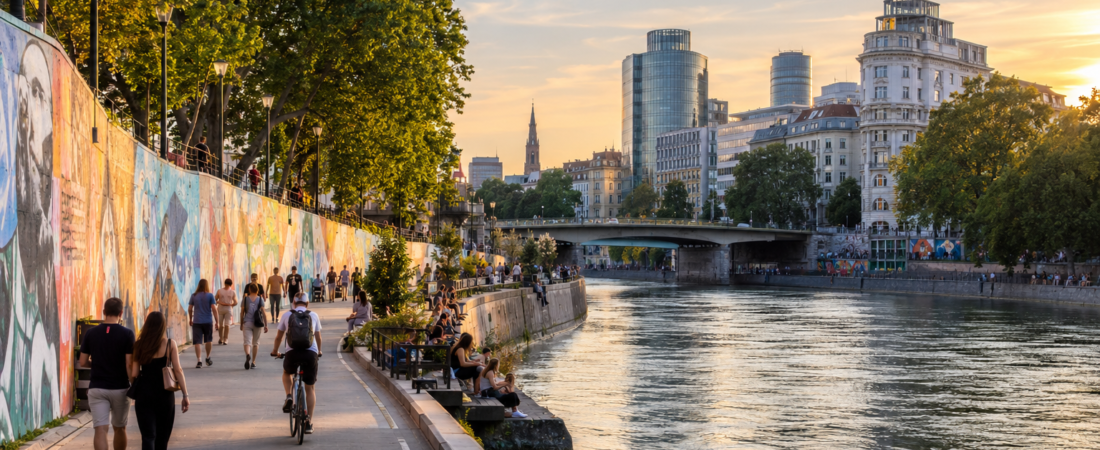
14. Walk Along the Danube Canal
The Danube Canal passes close to Vienna’s historic centre and offers a different perspective on the city.
Public riverside paths feature murals, bridges and a mixture of historic and contemporary buildings. Walking and cycling along the canal are free.
The atmosphere becomes livelier during warm evenings when seasonal bars and restaurants operate beside the water.
Purchasing food or drinks is optional.
Remain on designated paths and be aware of bicycles in shared areas.
15. Visit Danube Island
Danube Island is an extensive recreational area between the Danube and New Danube.
Visitors can walk, cycle, picnic and relax beside the water without paying admission. Natural bathing areas and sporting facilities are popular during summer.
The island is approximately 21 kilometres long, so choose a specific section rather than attempting to explore it completely.
Some equipment rentals, food outlets and organised activities charge separately.
Check water conditions and follow safety notices before swimming.
16. Browse Naschmarkt
Naschmarkt is Vienna’s best-known food market.
Approximately 130 stalls and numerous eateries offer produce, spices, baked goods and international food. Browsing the market is free, while all purchases are optional.
The market provides an interesting introduction to Vienna’s everyday food culture.
A flea market normally takes place on Saturdays and attracts additional visitors.
Check prices before ordering because restaurants and prepared-food stalls vary considerably in cost.
17. See Karlskirche from Karlsplatz
Karlskirche is one of Vienna’s most impressive Baroque landmarks.
Its large copper dome, classical portico and two decorated columns dominate the southern side of Karlsplatz. Visitors can admire and photograph the exterior without paying admission.
The reflecting pool in front of the church creates an attractive view when filled.
Entry to the church and designated interior attractions may require a ticket.
Combine Karlskirche with Naschmarkt, the Secession Building exterior and nearby Art Nouveau architecture.
18. Visit Vienna City Hall and Rathauspark
Vienna City Hall is a monumental neo-Gothic building on the Ringstrasse.
Visitors can admire its exterior from Rathausplatz and walk through the adjoining Rathauspark for free. Statues, trees, paths and seating areas surround the building.
The square hosts public events throughout the year, including seasonal markets and summer cultural programmes.
Some events provide free admission, while food, drinks and particular activities cost extra.
Normal access arrangements may change when major events are being installed or removed.
19. See the Austrian Parliament
The Austrian Parliament occupies a prominent position on the Ringstrasse.
Its classical façade, broad ramp and Pallas Athena Fountain can be viewed from public areas without paying admission.
The building is particularly attractive when illuminated after dark.
Tours and interior visits follow separate access and reservation arrangements. Check official information if you want to enter.
Combine the Parliament exterior with Volksgarten, Vienna City Hall and the Hofburg.
20. See Hundertwasser House
Hundertwasser House is a colourful residential building designed according to the ideas of Austrian artist Friedensreich Hundertwasser.
Its irregular façade, curved lines, vegetation and bright colours make it one of Vienna’s most unusual architectural sights.
Viewing the building from the public street is free.
The apartments are private and cannot be toured. Visitors should remain considerate of residents and avoid blocking entrances.
Nearby commercial and exhibition spaces may have separate charges.
21. Explore Augarten
Augarten is a large Baroque public park in Leopoldstadt.
Broad tree-lined avenues, lawns and formal sections provide space for walking, running and picnics. The park also contains prominent Second World War-era flak towers.
General access is free during opening hours.
Cultural institutions and businesses within the wider grounds operate separately and may charge admission.
The park offers a calmer alternative to the busier Prater.
22. Visit Kahlenberg
Kahlenberg stands within the Vienna Woods and provides one of the city’s best panoramic viewpoints.
Visitors can reach the hill by public transport or follow an official city hiking trail through vineyards from Nussdorf. The climb typically requires a reasonable level of fitness.
Access to the main public viewpoint and hiking paths is free.
Clear weather provides the best views across Vienna and towards the Danube.
Restaurants, refreshments and transport remain optional expenses.
23. Walk Through Vienna’s Vineyards
Vienna has extensive vineyards within its city boundaries.
Public walking routes around Nussberg, Kahlenberg and other wine-growing areas combine countryside scenery with distant urban views.
Walking is free, although food and drinks at traditional wine taverns must be purchased.
Stay on public routes, respect cultivated land and do not enter closed vineyard areas.
Late summer and early autumn provide particularly attractive conditions, but paths can become muddy after rain.
Read our guide to the best time to visit Vienna when planning a seasonal vineyard walk.
24. Explore the WU Vienna Campus
The Vienna University of Economics and Business campus near the Prater contains striking contemporary architecture.
Public outdoor areas allow visitors to see buildings designed by several international architectural practices. The Library and Learning Center is the campus’s most distinctive structure.
Walking through the open campus is free.
The university remains an active place of study, so visitors should avoid disrupting classes, entrances or student activities.
Interior access may be restricted to authorised users or particular public areas.
25. Attend a Free Seasonal Event
Vienna hosts several major free events, particularly during summer.
Examples have included:
- Danube Island Festival
- Film Festival at Rathausplatz
- Summer Night Concert at Schönbrunn
- Kultursommer Wien
- Selected outdoor concerts
- Public celebrations and parades
Dates, venues and admission arrangements change every year. Check the official event calendar before travelling and never assume that every event associated with a festival is free.
Popular programmes can become crowded, so arrive early and follow security instructions.
Book Your Vienna Experiences
Ready to start planning? Compare popular Vienna tours and activities, check current prices and availability, and book the experiences that suit your trip.
Affiliate disclosure: If you book through these links, we may earn a commission from Viator. This does not increase the price you pay.
Suggested Free 3-Day Vienna Itinerary
Vienna’s free attractions can be grouped into a practical 3-day plan.
Day 1: Historic Centre and Ringstrasse
Begin at St Stephen’s Cathedral and explore Graben and Kohlmarkt.
Continue through the Hofburg courtyards, Heldenplatz, Burggarten and Volksgarten. Walk past Parliament, City Hall and the Vienna State Opera along the Ringstrasse.
Day 2: Schönbrunn and Western Vienna
Spend the morning exploring Schönbrunn Palace Park and walking towards the Gloriette.
Return to MuseumsQuartier during the afternoon before walking through Spittelberg and Mariahilf.
Our 3 days in Vienna itinerary provides a complete first-time route combining free and paid attractions.
Day 3: Belvedere, Parks and the Danube
Walk through the Belvedere gardens before continuing to Karlskirche, Naschmarkt and Stadtpark.
Spend the afternoon beside the Danube Canal or travel to Danube Island. Finish at the Prater, where entry to the grounds is free and rides are optional.
Tips for Exploring Vienna for Free
Use these tips to keep costs under control:
- Walk between attractions in the historic centre.
- Use public transport for Schönbrunn, Kahlenberg and Danube Island.
- Check seasonal park opening hours.
- Confirm whether events require registration.
- Carry water and snacks.
- Visit one paid attraction rather than several each day.
- Use free palace gardens and courtyards.
- Look for free outdoor cultural programmes.
- Wear comfortable walking shoes.
- Begin early at popular locations.
- Check weather before vineyard walks.
- Distinguish free grounds from paid interiors.
- Respect religious buildings and residential areas.
- Follow swimming and safety notices beside the Danube.
Our Vienna travel budget explains typical accommodation, food, transport and attraction expenses.
Best Time for Free Activities
Spring and early autumn provide the most comfortable conditions for gardens, walking routes and viewpoints.
Summer offers the greatest selection of free outdoor events but may bring high temperatures and larger crowds.
Winter is suitable for historic streets, parks and festive markets, although cold weather and shorter daylight limit extended outdoor activities.
December markets are generally free to enter, but refreshments, shopping and selected activities cost extra.
Where to Stay
A central location can reduce transport costs, but accommodation in the Innere Stadt is usually more expensive.
Neubau and Mariahilf provide walking access to MuseumsQuartier, Naschmarkt and the Ringstrasse. Leopoldstadt is convenient for the Prater, Augarten and Danube Canal.
Our guide to where to stay in Vienna compares eight practical neighbourhoods.
Final Thoughts
Vienna offers enough free experiences to fill several days without purchasing multiple attraction tickets.
Prioritise the historic centre, Hofburg courtyards, Ringstrasse, Schönbrunn Palace Park, Belvedere gardens and one of the city’s elevated or riverside walking routes.
Paid museums and palaces can then be added selectively according to your interests and budget.
Explore more places through our destinations page or browse our complete collection of itineraries.