
3 days in Vienna provide enough time to explore imperial palaces, important museums, historic streets and several of the Austrian capital’s most recognisable landmarks.
This 3 days in Vienna itinerary groups attractions by location to reduce unnecessary travel. Day one concentrates on the historic centre and Hofburg, day two combines Schönbrunn Palace with the museum district, and day 3 covers Belvedere Palace, Naschmarkt and the Prater.
Some attractions use timed admission, so reserve priority tickets before travelling. Opening hours, transport arrangements and admission prices can change throughout the year.
Read our complete Vienna travel guide before your visit for additional advice about transport, neighbourhoods, food and practical planning.
3 Days in Vienna at a Glance
Day 1: Historic Centre and the Hofburg
- St Stephen’s Cathedral
- Graben and Kohlmarkt
- Hofburg
- Heldenplatz
- Burggarten
- Vienna State Opera
- Ringstrasse
- Traditional Viennese dinner or evening performance
Day 2: Schönbrunn and the Museum District
- Schönbrunn Palace
- Schönbrunn Palace Park
- Gloriette viewpoint
- Maria-Theresien-Platz
- Kunsthistorisches Museum or Leopold Museum
- MuseumsQuartier
- Viennese coffee house
Day 3: Belvedere, Naschmarkt and the Prater
- Upper Belvedere
- Karlskirche
- Naschmarkt
- Secession Building exterior
- Stadtpark
- Danube Canal
- Prater and Giant Ferris Wheel
Top Tours & Experiences in Vienna
Discover popular Vienna tours and experiences. Check current availability, ratings and prices before you book.
Affiliate disclosure: If you book through these links, we may earn a commission from Viator. This does not increase the price you pay.
Before Starting Your Vienna Itinerary
Vienna’s historic centre is highly walkable, but several major attractions are located beyond it. Underground trains and trams make it straightforward to travel between Schönbrunn, Belvedere and the Prater.
Consider purchasing an appropriate public transport pass if you expect to make several journeys each day. Activate or validate the ticket correctly according to its format and conditions.
Comfortable shoes are essential because this itinerary includes long walks and numerous stone-paved streets.
Book Schönbrunn Palace, Upper Belvedere and any evening performances in advance when they are priorities. Avoid reserving consecutive attractions too closely together because security checks, queues and transport delays may affect your schedule.
Day 1: Historic Vienna and the Hofburg
The first day introduces Vienna’s medieval centre, imperial architecture and grand Ringstrasse buildings.
Most attractions on this route are within walking distance of one another.
Morning: St Stephen’s Cathedral
Begin at St Stephen’s Cathedral in Stephansplatz.
The cathedral’s Gothic tower and colourful tiled roof form one of Vienna’s most recognisable views. Part of the building may be accessible without a general sightseeing ticket, while towers, catacombs, guided sections and other areas can require separate admission.
If you want to climb a tower or join a tour, allow additional time and check the current schedule.
After visiting the cathedral, explore the surrounding pedestrian streets before they become busy.
Walk Along Graben and Kohlmarkt
From Stephansplatz, continue along Graben, one of the principal pedestrian streets in central Vienna.
The street is lined with historic buildings, shops and monuments, including the Baroque Plague Column. Nearby Petersplatz provides a view of St Peter’s Church.
Continue towards Kohlmarkt, which leads directly to the Hofburg. Even without shopping, this route provides an attractive introduction to the historic centre.
Short diversions through the surrounding lanes reveal courtyards, churches and quieter architectural details.
Late Morning: Explore the Hofburg
The Hofburg was the principal residence of the Habsburg rulers and now contains museums, government offices and cultural institutions.
Visitors can choose among attractions such as the Imperial Apartments, Sisi Museum, Imperial Treasury and Spanish Riding School. Attempting to visit every section would occupy much of the day, so select one experience according to your interests.
The Imperial Apartments and Sisi Museum suit visitors interested in court life and Empress Elisabeth. The Imperial Treasury contains crowns, ceremonial objects and other items associated with imperial history.
Even without purchasing admission, visitors can walk through several public courtyards and admire the complex’s exterior architecture.
Heldenplatz and Burggarten
Leave the Hofburg through Heldenplatz, a large ceremonial square surrounded by important historic buildings.
Walk towards the Burggarten, a landscaped park beside the palace complex. The garden contains the well-known Mozart Monument and offers a quiet place to rest.
The nearby Neue Burg, Austrian National Library and Albertina provide further architectural interest.
If you prefer art to imperial interiors, the Albertina can replace the Hofburg museum in your morning programme.
Lunch in the Historic Centre
For lunch, choose a restaurant away from the busiest section of Stephansplatz or Kärntner Strasse.
Traditional options may include Wiener schnitzel, goulash, tafelspitz or seasonal Austrian dishes. A sausage stand can provide a quicker and less expensive alternative.
Check displayed menus and prices before sitting down, particularly in heavily visited locations.
Keep lunch reasonably short if you plan to enter another attraction during the afternoon.
Afternoon: Vienna State Opera
Continue towards the Vienna State Opera.
The building can be admired from Opernring and from the elevated terrace outside the Albertina. Guided tours provide access to selected interior spaces when the performance and rehearsal schedule permits.
If attending an opera or ballet during the evening, confirm the performance time and dress expectations in advance.
Travellers who do not want a tour can use this time for the Albertina, the Austrian National Library or a longer walk around the Ringstrasse.
Walk Along the Ringstrasse
The Ringstrasse surrounds Vienna’s historic centre and contains an impressive sequence of nineteenth-century buildings.
From the State Opera, walk or take a tram towards:
- Austrian Parliament
- Vienna City Hall
- Burgtheater
- University of Vienna
- Votive Church
You do not need to complete the entire circular boulevard. Select a manageable section and use public transport when necessary.
The area around Parliament and City Hall is particularly attractive during the late afternoon. Public events may occasionally alter pedestrian routes.
Evening: Dinner, Music or a City Walk
Vienna offers numerous evening concerts, opera performances and theatrical productions.
Buy tickets through official venues or reputable sellers and verify the location carefully because performances take place in many different halls.
Alternatively, spend the evening walking through the illuminated historic centre. St Stephen’s Cathedral, the Hofburg and Vienna State Opera look particularly impressive after dark.
Finish with dinner at a traditional restaurant or a relaxed visit to a Viennese coffee house.
Day 2: Schönbrunn Palace and Vienna’s Museums
Day two combines Vienna’s most famous imperial palace with one of its major museum collections.
Begin early because Schönbrunn can become crowded and requires considerable walking.
Morning: Travel to Schönbrunn Palace
Schönbrunn Palace is located west of the historic centre and is accessible by public transport.
Check your route shortly before travelling because maintenance and temporary service changes can affect trains, trams or buses.
Arrive close to your reserved entry time and allow sufficient time to locate the correct entrance. The palace offers different visitor routes, so confirm which rooms are included in your ticket.
Tour Schönbrunn Palace
The palace interiors introduce visitors to the history of the Habsburg monarchy and figures including Maria Theresa, Emperor Franz Joseph and Empress Elisabeth.
Ceremonial rooms, private apartments and decorative interiors illustrate how the imperial family lived and governed.
Admission routes vary in length. A shorter palace tour leaves more time for the gardens, while an extended option provides a deeper historical experience.
Photography restrictions may apply inside certain rooms. Follow signs and staff instructions throughout the visit.
Explore Schönbrunn Palace Park
After touring the palace, walk through Schönbrunn Palace Park.
General access to the main park is free during opening hours. Formal flower beds, fountains, statues and broad avenues extend behind the palace.
Certain specialised attractions—including particular gardens, the maze, zoo and other facilities—require individual tickets.
Walk uphill towards the Neptune Fountain and the Gloriette if weather and mobility permit. The slope is noticeable, but the elevated area provides a broad view towards the palace and Vienna.
The park opens early and operates throughout the year, although closing times vary seasonally.
Lunch Near Schönbrunn
Restaurants and cafés operate within and around the palace complex.
Eating farther from the main entrance may provide greater variety and better value. Alternatively, return towards the centre before stopping for lunch.
Allow time for the journey because Schönbrunn’s grounds are extensive, and reaching the nearest transport stop can take longer than expected.
Afternoon: Maria-Theresien-Platz
Return to central Vienna and travel to Maria-Theresien-Platz.
The square lies between two monumental museum buildings: the Kunsthistorisches Museum and the Natural History Museum. Its gardens and monuments provide an impressive approach to Vienna’s museum district.
Choose one major museum for the afternoon rather than attempting several large collections.
Option One: Kunsthistorisches Museum
The Kunsthistorisches Museum is the strongest choice for visitors interested in European paintings, antiquities and imperial collections.
Its galleries contain works by artists including Bruegel, Titian, Velázquez and Rubens. Egyptian, Greek and Roman objects occupy additional sections.
The museum building itself is richly decorated, with a monumental staircase and domed central hall.
Allow at least 2 or 3 hours for a focused visit.
Option Two: Leopold Museum
The Leopold Museum in MuseumsQuartier specialises in Austrian modernism.
Its collection is particularly associated with Egon Schiele and also includes works by Gustav Klimt and other Austrian artists.
This museum is a suitable alternative for travellers who prefer late nineteenth- and early twentieth-century art.
Check the current exhibitions before deciding between the Leopold Museum and Kunsthistorisches Museum.
Explore MuseumsQuartier
Spend some time in the public courtyards of MuseumsQuartier after your museum visit.
The large cultural complex contains museums, exhibition spaces, shops, restaurants and seasonal seating. Access to the outdoor courtyards is free.
The atmosphere is generally less formal than the imperial attractions visited earlier in the itinerary.
Nearby Spittelberg contains narrow streets, restored historic houses and independent restaurants.
Evening: Experience a Viennese Coffee House
Reserve the evening for Vienna’s traditional coffee-house culture.
Popular orders include melange, espresso-based drinks, apple strudel, Sachertorte and other pastries. Coffee houses range from ornate historic institutions to quieter neighbourhood establishments.
Famous central cafés may have queues. Choosing a less prominent location can provide a more relaxed experience.
Coffee houses are designed for lingering, so avoid planning the visit too close to closing time.
Day 3: Belvedere, Naschmarkt and the Prater
The final day combines Baroque architecture, art, food markets and a more recreational side of Vienna.
Reserve a timed entry for Upper Belvedere if seeing Gustav Klimt’s The Kiss is essential.
Morning: Upper Belvedere
Begin at Upper Belvedere before the busiest part of the day.
The palace houses an important collection of Austrian art, including works by Gustav Klimt, Egon Schiele and Oskar Kokoschka. Its best-known painting is Klimt’s The Kiss.
Upper Belvedere uses timed admission, so arrive close to the selected entry period. Online tickets can reduce time spent at the ticket office.
After seeing the collection, explore the formal gardens between Upper and Lower Belvedere. The terraces provide symmetrical views across fountains and landscaped grounds.
A complete visit to both palace museums requires considerably more time. First-time visitors following this itinerary should usually prioritise Upper Belvedere.
Walk to Karlskirche
Continue towards Karlsplatz and Karlskirche.
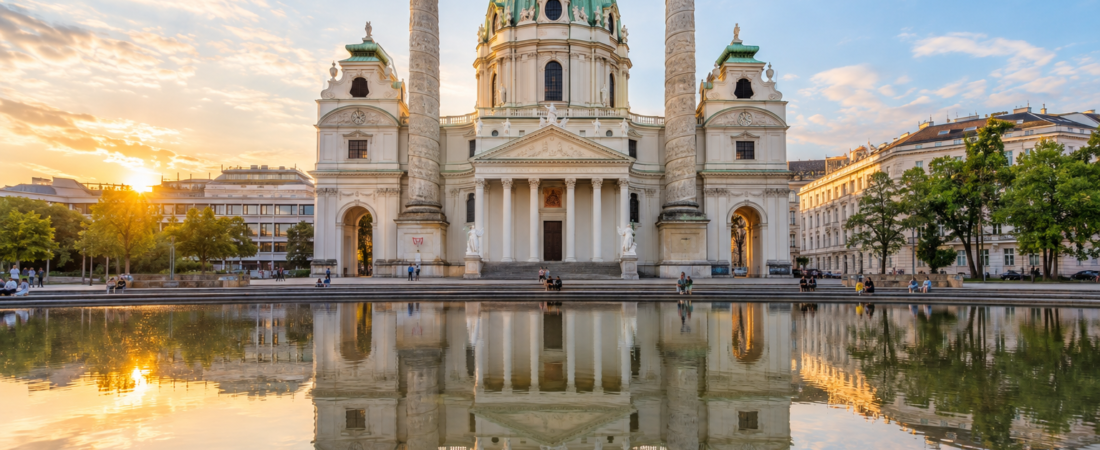
Karlskirche is one of Vienna’s most impressive Baroque churches, recognised by its large copper dome and two decorated columns.
The exterior and reflecting pool can be viewed from the public square without admission. Interior access and special viewing areas may require a ticket.
The surrounding Karlsplatz area also contains cultural institutions and examples of Art Nouveau architecture.
Late Morning: Browse Naschmarkt
Walk from Karlsplatz to Naschmarkt.
The market contains produce stalls, speciality food shops and restaurants offering Austrian and international cuisine. Browsing is free, but prices vary between vendors.
Use the market for lunch or purchase a lighter snack while exploring. Check prices before ordering and avoid assuming that every stall offers budget rates.
A flea market operates on selected days, creating a busier atmosphere.
See the Secession Building
The Secession Building stands near Naschmarkt and is known for its distinctive golden dome.
Viewing the exterior is free and takes only a short time. Admission is required to see exhibitions and Gustav Klimt’s Beethoven Frieze.
Its compact location makes it easy to include without disrupting the wider itinerary.
Afternoon: Stadtpark
Travel or walk to Stadtpark after lunch.
The park contains landscaped paths, bridges and monuments, including the gilded statue of Johann Strauss. Entry is free.
Stadtpark provides a useful break after two days of palaces and museums. It can be crossed while travelling from the historic centre towards the Danube Canal.
During warm weather, the lawns and shaded paths are popular with residents and visitors.
Walk Along the Danube Canal
The Danube Canal passes close to the historic centre and presents a more contemporary side of Vienna.
Sections of the canal contain murals, outdoor venues and riverside paths. Walking along the public areas costs nothing.
The atmosphere varies considerably between quiet daytime periods and lively summer evenings.
After a short walk, continue by public transport to the Prater.
Late Afternoon: Explore the Prater
The Prater consists of an amusement park and an extensive green recreational area.
There is generally no admission charge to enter the amusement section. Visitors pay separately for the Giant Ferris Wheel and other rides.
Walking through the grounds provides a colourful conclusion to the itinerary, even without using the attractions.
The wider Green Prater contains long avenues suitable for walking and cycling.
Evening: Giant Ferris Wheel or Final Dinner
Ride the Giant Ferris Wheel near sunset if you want an elevated view across Vienna.
Tickets can be purchased separately, but queues may form during busy periods. Check the operating schedule and weather conditions beforehand.
Travellers who prefer to remain on the ground can explore the amusement park before having dinner in Leopoldstadt or returning to the centre.
A final Viennese meal could include schnitzel, tafelspitz, goulash or a simpler sausage-stand dinner.
Alternative Activities for 3 Days in Vienna
This itinerary can be adapted according to individual interests.
For Art Lovers
Add the Albertina, Lower Belvedere or mumok. Reduce time at the Prater or skip one imperial interior to avoid museum fatigue.
For Families
Spend more time at Schönbrunn, where the wider complex includes the zoo and children-focused attractions. The Prater can also occupy a full afternoon.
For Classical-Music Enthusiasts
Book a performance at the Vienna State Opera, Musikverein or Konzerthaus. The House of Music provides an interactive alternative during the day.
For Budget Travellers
Concentrate on free public spaces, including the historic centre, Hofburg courtyards, Schönbrunn Palace Park, Belvedere gardens, Ringstrasse and Stadtpark.
During Winter
Allow extra time for museums and coffee houses. Christmas markets can replace park visits from approximately mid-November through the festive season, depending on the annual schedule.
Where to Stay for This Itinerary
The Innere Stadt provides the easiest access to the first day’s attractions but normally has higher accommodation prices.
Neubau and Mariahilf are convenient for MuseumsQuartier, Naschmarkt and central transport connections. Wieden works well for Belvedere and Karlsplatz.
Leopoldstadt offers access to the Prater and remains well connected to the historic centre.
Choose accommodation near an underground or tram stop if staying outside the central districts.
Transport Tips
Vienna’s underground, tram and bus network connects every major stop in this itinerary.
Useful principles include:
- Check your route before leaving each morning.
- Purchase the correct ticket for the required zones and duration.
- Activate or validate tickets according to their conditions.
- Keep your ticket available for inspection.
- Allow extra time during planned maintenance.
- Use trams for shorter scenic journeys.
- Walk between closely grouped central attractions.
- Avoid driving into the historic centre unless necessary.
A standard sightseeing bus is not essential because regular public transport reaches the principal attractions efficiently.
How Much Walking Is Involved?
This itinerary includes substantial walking every day.
Day one covers stone-paved historic streets and the Ringstrasse. Day two involves extensive walking through Schönbrunn Palace Park. Day 3 includes palace gardens, Naschmarkt and the Prater.
Travellers with limited mobility can shorten individual sections and use public transport between closely spaced stops.
Check step-free routes and attraction accessibility before travelling when lifts or level entrances are required.
Essential Booking Checklist
Reserve the following before your trip when they are priorities:
- Schönbrunn Palace admission
- Upper Belvedere timed entry
- Hofburg museums
- Vienna State Opera tours
- Opera, concert or ballet tickets
- Popular restaurants
- Airport transport for unusual arrival times
Keep digital confirmations accessible and save important booking details offline.
Avoid booking every hour of the day. Vienna is best experienced with enough time for unplanned streets, cafés and public spaces.
Final Tips for 3 Days in Vienna
Begin each day early and focus on one major paid attraction during each morning.
Group nearby locations together and leave enough time for meals, transport and rest. Vienna’s large museums can be tiring when visited consecutively.
Check official websites shortly before travelling because opening hours, ticket conditions and exhibitions may change.
3 days will not cover every museum or palace, but this route provides a balanced introduction to Vienna’s imperial history, art, neighbourhoods and recreational spaces.
Book Your Vienna Experiences
Ready to start planning? Compare popular Vienna tours and activities, check current prices and availability, and book the experiences that suit your trip.
Affiliate disclosure: If you book through these links, we may earn a commission from Viator. This does not increase the price you pay.
Continue exploring destinations through our complete collection of city itineraries.