
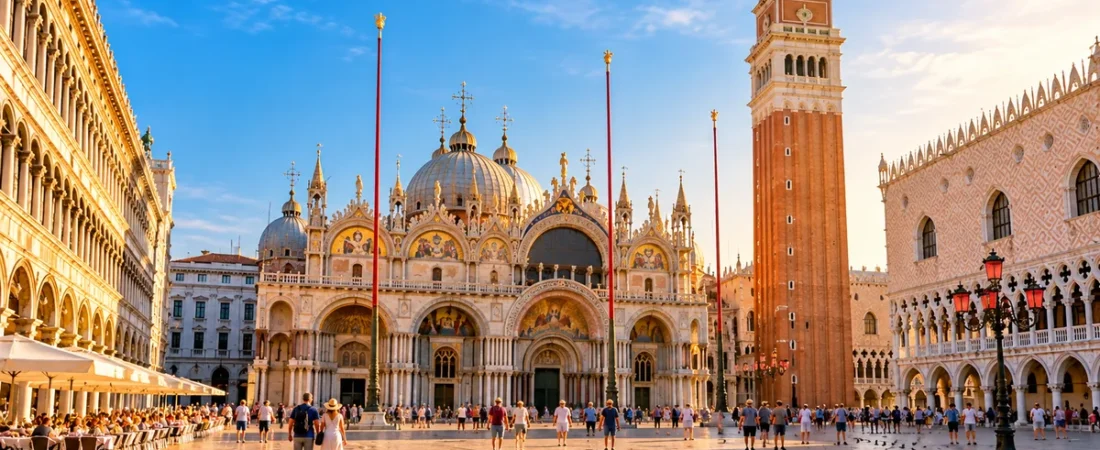
3 days gives you enough time to experience Venice’s famous landmarks while also discovering quieter neighbourhoods and the islands of the Venetian Lagoon. This 3 days in Venice itinerary combines St. Mark’s Square, Doge’s Palace, the Grand Canal, Rialto, Cannaregio, Dorsoduro, Murano and Burano without trying to squeeze everything into an exhausting schedule.
Before your trip, read our Venice travel guide for essential transport and sightseeing information. Choosing a convenient base also saves valuable time, so our guide to where to stay in Venice can help you decide which neighbourhood suits your trip.
Price note: All prices in this article are approximate and were checked at the time of publication. Prices may change.
Day 1: St. Mark’s Square, Doge’s Palace and the Grand Canal
Your first day concentrates on Venice’s most famous landmarks. Starting early makes a significant difference because the San Marco area becomes considerably busier later in the morning.
Morning: Start at St. Mark’s Square
Begin at Piazza San Marco.
Take some time to appreciate the square before immediately entering an attraction. St. Mark’s Basilica, the Campanile, Doge’s Palace and the surrounding arcades create one of Europe’s most distinctive public spaces.
Early morning is particularly rewarding because you’ll experience the architecture before the largest sightseeing crowds arrive.
Next, visit St. Mark’s Basilica. Its mosaics, domes and elaborate interior reflect Venice’s long connections with the Byzantine world and eastern Mediterranean.
Check current entry arrangements before your visit and reserve ahead when appropriate.
Late Morning: Explore Doge’s Palace
Continue next door to Doge’s Palace.
The palace was the political centre of the Venetian Republic and remains one of the city’s most important historic attractions.
Inside, you’ll pass through grand institutional chambers and richly decorated rooms before following the route toward the historic prisons and Bridge of Sighs.
The standard St. Mark’s Square Museums ticket currently costs approximately €35 and includes Doge’s Palace along with several other museums around the square.
Allow around two hours rather than rushing through.
Afternoon: Lunch and the Rialto Bridge
After leaving San Marco, stop for lunch before walking toward Rialto.
Instead of choosing the first restaurant directly beside a major attraction, explore the surrounding side streets and look for a bacaro serving cicchetti — traditional Venetian small bites.
Continue toward the Rialto Bridge.
Cross slowly and stop to enjoy views along the Grand Canal. The bridge and surrounding streets can become extremely crowded, but walking a few minutes beyond the busiest points quickly changes the atmosphere.
Explore the Rialto Market area before continuing through San Polo.
Evening: See the Grand Canal from the Water
Finish your first day aboard a vaporetto along the Grand Canal.
A standard ACTV 75-minute ticket currently costs approximately €9.50. If you’re following this full 3-day itinerary and plan to visit Murano and Burano, compare individual fares with the 72-hour visitor transport pass, currently approximately €45.
A Grand Canal ride around sunset or early evening is particularly memorable.
Historic palaces line both sides of the water, and the city takes on a different character as lights begin appearing in windows and along the waterfront.
Afterwards, enjoy dinner away from the busiest parts of Piazza San Marco.
Day 2: Cannaregio, San Polo and Dorsoduro
Your second day moves beyond Venice’s headline landmarks and explores neighbourhoods where the pace is generally more relaxed.
Morning: Discover Cannaregio
Start in Cannaregio.
If you’re staying near Venezia Santa Lucia railway station, you may already be familiar with the busier western part of the district. This morning, venture away from the main pedestrian routes.
Cannaregio contains residential canals, neighbourhood restaurants, small squares and the historic Jewish Ghetto.
Spend time walking rather than following a strict attraction-to-attraction route. Venice is often at its best when you allow yourself to explore whichever lane or bridge looks interesting.
Stop for coffee before continuing toward the central city.
Late Morning: Walk Through San Polo
Make your way toward San Polo.
Although you saw Rialto on Day 1, today is about exploring the surrounding neighbourhood rather than simply visiting the bridge.
Small squares and narrow lanes lead away from the busiest shopping streets, providing plenty of opportunities for photography and casual exploration.
Depending on your interests, you can also visit one of the district’s churches or simply spend the late morning wandering.
Afternoon: Explore Dorsoduro
Cross the Grand Canal into Dorsoduro.
This district offers a particularly good combination of art, architecture and waterfront scenery.
Art enthusiasts can choose between major cultural attractions such as the Gallerie dell’Accademia and the Peggy Guggenheim Collection.
You don’t need to visit every museum. 3 days in Venice is much more enjoyable when you leave enough time to appreciate the city itself.
Continue toward the Zattere waterfront.
The broad promenade provides open views across the Giudecca Canal and feels very different from Venice’s narrow interior streets.
Evening: Dorsoduro and Cicchetti
Stay in Dorsoduro for the early evening or walk back toward San Polo.
This is a good opportunity to experience Venice’s bacaro tradition.
Rather than having one long formal meal, you can visit one or two local spots for cicchetti accompanied by your preferred drink.
After dinner, take a slow evening walk.
Venice becomes particularly atmospheric once many day visitors have departed, and neighbourhood canals that seemed busy during the afternoon can become remarkably peaceful.
Day 3: Murano and Burano
Your final day leaves central Venice to explore two of the best-known islands in the lagoon.
Start reasonably early because travelling between the islands takes time.
Morning: Take the Vaporetto to Murano
Begin with Murano, internationally known for its centuries-old glassmaking tradition.
The island is actually a collection of smaller islands connected by bridges, creating a miniature version of Venice with canals running between historic buildings.
Walk along the main canals, explore quieter streets and browse glass shops.
If you’re particularly interested in glassmaking, consider visiting the Glass Museum or a reputable glass workshop.
Be cautious about assuming every inexpensive souvenir labelled “Murano glass” was actually produced on the island. If authenticity matters, ask about the origin before purchasing.
Allow roughly two hours for general exploration before continuing to Burano.
Afternoon: Explore Colourful Burano
Burano provides one of the most colourful scenes in the Venetian Lagoon.
Rows of brightly painted houses line small canals, creating a completely different visual experience from central Venice.
The island is also traditionally associated with lacemaking.
Walk beyond the first streets near the vaporetto stop. The quieter residential lanes provide some of Burano’s most attractive views.
Have lunch here if your schedule allows.
Burano is an excellent place to slow down on the final afternoon rather than rushing between multiple attractions.
Optional: Add Torcello
If you started early and still have sufficient time, you can add nearby Torcello.
Torcello is quieter and historically important, with a landscape that feels dramatically different from densely built central Venice.
However, don’t force it into the itinerary simply to tick off another island.
Murano and Burano already make a satisfying day trip, particularly if you enjoy taking photographs and exploring slowly.
Evening: Return to Venice for a Final Walk
Return to central Venice for your final evening.
Rather than scheduling another major attraction, revisit whichever neighbourhood you enjoyed most.
You might return to the Grand Canal, walk through Cannaregio, explore Castello or simply find a quiet canal-side restaurant.
If you haven’t already done so and your budget allows, this can also be an opportunity for a gondola ride.
Otherwise, a final evening vaporetto journey provides a much less expensive way to enjoy Venice from the water.
Should You Buy a Venice Transport Pass?
For this itinerary, a multi-day ACTV pass is worth considering because Day 3 requires water transport to the lagoon islands.
The standard 75-minute waterbus fare is currently approximately €9.50.
Current visitor passes cost approximately €25 for 24 hours, €35 for 48 hours and €45 for 72 hours.
If you expect to take several vaporetto journeys during your 3 days, calculate the likely number of trips before deciding.
Remember that airport transfers are generally not included in the ordinary visitor transport pass.
How to Make This Venice Itinerary Easier
Stay within the historic centre if your accommodation budget permits. It reduces commuting and makes early-morning and evening sightseeing considerably easier.
Wear comfortable shoes because you’ll spend much of each day walking over stone streets and bridges.
Don’t schedule every hour. Getting slightly lost in Venice often leads to beautiful canals and squares you wouldn’t otherwise see.
Book high-demand attractions ahead when possible, particularly during spring and summer.
Start early on Day 1 and Day 3. This helps with crowds around San Marco and gives you more time on the lagoon islands.
Most importantly, resist the temptation to add too many attractions. Venice is best experienced at a walking pace.
What If You Only Have Two Days in Venice?
If you only have two days, follow Days 1 and 2.
That gives you the major San Marco landmarks, Rialto, the Grand Canal and several different neighbourhoods.
You could replace part of Day 2 with Murano or Burano if the islands are particularly important to you.
However, for a first visit, spending two full days within Venice itself usually provides a better introduction than rushing through the historic centre in order to fit in an island excursion.
What If You Have Four Days?
A fourth day makes the itinerary considerably more relaxed.
You can separate Murano and Burano from central sightseeing, visit additional museums, spend more time in Castello or explore the Lido.
It also gives you flexibility if the weather isn’t ideal on one of your planned island days.
Is 3 Days Enough for Venice?
Yes. 3 days provides an excellent introduction to Venice.
You’ll have time for the city’s essential landmarks, several contrasting neighbourhoods, a journey along the Grand Canal and an excursion into the Venetian Lagoon.
The secret is not trying to see everything.
Use this 3 days in Venice itinerary as a framework rather than a minute-by-minute schedule. Leave room for unexpected churches, quiet bridges, cicchetti stops and the occasional wrong turn.
Those unscheduled moments are often what make Venice memorable.
Explore more places through our destinations page or browse our complete collection of itineraries.