
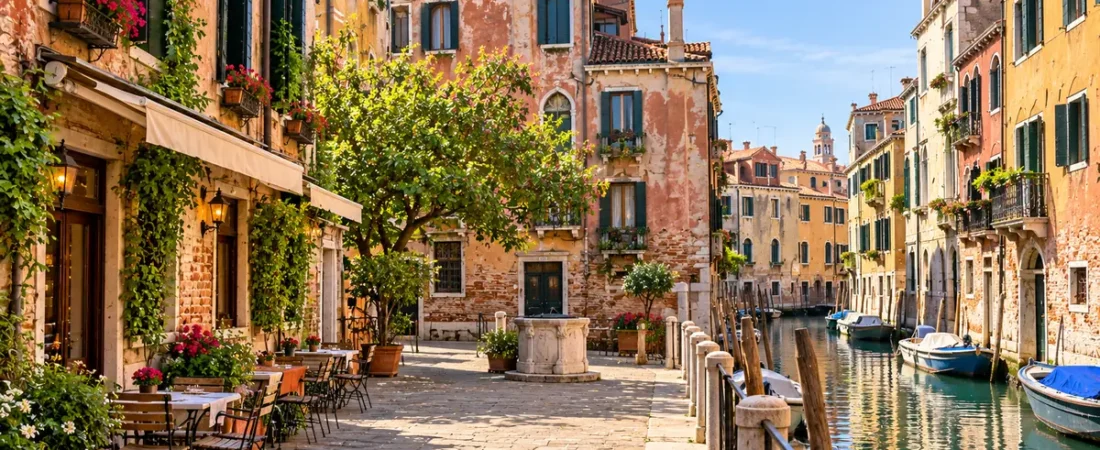
Choosing where to stay in Venice can have a surprisingly big impact on your trip. The city is divided into six historic districts, or sestieri, and each offers a different balance of atmosphere, convenience, sightseeing and price. This guide to where to stay in Venice compares the best areas for first-time visitors, couples, families, nightlife, sightseeing and travellers looking for a quieter experience.
Unlike most cities, Venice has no cars within its historic centre. Reaching your hotel can involve walking through narrow lanes, crossing bridges or taking a vaporetto, so location matters even more when you’re travelling with luggage. Before choosing an area, read our Venice travel guide for an introduction to the city’s attractions, transport and essential planning information.
Price note: All prices in this article are approximate and were checked at the time of publication. Prices may change.
San Marco: Best for First-Time Sightseeing
If this is your first visit and being close to Venice’s most famous attractions is your priority, San Marco is the obvious place to start.
The district contains St. Mark’s Square, St. Mark’s Basilica, Doge’s Palace and numerous historic streets leading toward the Grand Canal.
Staying here means you can walk to several major attractions within minutes. It also makes early-morning sightseeing particularly easy, allowing you to reach Piazza San Marco before many day visitors arrive.
The disadvantage is price. Accommodation around the most famous parts of San Marco is often among the most expensive in Venice.
The area can also become extremely busy during the daytime.
San Marco Is Best For
First-time visitors, short stays, travellers prioritising major attractions and anyone who values location over finding the lowest accommodation price.
Cannaregio: Best Overall for Many Travellers
Cannaregio offers one of the best combinations of convenience and neighbourhood atmosphere.
Venezia Santa Lucia railway station sits at the western end of the district, making Cannaregio particularly useful for travellers arriving by train.
The busy Strada Nova provides a walking route toward Rialto, but venture into the side streets and you’ll discover quieter canals, small squares, neighbourhood restaurants and traditional bacari.
Cannaregio also contains Venice’s historic Jewish Ghetto.
Staying here can make it easier to experience everyday Venice while remaining within walking distance of the major attractions.
The district is large, however. Accommodation near the railway station provides different surroundings from hotels closer to Rialto, so check the exact position before booking.
Cannaregio Is Best For
First-time visitors wanting a balance of convenience and atmosphere, train travellers, couples and anyone who prefers a more residential setting.
Dorsoduro: Best for Culture and a Relaxed Atmosphere
Dorsoduro lies across the Grand Canal from San Marco and is one of Venice’s most appealing areas for travellers who prefer a slightly slower pace.
The district contains important cultural attractions including the Gallerie dell’Accademia and Peggy Guggenheim Collection.
Its waterfront areas are another highlight. Walking along the Zattere provides open lagoon views and a refreshing contrast to Venice’s narrow interior lanes.
There are also plenty of cafés, restaurants and small bars, partly because the area has a significant student population.
Accommodation ranges from elegant hotels to smaller guesthouses and apartments.
Dorsoduro Is Best For
Couples, art lovers, repeat visitors and travellers wanting somewhere atmospheric without staying directly beside Venice’s busiest landmarks.
San Polo: Best for a Central Location
San Polo is one of Venice’s most central districts.
The Rialto Bridge connects it with San Marco, while the surrounding lanes provide convenient access to the Grand Canal and Rialto Market area.
This makes San Polo particularly useful if you want to explore much of Venice on foot without necessarily staying beside St. Mark’s Square.
The neighbourhood mixes busy sightseeing areas with quieter pockets, so accommodation location matters.
Properties immediately around Rialto experience substantial pedestrian traffic, while streets farther away can feel much calmer.
San Polo Is Best For
Travellers who want a very central base, food lovers, couples and visitors planning to explore primarily on foot.
Santa Croce: Best for Easier Arrivals
Santa Croce can be an excellent choice for travellers concerned about carrying luggage through Venice.
Piazzale Roma, the city’s principal road transport terminal, is located beside the district. Buses, taxis and other road vehicles terminate here because they cannot continue through the historic centre.
Venice’s railway station is also relatively accessible across the Grand Canal.
The closer you stay to Piazzale Roma, the easier your arrival and departure may be.
Move deeper into Santa Croce and you’ll find canals, small squares and streets that feel much more characteristically Venetian.
Santa Croce Is Best For
Travellers with substantial luggage, short stays, early departures and anyone arriving in Venice by bus or road transport.
Castello: Best for a Quieter Venice Experience
Castello occupies a large part of eastern Venice.
Its western section begins close to St. Mark’s Square, making some parts extremely convenient for sightseeing. Continue east, however, and the neighbourhood becomes increasingly residential.
This gives Castello an interesting advantage: you can potentially stay within reasonable walking distance of Venice’s headline attractions while enjoying quieter surroundings.
The district also includes the Giardini and Arsenale areas associated with the Venice Biennale.
For travellers who enjoy walking through local neighbourhoods rather than remaining within the most tourist-heavy streets, Castello deserves serious consideration.
Castello Is Best For
Repeat visitors, longer stays, couples and travellers looking for a more local atmosphere.
Should You Stay in Mestre?
Mestre is located on the mainland rather than within Venice’s historic island centre.
Its biggest advantage is usually value. Accommodation can be considerably more affordable, particularly during busy periods.
Frequent transport connections make it possible to travel between Mestre and Venice each day.
However, there is an important trade-off.
Staying in the historic centre allows you to experience Venice early in the morning and late in the evening, when many day visitors have departed. Staying in Mestre means commuting in and out.
For a very tight budget, Mestre can make sense. For a first visit of only a few days, however, staying within historic Venice provides a more immersive experience if your accommodation budget allows it.
Best Area in Venice for Couples
Dorsoduro and quieter parts of Cannaregio are particularly appealing for couples.
Both provide atmospheric canals and attractive places for evening walks without requiring you to remain around the busiest sections of San Marco.
San Marco can still be an excellent choice for a special occasion if convenience and proximity to iconic landmarks matter more than price.
Best Area in Venice for Families
Families may appreciate Cannaregio, Santa Croce or Dorsoduro.
When travelling with young children, look beyond the neighbourhood name and study the exact route between your accommodation and the nearest transport stop.
Venice’s bridges often include steps, which can make moving luggage and pushchairs more difficult.
A hotel requiring a ten-minute walk might involve several bridge crossings, while another slightly farther away geographically could have much easier vaporetto access.
Best Area for Budget Travellers
Accommodation within Venice’s historic centre is rarely genuinely cheap during popular travel periods.
Cannaregio and parts of Castello or Santa Croce can sometimes offer better value than prime San Marco locations.
If price is the overriding consideration, compare accommodation in Mestre as well.
Remember to consider transportation costs when comparing a cheaper mainland hotel with accommodation inside Venice.
Historic Centre or Mainland: Which Should You Choose?
For most first-time visitors spending 2 or 3 nights in Venice, staying within the historic centre has a major advantage: time.
You can walk outside early in the morning, explore before peak crowds arrive, return to your accommodation during the day and stay out after evening visitors leave.
Mestre makes more sense when accommodation savings are substantial, you’re travelling by car, or Venice forms only one part of a longer regional trip.
Rather than automatically choosing the cheapest room, compare the total experience and daily transportation involved.
Venice Tourist Tax
Visitors staying overnight in registered accommodation within the Municipality of Venice should budget for the city’s tourist tax.
The amount varies according to factors including the type and classification of accommodation, location and season. Current full rates generally range from approximately €1 to €5 per person per night.
The tax applies for a maximum of the first five consecutive nights.
Children under 10 are exempt, while children aged 10 to 16 receive a reduction. Other exemptions and reductions may apply in specific circumstances.
The accommodation provider normally collects the tax and provides proof of payment.
Because rates depend on the individual property and travel dates, confirm the exact amount with your accommodation when booking.
Tips for Choosing Your Venice Accommodation
Before booking, locate the property on a map rather than relying only on the district name.
Check the nearest vaporetto stop and count how many bridges separate it from the accommodation, especially if you will have heavy luggage.
Consider whether the property has stairs or a lift. Many Venetian buildings are historic, and facilities can differ considerably from modern hotels.
Read recent reviews for comments about noise. A room above a lively street or square may be convenient but less suitable for light sleepers.
Also consider the season. Venice accommodation prices can rise substantially during major events and popular travel periods, so booking earlier gives you a wider choice.
Most importantly, choose a registered accommodation property and verify exactly what is included in the quoted price.
Which Venice Area Should You Choose?
For maximum sightseeing convenience, choose San Marco.
For the strongest all-round combination of location and neighbourhood atmosphere, consider Cannaregio.
For culture and a more relaxed setting, choose Dorsoduro.
For a highly central walking base, San Polo works particularly well.
For convenient arrivals and departures, consider Santa Croce.
For a quieter, more residential experience, explore Castello.
And if keeping accommodation costs as low as possible is the main priority, compare Mestre with options inside Venice.
There isn’t one neighbourhood that works for every traveller. The best place to stay depends on your budget, arrival method and how you want to experience the city.
Explore more places through our destinations page or browse our complete collection of itineraries.