
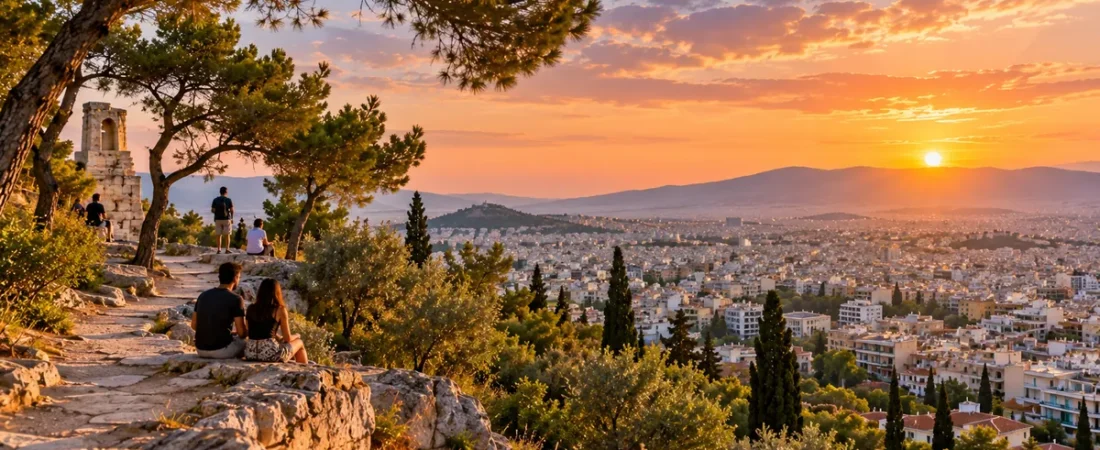
Some of the best free things to do in Athens are also among the city’s most memorable experiences. You can climb hills for panoramic views, explore historic neighbourhoods, watch the changing of the guard, wander through gardens and markets, discover street art and see famous ancient monuments from public spaces without buying a ticket.
Athens certainly has important paid attractions — particularly the Acropolis and major archaeological sites — but you do not need to spend money continuously to enjoy the Greek capital.
This guide covers 25 genuinely free experiences in Athens, making it useful whether you’re travelling on a tight budget or simply want to balance paid sightseeing with neighbourhoods, viewpoints and outdoor attractions.
Start with our Athens travel guide if this is your first visit, and use our Athens travel budget to estimate your overall trip costs.
Price note: All prices in this article are approximate and were checked at the time of publication. Prices may change.
1. Climb Philopappos Hill
Philopappos Hill is one of the best places to enjoy Athens without spending anything.
The wooded hill rises southwest of the Acropolis and contains walking paths, archaeological remains and several viewpoints.
As you climb, openings between the trees reveal increasingly impressive perspectives towards the Acropolis and surrounding city.
Walking the hill itself is free.
Late afternoon is particularly attractive because the light becomes softer and temperatures are usually more comfortable than around midday.
Wear shoes with good grip because some paths and rocky surfaces can be uneven.
2. Walk Up Lycabettus Hill
Lycabettus Hill provides one of Athens’ widest panoramas.
The hill rises dramatically above central neighbourhoods, and the summit offers views across the enormous urban area.
On a clear day, you can see the Acropolis, surrounding mountains and areas towards the coast.
Walking to the top costs nothing.
There is also a funicular, but that is a paid alternative, so budget travellers should take the walking route.
Bring water and avoid the hottest part of a summer day.
Sunset is especially popular.
3. Watch the Changing of the Guard at Syntagma Square
One of central Athens’ most distinctive free experiences takes place outside the Hellenic Parliament.
The Tomb of the Unknown Soldier is guarded by the Evzones, members of Greece’s Presidential Guard.
Their ceremonial uniforms and carefully coordinated movements make the changing of the guard fascinating to watch.
The guard changes every hour, and watching from Syntagma Square is free.
A larger ceremonial change takes place on Sunday.
Arrive early if you want a clear view during busy periods.
4. Explore Plaka
You do not need a ticket to enjoy Athens’ most famous historic neighbourhood.
Plaka sits beneath the Acropolis and contains narrow streets, neoclassical buildings, small squares, churches, cafés and shops.
The busiest streets can feel very tourist-oriented, but quieter lanes still provide a wonderful atmosphere.
Walk without a strict route.
The neighbourhood is compact enough that getting slightly lost is part of the experience.
Early morning can be particularly pleasant before the streets become busy.
5. Discover Anafiotika
Hidden on the slopes above Plaka is tiny Anafiotika.
Its whitewashed houses and narrow passages create an atmosphere more commonly associated with the Cycladic islands.
The neighbourhood was developed by builders who came to Athens from the island of Anafi.
Exploring the public passages costs nothing.
Remember that this is a residential neighbourhood rather than an attraction built for visitors.
Keep noise down, avoid blocking doorways and respect private property.
6. Explore Monastiraki Square
Monastiraki Square is one of the liveliest public spaces in central Athens.
Ancient remains, historic buildings, street activity, shops and the Acropolis skyline all come together here.
You can simply stand in the square and watch Athens pass by.
It is also an excellent starting point for exploring the surrounding flea-market streets, Psirri, Plaka and the Ancient Agora area.
The square becomes particularly atmospheric towards evening.
7. Browse the Monastiraki Flea Market
You do not have to buy anything to enjoy the Monastiraki flea-market district.
The surrounding streets contain souvenir shops, clothing, antiques, second-hand items and all kinds of unusual merchandise.
Browsing is free.
The area can become crowded, so keep normal city precautions in mind and secure your valuables.
Combine the market with Monastiraki Square and Psirri for an inexpensive afternoon.
8. Walk Through Psirri
Psirri provides a very different experience from ancient Athens.
The neighbourhood is known for restaurants, bars, street art and creative businesses.
During the day, wandering its streets costs nothing.
Look for murals, colourful façades and small details rather than rushing between specific landmarks.
Psirri becomes much livelier in the evening, when restaurants and bars fill with customers.
You can enjoy the atmosphere without necessarily spending money.
9. See Athens Street Art
Athens has a substantial street-art scene.
Murals and smaller works appear throughout neighbourhoods such as Psirri, Keramikos, Metaxourgeio and Exarchia.
The art changes over time, which means a street can look different on a return visit.
You don’t need a formal street-art tour to begin exploring.
Simply keep your eyes open while walking between neighbourhoods.
Street art is particularly useful for travellers who want to experience contemporary Athens rather than focusing entirely on ancient monuments.
10. Walk Along Ermou Street
Ermou is one of central Athens’ main pedestrian shopping streets.
It connects Syntagma with the Monastiraki area.
Walking the street costs nothing and provides plenty of people-watching.
One of its most interesting landmarks is the small Byzantine Church of Panagia Kapnikarea, which sits amid the modern commercial district.
Even travellers who have no interest in shopping will probably walk part of Ermou during a central Athens visit.
11. Visit the National Garden
The National Garden provides a green retreat beside Syntagma Square.
Shaded paths wind among mature trees and plants, creating a welcome break from traffic and exposed archaeological sites.
Entry is free.
The garden is particularly useful during warm weather when you need somewhere cooler to walk or rest.
Its central location means you can combine it with Syntagma Square, the Parliament area and the Panathenaic Stadium.
12. Walk Around Zappeion
Beside the National Garden stands the impressive Zappeion building and surrounding grounds.
The neoclassical structure is associated with modern Greek public life and the history of the Olympic movement.
Even when there is no reason to enter the building, the surrounding public spaces are worth exploring.
Combine Zappeion with the National Garden for a longer free walk through central Athens.
13. See the Panathenaic Stadium from Outside
Entering the Panathenaic Stadium requires a ticket, but you can see significant portions of the famous marble structure from outside.
The stadium occupies a site associated with ancient athletic competitions and played a major role in the first modern Olympic Games in 1896.
If your budget does not allow an interior visit, the exterior view still provides a good sense of its scale.
You can combine it with the National Garden and Pangrati.
14. See Hadrian’s Arch
Hadrian’s Arch is one of the easiest ancient monuments to see for free.
The Roman-era arch stands beside a major road near the Temple of Olympian Zeus.
You can view and photograph it from the surrounding public space without buying admission.
Its central position makes it an easy addition to a walking route between Plaka, Syntagma and the Acropolis area.
15. See the Temple of Olympian Zeus from Outside
Entering the Temple of Olympian Zeus archaeological site requires a ticket.
However, portions of its enormous surviving columns can be seen from surrounding public areas.
The surviving columns give you an idea of the extraordinary scale of the ancient sanctuary.
If archaeological sites are a major priority, paying to enter may still be worthwhile.
For travellers on a strict budget, the exterior views provide a free alternative.
16. Walk Around the Acropolis Pedestrian Zone
You need a ticket to enter the Acropolis itself, but walking around the base of the hill is free.
Pedestrian routes connect areas around the Acropolis Museum, Plaka, Philopappos Hill and Thissio.
Along the way, you will encounter ancient landscapes, historic buildings, musicians and views towards the Acropolis.
Early morning and evening are particularly enjoyable.
Our 3 days in Athens itinerary uses this walkable historic core extensively.
17. Visit Areopagus Hill
Areopagus Hill sits beside the Acropolis and provides another free viewpoint.
The rocky outcrop has connections with ancient Athenian history and later Christian tradition.
Today, visitors come primarily for the views.
You can see the Acropolis from one direction and the modern city from another.
The rocks can be extremely slippery, so wear suitable shoes and take particular care when descending.
18. Walk Through Thissio
Thissio is one of the most pleasant neighbourhoods for walking near Athens’ archaeological centre.
Its pedestrian areas provide views towards the Acropolis, while cafés and residential streets create a relaxed atmosphere.
You can connect Thissio with Monastiraki, the Ancient Agora area and Philopappos Hill.
The neighbourhood is especially attractive around sunset.
Our guide to where to stay in Athens also covers Thissio as an accommodation option.
19. Explore the Athens Central Market Area
The area around Varvakios Agora offers a glimpse of everyday Athens.
Food stalls and surrounding shops sell meat, fish, produce, spices and other ingredients.
Browsing the market area costs nothing.
Visit during active daytime hours for the best atmosphere.
Even if you do not buy anything, the market provides an interesting contrast with the historic streets around Plaka.
20. Wander Through Pangrati
Pangrati is an excellent neighbourhood for travellers who want to experience modern residential Athens.
Its streets contain cafés, local restaurants, shops and neighbourhood squares.
Walking around costs nothing.
The area works particularly well after seeing the Panathenaic Stadium because the two can easily be combined.
Pangrati feels less dominated by major visitor attractions than Plaka and Monastiraki.
21. Explore Kolonaki
Kolonaki is one of Athens’ more polished central neighbourhoods.
Boutiques, cafés and galleries line streets beneath Lycabettus Hill.
You certainly can spend money here, but exploring the neighbourhood itself is free.
Walk around Kolonaki before climbing Lycabettus for a useful contrast between elegant modern Athens and the panoramic natural setting above it.
22. Explore Syntagma Square
Syntagma is much more than somewhere to catch the Metro.
It is one of modern Athens’ most important civic spaces.
The Hellenic Parliament overlooks the square, while major streets lead towards Plaka, Monastiraki and Kolonaki.
Spend some time observing daily city life before or after watching the Evzones.
The square is also a useful starting point for a free walk through the National Garden and surrounding central neighbourhoods.
23. Explore the Archaeological Displays at Syntagma Metro Station
Athens’ Metro construction uncovered archaeological material beneath the modern city.
Syntagma station incorporates archaeological displays that travellers can see while passing through the station.
This is a wonderful example of ancient and modern Athens occupying the same space.
If you are already using the Metro, take a few extra minutes to examine the displays rather than rushing directly to the platform.
Access to areas outside the ticketed transport zone can be viewed without purchasing a museum ticket.
24. Walk Around Keramikos and Gazi
The neighbourhoods west of the historic centre reveal another side of Athens.
Keramikos combines archaeological surroundings with contemporary cultural spaces, while nearby Gazi is known for nightlife and converted industrial architecture.
Entering the Kerameikos archaeological site requires admission, but exploring the surrounding neighbourhoods is free.
This area is particularly interesting for travellers who enjoy street art and contemporary urban environments.
25. Watch the Athens Sunset for Free
One of the best ways to finish a day in Athens costs nothing.
You do not need an expensive rooftop bar to enjoy the sunset.
Philopappos Hill, Lycabettus Hill and several other elevated public spaces provide excellent views.
Bring water, arrive before sunset and find a safe place to sit.
As the light changes, Athens’ pale buildings turn warmer and the surrounding mountains gradually fade into silhouette.
Watching the city change from daylight to evening is one of the simplest and most memorable free experiences in Athens.
Book Your Athens Experiences
Ready to start planning? Compare popular Athens tours and activities, check current prices and availability, and book the experiences that suit your trip.
Affiliate disclosure: If you book through these links, we may earn a commission from Viator. This does not increase the price you pay.
Best Free Things to Do in Athens at Night
Athens remains lively after dark.
Walk through illuminated Plaka.
Experience the atmosphere around Monastiraki Square.
Explore Psirri’s streets.
Walk along Ermou.
See the illuminated Acropolis from public viewpoints.
Spend time in Syntagma Square.
You do not need to enter a bar or restaurant every evening to enjoy the city.
A simple night walk through central Athens can be one of the highlights of your trip.
Best Free Athens Viewpoints
For panoramic views, prioritise:
Philopappos Hill for excellent Acropolis perspectives.
Areopagus Hill for a close historic-centre viewpoint.
Lycabettus Hill for one of the widest panoramas across Athens.
All three can be reached without paying an admission fee if you walk.
If you have enough time, visit more than one because each offers a different perspective.
Best Free Things to Do for Families
Families can enjoy many of the same free attractions.
The National Garden provides space away from busy streets.
The guard change at Syntagma is visually interesting for children.
Philopappos Hill offers a combination of walking, greenery and views.
Plaka and Anafiotika provide interesting streets to explore without needing a structured activity.
During summer, avoid scheduling long exposed walks around the hottest part of the day.
Can You Visit Athens on a Small Budget?
Yes.
Although major archaeological attractions now represent a meaningful expense, much of the city’s atmosphere is available for free.
A budget traveller could pay for the Acropolis and perhaps one or two additional major attractions while spending the rest of the trip exploring neighbourhoods, viewpoints, gardens and public spaces.
Food can also remain relatively affordable if you mix restaurant meals with bakeries, markets and casual souvlaki.
Our complete Athens travel budget explains expected costs for accommodation, food, attractions, airport transport and public transportation.
How to Combine Free and Paid Athens Attractions
The most effective approach is not necessarily to avoid every admission fee.
Instead, identify the paid attractions that are genuinely important to you.
For a first visit, the Acropolis is likely to be the highest priority.
You might then choose the Acropolis Museum or Ancient Agora depending on your interests.
Surround these paid attractions with free experiences.
For example:
Visit the Acropolis in the morning, then explore Plaka and Anafiotika for free.
Visit the Ancient Agora, then walk through Monastiraki and Psirri.
Spend a museum morning indoors, then walk through the National Garden and climb Lycabettus in the afternoon.
This approach provides variety while controlling costs.
Best Time for Free Outdoor Activities in Athens
Spring and autumn are particularly comfortable for free outdoor sightseeing.
April, May, September and October generally provide better walking conditions than the hottest part of summer.
Summer visitors should begin early, rest during periods of extreme heat and resume outdoor activities later.
Winter can also be excellent for neighbourhood walks and hill viewpoints on clear days.
Our best time to visit Athens guide compares each season in detail.
How Many Free Activities Can You Fit Into 3 Days?
You could easily experience ten or more of these attractions without making your itinerary feel rushed.
Many are located close together.
For example, Plaka, Anafiotika, Hadrian’s Arch, Syntagma and the National Garden can be combined.
Monastiraki, Psirri, the market area and Ermou Street form another easy group.
Philopappos Hill, Thissio and the Acropolis pedestrian zone work naturally together.
Use our 3 days in Athens itinerary as the foundation and add free activities wherever they fit.
Final Thoughts on Free Things to Do in Athens
The best free things to do in Athens show that experiencing the Greek capital does not require paying for an attraction every few hours.
Ancient monuments dominate the city’s history, but Athens is equally rewarding at street level.
Walk through Plaka and Anafiotika.
Explore markets and neighbourhoods.
Watch the Evzones at Syntagma.
Rest in the National Garden.
Climb Philopappos and Lycabettus.
Watch the sun disappear behind the mountains.
These free experiences complement the Acropolis and museums rather than replacing them.
Together, they reveal a city that is not simply an archaeological destination but a living European capital filled with neighbourhoods, public spaces, hills and everyday Greek life.
Explore more places through our destinations page or browse our complete collection of itineraries.