
A 3 days in Athens itinerary gives first-time visitors enough time to experience the city’s most important ancient monuments while also exploring its historic neighbourhoods, markets, museums and panoramic viewpoints.
Over 3 days, you can visit the Acropolis and Parthenon, explore the Acropolis Museum, wander through Plaka and Anafiotika, discover the Ancient Agora, experience Monastiraki and Psirri, watch the changing of the guard at Syntagma Square and finish with spectacular views across Athens.
This itinerary is designed to keep nearby attractions together, reducing unnecessary travel and giving you more time to enjoy the city.
Before your trip, read our Athens travel guide for additional information about attractions, transport, food and practical planning. If you haven’t booked accommodation yet, our guide to where to stay in Athens compares the city’s most convenient neighbourhoods.
Price note: All prices in this article are approximate and were checked at the time of publication. Prices may change.
Top Tours & Experiences in Athens
Discover popular Athens tours and experiences. Check current availability, ratings and prices before you book.
Affiliate disclosure: If you book through these links, we may earn a commission from Viator. This does not increase the price you pay.
3 Days in Athens at a Glance
Day 1
Acropolis → Acropolis Museum → Plaka → Anafiotika → Hadrian’s Arch → Syntagma Square
Day 2
Ancient Agora → Monastiraki → Psirri → Central Market area → Ermou Street → sunset viewpoint
Day 3
National Archaeological Museum → National Garden → Panathenaic Stadium → Kolonaki → Lycabettus Hill
This route covers the essential ancient landmarks while leaving enough time to experience modern Athens.
Day 1: The Acropolis and Historic Athens
Your first day focuses on the landmarks that define Athens.
Start early, particularly during warmer months, because much of the Acropolis archaeological site is exposed to the sun.
Morning: Visit the Acropolis
Begin your 3 days in Athens with the city’s most important attraction.
The Acropolis rises above central Athens and has dominated the city’s landscape for thousands of years.
Its best-known monument is the Parthenon, constructed during the fifth century BC and dedicated to Athena.
Other important structures include the Erechtheion, Temple of Athena Nike and monumental Propylaea.
Standard Acropolis admission is currently approximately €30.
Timed-entry arrangements apply, so purchasing your ticket ahead can be useful, especially during busy travel periods.
Allow approximately two hours for the archaeological site.
Do not rush directly to the Parthenon and leave.
Walk through the complex, examine the surrounding monuments and take time to appreciate the extraordinary views across modern Athens.
Acropolis Tip
Wear shoes with good grip.
Ancient stone surfaces can become polished and slippery after centuries of use.
During hot weather, bring water, sun protection and a hat.
Late Morning: Walk Down to the Acropolis Museum
After leaving the archaeological site, walk towards the Acropolis Museum.
The modern museum is one of the best places to understand the monuments you have just visited.
Its collections contain archaeological finds from the Acropolis, while the upper Parthenon Gallery presents surviving elements of the temple’s sculptural decoration.
Large windows create a visual connection between the gallery and the actual Parthenon above the city.
General museum admission is currently €20.
Allow approximately 1½–2 hours.
If you enjoy archaeology, you could easily stay longer.
Lunch Around Koukaki
After the museum, walk into nearby Koukaki.
The neighbourhood offers plenty of cafés, bakeries and restaurants without requiring you to travel across the city.
A casual lunch also gives you time to rest after a morning of archaeological sightseeing.
Koukaki is one of the neighbourhoods we recommend in our guide to where to stay in Athens.
Afternoon: Explore Plaka
After lunch, move into Plaka.
Athens’ famous historic neighbourhood lies beneath the Acropolis and is perfect for unstructured wandering.
Explore narrow streets lined with colourful buildings, small shops, restaurants and Byzantine churches.
Some of Plaka’s busiest streets are heavily visitor-oriented, so turn into quieter side streets occasionally.
The neighbourhood becomes more atmospheric when you stop following the most obvious tourist route.
Discover Anafiotika
While exploring Plaka, look for Anafiotika on the slopes below the Acropolis.
This tiny neighbourhood was built by workers who came to Athens from the Cycladic island of Anafi.
Whitewashed houses and narrow passages give the area a surprisingly island-like appearance.
Anafiotika remains residential.
Walk quietly, avoid blocking doorways and respect private homes.
You do not need long here, but it provides one of the most unusual contrasts in central Athens.
See Hadrian’s Arch
Continue towards Hadrian’s Arch.
The Roman-era monument stands beside one of the main walking routes between Plaka and the Temple of Olympian Zeus.
You can see and photograph the arch freely from the surrounding public area.
The enormous surviving columns of the Temple of Olympian Zeus can also be seen nearby.
Entering the archaeological site requires admission, so decide whether you want to add it depending on your energy and interest.
Evening: Syntagma Square
Finish your first day’s sightseeing around Syntagma Square.
The Hellenic Parliament overlooks the square.
In front of the building is the Tomb of the Unknown Soldier, guarded by the Evzones.
Watching the guard ceremony is free.
From Syntagma, you can walk along Ermou Street, return towards Plaka or choose a restaurant for dinner.
Dinner in Plaka or Koukaki
For your first evening, keep things simple.
Return towards Plaka for historic atmosphere or Koukaki for a more neighbourhood-oriented restaurant scene.
Try Greek dishes such as souvlaki, grilled meats, moussaka, Greek salad, stuffed vegetables or a selection of mezze.
Do not feel pressured to choose a restaurant immediately beside a major landmark.
Walking several streets away can often provide a more relaxed dining experience.
Day 2: Ancient Agora, Markets and Local Athens
Your second day moves from ancient Athens into the city’s modern commercial and nightlife districts.
Morning: Ancient Agora
Begin at the Ancient Agora.
This was one of the most important centres of public life in ancient Athens.
Politics, commerce, religion and social activity all took place here.
Today, the site combines archaeological remains with trees and open spaces, making it a very different experience from the Acropolis.
Standard admission is currently €20.
The archaeological site is generally open from morning into the afternoon or evening, with hours varying seasonally.
See the Temple of Hephaestus
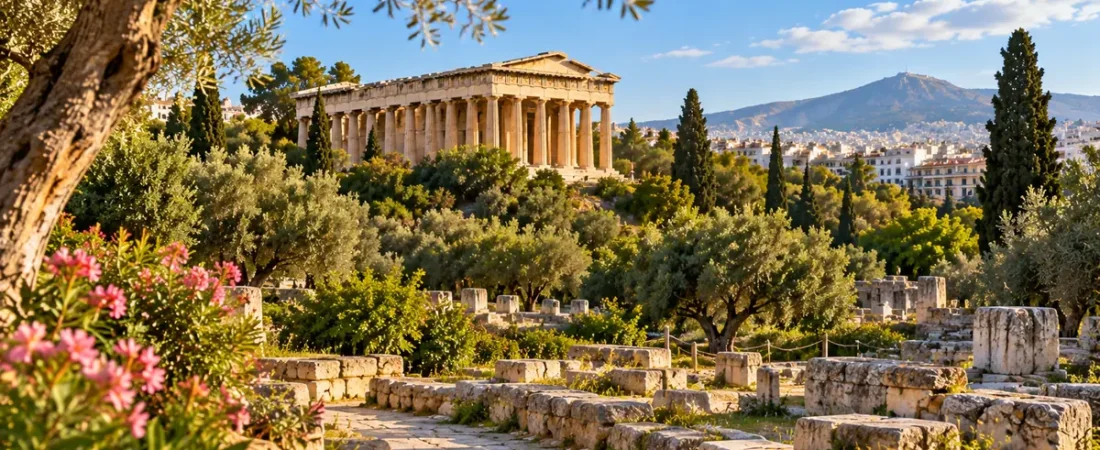
The highlight of the Ancient Agora for many visitors is the Temple of Hephaestus.
It is among the best-preserved ancient Greek temples.
Its relatively complete columns and structure make it easier to imagine how ancient temples originally appeared.
Walk around the permitted paths and view the temple from several angles.
This is also the landmark used for our featured image for this itinerary.
Visit the Stoa of Attalos
Within the Ancient Agora stands the reconstructed Stoa of Attalos.
The long colonnaded building houses the Museum of the Ancient Agora.
Its exhibits help explain everyday life and the political development of ancient Athens.
Do not skip the museum simply because you have already visited the Acropolis Museum.
The two collections tell different stories.
Late Morning: Monastiraki Square
Leave the Ancient Agora and walk towards Monastiraki.
The transition from archaeological site to busy modern square happens remarkably quickly.
Monastiraki is surrounded by shops, restaurants, markets and historic buildings.
The Acropolis remains visible above parts of the neighbourhood.
Take time to explore the streets rather than treating the square simply as a transport stop.
Browse the Monastiraki Flea Market Area
Continue through the surrounding market streets.
You will find souvenirs, clothing, antiques and various small shops.
Browsing costs nothing.
Even travellers with no intention of shopping can enjoy the contrast between this busy commercial area and the ancient ruins visited earlier.
Lunch in Psirri
Walk into neighbouring Psirri for lunch.
This district is known for restaurants, cafés, street art and evening nightlife.
During the day it has a more relaxed character.
A casual taverna meal or souvlaki works well before continuing your sightseeing.
Afternoon: Explore the Central Market Area
Continue towards the Athens Central Market area around Varvakios Agora.
This part of Athens provides another perspective on the city.
Food stalls and traditional businesses create a completely different atmosphere from Plaka and the Acropolis.
Visit during active daytime hours rather than late in the evening.
The surrounding streets are also worth exploring if you enjoy markets and everyday city life.
Walk Along Ermou Street
From the market area, make your way towards Ermou Street.
Athens’ principal pedestrian shopping street connects Monastiraki with Syntagma.
Even if you are not interested in shopping, the route is useful and lively.
Look for the small Byzantine Church of Panagia Kapnikarea, which appears almost unexpectedly among modern commercial buildings.
Late Afternoon: Choose a Viewpoint
For the end of Day 2, choose one of Athens’ panoramic hills.
Option 1: Philopappos Hill
Philopappos Hill is an excellent choice if you want close views towards the Acropolis.
Walking up the hill is free.
The paths pass through greenery before reaching viewpoints across Athens.
It is especially attractive near sunset.
Option 2: Areopagus Hill
Areopagus sits close to the Acropolis and provides another famous viewpoint.
Access is free.
The rock can be slippery, so take care, particularly after rain or when wearing smooth-soled shoes.
Evening in Psirri or Monastiraki
Return to Psirri if you want restaurants and nightlife.
Alternatively, choose one of the rooftop venues around Monastiraki for an evening view towards the illuminated Acropolis.
Rooftop locations can charge a premium, so check menus before ordering if you are travelling on a budget.
Day 3: Museums, Gardens and Athens from Above
Your final day focuses on a broader look at Greek history and modern central Athens.
Morning: National Archaeological Museum
Start at the National Archaeological Museum.
While the Acropolis Museum concentrates on material from the Acropolis, the National Archaeological Museum contains treasures from archaeological sites across Greece.
This makes it particularly worthwhile for travellers whose trip does not include many destinations elsewhere in the country.
Allow at least two hours.
Travellers with a strong interest in ancient Greece may want considerably longer.
Coffee Break
After the museum, stop for coffee before continuing.
Athens has a strong café culture, and taking a slower break is part of experiencing the modern city.
There is no need to fill every hour of your itinerary with monuments.
Late Morning: Syntagma and the National Garden
Travel or walk towards Syntagma Square.
If you only passed through quickly on Day 1, take another look at the Parliament area.
Then enter the National Garden behind it.
The garden provides shaded paths and greenery in the centre of the city.
Entry is free.
It is especially useful during warmer weather when you want a break from exposed archaeological sites.
Walk Towards the Panathenaic Stadium
Continue through or around the garden towards the Panathenaic Stadium.
The marble stadium is connected with the first modern Olympic Games in 1896.
You can see parts of the structure from outside for free.
Entering the stadium requires a ticket.
If Olympic history interests you, the interior visit may be worthwhile.
Otherwise, viewing the stadium from outside is sufficient before continuing.
Lunch Around Pangrati
Head towards Pangrati for lunch.
This neighbourhood offers a more residential Athens experience with cafés, restaurants and local squares.
It is an excellent place to spend part of your final day away from the busiest tourist streets.
If you prefer to remain closer to the centre, return towards Syntagma or Kolonaki instead.
Afternoon: Explore Kolonaki
Continue to Kolonaki.
This upscale neighbourhood sits below Lycabettus Hill and is known for cafés, boutiques, restaurants and museums.
Walk around the streets, stop for coffee or browse shops before beginning your final climb.
Late Afternoon: Lycabettus Hill
Finish your 3-day Athens itinerary with one of the city’s greatest panoramas.
Mount Lycabettus rises above central Athens and provides sweeping views across the city.
On clear days you can see the Acropolis, surrounding mountains and areas towards the coast.
Walking to the summit is free.
The climb is steep, so take your time and carry water.
Travellers who do not want to walk can use the funicular for a fee.
Sunset from Lycabettus
Try to reach the summit before sunset rather than arriving at the exact sunset time.
This gives you an opportunity to explore the viewpoint and find a good position.
As daylight fades, the city begins to illuminate below.
From this elevation, the Acropolis appears relatively small within the enormous modern city, providing a completely different perspective from the close-up views of Day 1.
It is an excellent way to finish 3 days in Athens.
Alternative Day 3: More Ancient Athens
Not everyone wants to spend the final morning inside another large museum.
If you prefer archaeological sites, replace the National Archaeological Museum with additional ancient monuments.
Possible choices include the Roman Agora, Temple of Olympian Zeus or other archaeological sites around the historic centre.
The Roman Agora currently has standard admission of approximately €10.
This alternative keeps the itinerary focused more heavily on ancient Athens.
How Much Will 3 Days in Athens Cost?
Your costs depend heavily on accommodation and how many paid attractions you choose.
The main sightseeing expenses in this itinerary include the Acropolis, Acropolis Museum, Ancient Agora and any additional museums or archaeological sites.
Current standard prices include approximately:
- Acropolis — €30
- Acropolis Museum — €20
- Ancient Agora — €20
- Roman Agora — €10 if added
Food can range from inexpensive souvlaki and bakery meals to higher-priced rooftop restaurants.
Public transport is relatively affordable.
A standard 90-minute Athens public transport ticket currently costs €1.20, while the 24-hour ticket costs €4.10.
Many attractions in this itinerary are close enough to walk between.
Getting Around During This Athens Itinerary
Walking should be your primary form of transport for Days 1 and 2.
The Acropolis, Plaka, Monastiraki, Psirri and Ancient Agora are concentrated within central Athens.
Metro travel becomes more useful when reaching attractions farther away or when you want to reduce walking.
Athens’ standard €1.20 ticket is valid for 90 minutes on eligible urban public transport.
Contactless payment using eligible bank cards or mobile wallets is also available on the OASA network for full-fare products.
If you stay centrally, your total transport spending over 3 days may remain very low.
Where to Stay for This Itinerary
Location matters when you only have 3 days.
Plaka places you close to many Day 1 attractions.
Koukaki provides excellent access to the Acropolis and Acropolis Museum.
Monastiraki is particularly convenient for Day 2 and has strong metro connections.
Syntagma provides excellent transportation and a central position.
Our complete where to stay in Athens guide compares these areas along with Psirri, Kolonaki, Thissio and Pangrati.
Best Time for a 3-Day Athens Trip
Spring and autumn are excellent periods for an itinerary involving this much walking.
Summer provides long daylight hours but can be extremely hot, particularly around exposed archaeological sites.
During hot weather, start sightseeing early, schedule indoor museums around the hottest part of the afternoon and resume outdoor exploration later.
Winter can work very well for archaeology and museums, although daylight hours are shorter and weather is less predictable.
What to Pack for 3 Days in Athens
Comfortable walking shoes should be your first priority.
You will encounter hills, cobblestones and polished ancient surfaces.
During warmer months, bring:
- Lightweight clothing
- Sun protection
- Sunglasses
- A hat
- Reusable water bottle
A small day bag is useful, but avoid carrying unnecessary weight because this itinerary involves considerable walking.
Check dress requirements if you plan to enter churches or religious sites.
Can You See Athens in 3 Days?
Yes.
3 days is enough for a very satisfying first visit.
You can see the Acropolis, explore important archaeological sites, visit major museums and experience several distinctive neighbourhoods without rushing continuously.
The key is grouping attractions geographically.
Trying to visit every Athens museum and archaeological site in 3 days would make the trip exhausting.
Instead, prioritise the places that interest you most and leave time for meals, cafés and wandering.
Final 3 Days in Athens Itinerary
For an easy reference, your trip looks like this:
Day 1: Acropolis → Acropolis Museum → Koukaki → Plaka → Anafiotika → Hadrian’s Arch → Syntagma.
Day 2: Ancient Agora → Temple of Hephaestus → Monastiraki → Psirri → Central Market → Ermou Street → Philopappos or Areopagus viewpoint.
Day 3: National Archaeological Museum → National Garden → Panathenaic Stadium → Pangrati → Kolonaki → Lycabettus Hill.
This itinerary balances the ancient monuments that make Athens famous with neighbourhoods and experiences that reveal the modern Greek capital.
Use our Athens travel guide for additional trip-planning information and our where to stay in Athens guide before choosing your hotel.
Book Your Athens Experiences
Ready to start planning? Compare popular Athens tours and activities, check current prices and availability, and book the experiences that suit your trip.
Affiliate disclosure: If you book through these links, we may earn a commission from Viator. This does not increase the price you pay.
Explore more places through our destinations page or browse our complete collection of itineraries.