
Deciding where to stay in Shanghai can seem difficult at first because the city is enormous and its attractions are spread across several districts. For most visitors, however, choosing accommodation near a convenient Metro station is more important than staying beside one particular landmark.
For a first visit, areas around People’s Square, the Bund, Jing’an and the Former French Concession are particularly convenient. Pudong is another option if you prefer modern skyscrapers and easy access to the Lujiazui financial district.
This guide compares the best areas to stay in Shanghai, including their atmosphere, transport, sightseeing advantages and the types of travellers they suit.
For an overview of the city’s main attractions and practical essentials, start with our Shanghai travel guide.
Price note: All prices in this article are approximate and were checked at the time of publication. Prices may change.
Best Areas to Stay in Shanghai at a Glance
For most first-time visitors:
- People’s Square: best all-round central location
- The Bund: best for iconic Shanghai atmosphere and waterfront views
- Jing’an: best for restaurants, shopping and convenient city living
- Former French Concession: best for leafy streets and neighbourhood character
- Xintiandi: best for stylish dining and nightlife
- Lujiazui: best for skyscrapers, modern hotels and Pudong
- Hongqiao: best for short stays involving frequent high-speed train or airport connections
There is no single area that works for everyone.
Your ideal base depends on whether you prioritise sightseeing, nightlife, neighbourhood atmosphere, luxury hotels or transport convenience.
1. People’s Square – Best for First-Time Visitors
People’s Square is one of the most practical bases for a first trip to Shanghai.
Its central location places you close to Nanjing Road and within easy reach of the Bund, while multiple Metro connections make travelling elsewhere straightforward.
The surrounding area contains shopping centres, restaurants, cultural attractions and busy commercial streets.
Why Stay Near People’s Square?
The biggest advantage is convenience.
You can walk east along Nanjing Road towards the Bund and use the Metro for areas such as Jing’an, Xintiandi, Pudong and the Former French Concession.
This reduces the amount of time spent travelling between distant parts of Shanghai.
People’s Square also works well if you are visiting Shanghai for only 2 or 3 days and want a straightforward central base.
Potential Downsides
This is a busy commercial part of Shanghai.
If you imagine quiet tree-lined streets outside your hotel, other neighbourhoods will suit you better.
Accommodation around major central streets can also command higher rates.
Best for: first-time visitors, short stays and travellers prioritising transport convenience.
2. The Bund – Best for Classic Shanghai Views
Few places feel more unmistakably Shanghai than the Bund.
Staying nearby places you close to the historic waterfront and gives you easy access to views across the Huangpu River towards Pudong.
Early morning and evening walks become particularly convenient when your hotel is nearby.
Why Stay Near the Bund?
Location is the main attraction.
You can walk along the waterfront before large sightseeing crowds arrive and return after dark to see the illuminated Pudong skyline.
Nanjing Road and several central attractions are also within walking distance from parts of the Bund area.
Some higher-end hotels occupy historic buildings or offer impressive river and skyline views.
Potential Downsides
Prime waterfront accommodation can be expensive.
The Bund is also one of Shanghai’s busiest visitor areas.
Hotels advertised as being “near the Bund” may actually be some distance from the waterfront, so check the exact location rather than relying only on the property description.
Best for: first-time visitors, couples, photographers and travellers who want classic Shanghai atmosphere.
3. Jing’an – Best for Restaurants, Shopping and Convenience
Jing’an is one of the strongest all-round alternatives to the immediate tourist centre.
The district combines shopping centres, restaurants, cafés, offices, residential streets and cultural attractions.
Jing’an Temple provides one of the area’s most recognisable landmarks.
Why Stay in Jing’an?
The neighbourhood feels central without requiring you to stay directly beside the Bund.
Good Metro connections make it practical for sightseeing elsewhere.
You’ll also have extensive dining and shopping options nearby, which can be particularly useful after returning from a full day of sightseeing.
Jing’an offers accommodation across a broad range of categories, including international hotels and smaller properties.
Potential Downsides
The district covers a large area.
A hotel described simply as being in Jing’an could be considerably farther from the central sights than another property in the same district.
Always check the nearest Metro station.
Best for: food lovers, shoppers, repeat visitors and travellers wanting a convenient urban base.
4. Former French Concession – Best for Atmosphere
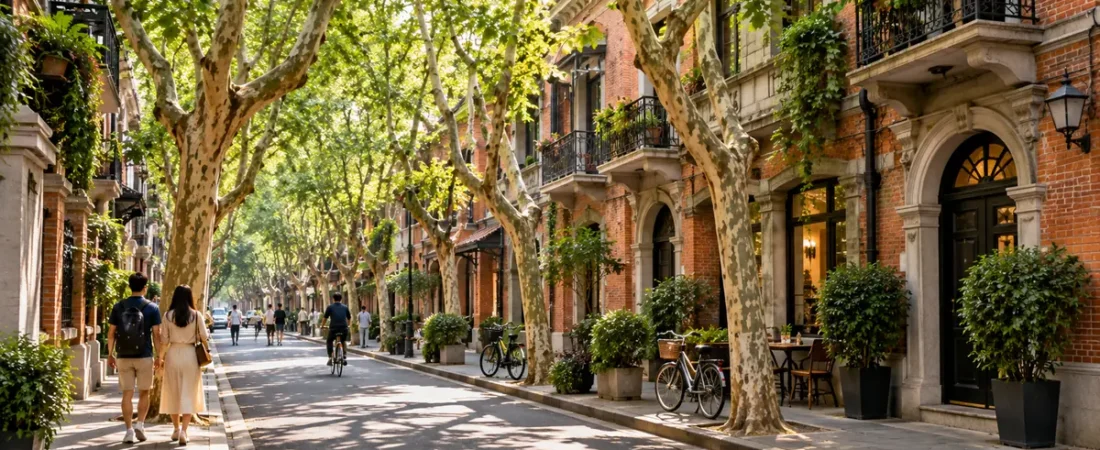
For travellers who prefer neighbourhood character to skyscraper views, the historic areas commonly referred to as the Former French Concession are particularly appealing.
Tree-lined streets, older villas, lane houses, cafés, boutiques and restaurants create a noticeably different atmosphere from central Pudong or Nanjing Road.
Wukang Road and the surrounding historic streets are especially popular for walking.
Why Stay Here?
This is one of Shanghai’s most enjoyable areas to explore slowly.
Instead of stepping directly from your hotel into a major tourist zone, you can spend mornings walking along leafy streets and discovering cafés, architecture and smaller neighbourhood businesses.
The atmosphere can feel more residential than around People’s Square or the Bund.
Potential Downsides
The Former French Concession covers a broad area rather than one precisely defined tourist district.
Metro convenience varies considerably according to your exact hotel.
Some accommodation can also be expensive because the neighbourhood is highly desirable.
Best for: couples, café lovers, photographers and travellers who enjoy walking through historic neighbourhoods.
5. Xintiandi – Best for Dining and Evening Atmosphere
Xintiandi combines restored shikumen architecture with restaurants, cafés, shops and nightlife.
The pedestrianised streets make it an attractive area for an evening walk.
Its central location also provides convenient access to several other sightseeing areas.
Why Stay in Xintiandi?
You have a large choice of restaurants and evening venues close to your accommodation.
The area’s architecture also provides more historic character than a typical modern commercial district.
Xintiandi can work particularly well for travellers who want to finish sightseeing and still have plenty happening near their hotel.
Potential Downsides
The neighbourhood is polished and heavily commercialised.
Dining and accommodation can be relatively expensive.
Travellers looking for a quieter or more everyday residential atmosphere may prefer nearby historic streets instead.
Best for: couples, nightlife, dining and travellers who enjoy stylish pedestrian districts.
6. Lujiazui – Best for Modern Shanghai
Lujiazui sits across the Huangpu River from the Bund and forms the heart of Shanghai’s famous Pudong skyline.
The district contains the Oriental Pearl Tower, Shanghai Tower and numerous modern skyscrapers.
Luxury hotels occupy several high-rise buildings and can offer extraordinary views.
Why Stay in Lujiazui?
If futuristic Shanghai is what attracted you to the city, staying among its skyscrapers can be memorable.
The area is also convenient for business travellers with meetings in Pudong.
Modern shopping centres, restaurants and Metro connections are readily available.
Potential Downsides
Lujiazui can feel more business-oriented than neighbourhoods west of the river.
Many of Shanghai’s historic streets and traditional attractions are on the opposite side of the Huangpu.
You may therefore spend more time using public transport if most of your sightseeing is in Puxi.
Best for: luxury travellers, business trips, skyscraper views and modern architecture.
7. Hongqiao – Best for Transport Connections
Hongqiao is considerably west of Shanghai’s traditional sightseeing centre.
For a normal first-time holiday focused on the Bund, Yu Garden and central neighbourhoods, it wouldn’t usually be my first choice.
However, it can be extremely practical for certain itineraries.
Shanghai Hongqiao Railway Station is a major high-speed rail hub, while Hongqiao International Airport is nearby.
Why Stay Near Hongqiao?
Consider this area if you have an early train, late arrival, short overnight connection or several rail trips planned from Shanghai.
It can reduce unnecessary cross-city journeys with luggage.
Potential Downsides
You’ll be much farther from the Bund and many central sightseeing districts.
Saving money on a hotel isn’t necessarily worthwhile if you spend substantial time commuting every day.
Best for: overnight connections, business travel and train-heavy itineraries.
How Much Does Accommodation Cost in Shanghai?
Shanghai has accommodation ranging from inexpensive hostels to some of China’s most luxurious hotels.
As broad planning estimates:
Budget Accommodation
Hostels and simple accommodation may start around ¥100–¥300 per night, although central private rooms usually cost more.
Mid-Range Hotels
A comfortable mid-range hotel might cost approximately ¥400–¥900 per night.
Location, season and hotel quality can move rates significantly.
Higher-End Hotels
Upscale hotels often begin around ¥1,000 per night, while luxury properties with prime Bund or Pudong views can cost substantially more.
Hotel prices are highly date-sensitive.
Major holidays, exhibitions, conferences and popular weekends can increase rates considerably.
Which Side of Shanghai Should You Stay On?
Visitors will often hear the terms Puxi and Pudong.
Puxi broadly refers to the older urban areas west of the Huangpu River. This includes many visitor districts such as the Bund, People’s Square, Jing’an and the historic neighbourhoods around the Former French Concession.
Pudong lies east of the river and includes Lujiazui and Shanghai’s famous modern skyline.
For most first-time leisure visitors, Puxi is generally the more convenient base because a larger concentration of traditional sightseeing areas lies on that side.
However, staying in Pudong can be an excellent choice if you prefer modern hotels, skyline views or have business there.
Where to Stay in Shanghai Without a Car
Almost every international visitor should plan to rely primarily on public transport rather than renting a car.
Shanghai’s Metro network makes this practical.
When comparing hotels, check:
- The walking distance to the nearest Metro station.
- Which Metro line serves that station.
- Whether reaching your main sightseeing areas requires several transfers.
A slightly less central hotel beside a useful Metro station can be more convenient than a theoretically central hotel requiring a long walk every morning.
Where to Stay in Shanghai for 3 Days
For a short 3-day visit, prioritise convenience.
People’s Square, the Bund, Jing’an or Xintiandi are all strong options.
They allow you to divide your time efficiently between central Shanghai, historic neighbourhoods and Pudong.
Avoid choosing accommodation far from the centre purely to save a small amount of money. On a short trip, your time has value too.
Where to Stay for Families
Families may prefer quieter parts of Jing’an or the historic residential districts rather than the busiest sections around Nanjing Road.
Look for larger rooms, convenient Metro access and nearby restaurants.
If Shanghai Disneyland is the main purpose of your visit, staying closer to the resort for part of the trip can make sense because it is far from many central attractions.
Families combining Disneyland with central sightseeing could also consider splitting their stay.
Where to Stay for Couples
The historic neighbourhoods around the Former French Concession are particularly attractive for couples.
Tree-lined streets, restaurants, cafés and evening walks create a more relaxed setting than the busiest commercial districts.
The Bund is another strong option if skyline views and landmark hotels are priorities.
Xintiandi suits couples who want restaurants and nightlife close by.
Where to Stay for Nightlife
Xintiandi provides an easy combination of restaurants, bars and evening atmosphere.
Jing’an also has extensive nightlife and dining options spread throughout the district.
Shanghai’s nightlife isn’t confined to one neighbourhood, so check where the particular venues you’re interested in are located before choosing accommodation solely around nightlife.
Where to Stay for Luxury Hotels
Both the Bund and Lujiazui contain some of Shanghai’s most impressive luxury properties.
Choose the Bund if you want historic surroundings and views towards Pudong.
Choose Lujiazui if you want to stay within the futuristic skyline and potentially look back towards the historic Bund.
High-rise rooms can offer spectacular views, but check the room category carefully because not every room in a skyline hotel faces the landmark view.
Where to Stay on a Budget
Look beyond the immediate Bund waterfront and premium parts of Xintiandi.
Properties near useful Metro stations in less tourist-heavy neighbourhoods can offer better value.
However, always calculate the trade-off between price and location.
Saving ¥100 per night isn’t necessarily worthwhile if your hotel requires long daily journeys to reach every attraction.
Tips for Booking a Shanghai Hotel
Check the property’s exact location on a map rather than relying only on the neighbourhood name.
Confirm the walking distance to the nearest Metro station.
International travellers should also verify that the accommodation accepts foreign guests and can complete the required guest registration.
Check recent reviews for noise, cleanliness, room size and air conditioning.
During major Chinese public holidays, book well ahead.
If a skyline view matters to you, reserve the correct room category rather than assuming every room has the same outlook.
Finally, keep the hotel’s address saved in both English and Chinese. This can be extremely useful when taking a taxi or asking for assistance.
Which Shanghai Area Is Best for You?
Choose People’s Square if convenience is your priority.
Choose the Bund for classic Shanghai scenery.
Choose Jing’an for an excellent balance of transport, restaurants and city life.
Choose the Former French Concession for leafy streets and historic atmosphere.
Choose Xintiandi for dining and nightlife.
Choose Lujiazui for skyscrapers and luxury hotels.
Choose Hongqiao when railway or airport connections matter more than sightseeing location.
For most first-time visitors, the safest strategy is simple: stay somewhere central and within a short walk of a Metro station.
Shanghai is too large to walk everywhere, but choosing the right base makes exploring the city considerably easier.
Explore more places through our destinations page or browse our complete collection of itineraries.