
Berlin proves that a memorable city break does not need to revolve around expensive attractions. Some of the capital’s most important landmarks, public spaces, memorials and historical sites can be experienced without paying an admission fee.
From walking beside surviving sections of the Berlin Wall to cycling along an old airport runway, the city offers plenty to travellers watching their spending. This guide covers the best free things to do in Berlin, along with practical tips for planning your visits.
Price note: All prices in this article are approximate and were checked at the time of publication. Prices may change.
1. See Brandenburg Gate
Brandenburg Gate is Berlin’s most recognisable landmark and an excellent place to begin exploring the city. Built in the late 18th century, it has witnessed imperial ceremonies, Nazi rallies, Cold War division and German reunification.
The gate stands at the eastern end of Tiergarten, facing Pariser Platz. You can walk through the square and view the monument from either side at any time without an admission fee.
Visit early in the morning if you want photographs with fewer people. The gate is also striking after dark, when its columns are illuminated.
Several important sights are within easy walking distance, including the Reichstag, the Memorial to the Murdered Jews of Europe and Unter den Linden. Our Berlin travel guide explains how these landmarks fit into a first visit to the city.
2. Visit the Reichstag dome
The glass dome above the Reichstag offers one of Berlin’s best free viewpoints. A gently rising walkway leads around the inside of the dome, revealing views over the government district, Tiergarten and the wider city.
The building is home to the German Bundestag, and the dome’s modern glass design symbolises political transparency. An audio guide available during the visit explains the surrounding landmarks and the parliamentary building below.
Admission to the dome and roof terrace is free, but advance registration is required. You will need to select an available time and provide the requested visitor details. Bring the identification specified in your confirmation and allow time for the security check.
Opening arrangements can change because of parliamentary business, maintenance or special events, so confirm your visit through the German Bundestag’s official visitor information before going.
3. Walk through the Memorial to the Murdered Jews of Europe
A short walk from Brandenburg Gate brings you to the Memorial to the Murdered Jews of Europe, also known as the Holocaust Memorial.
Its Field of Stelae contains 2,711 concrete blocks arranged across uneven ground. The paths become deeper and more enclosed toward the centre, creating an intentionally unsettling and reflective experience.
Walking through the memorial is free. This is a place of remembrance rather than a conventional tourist attraction, so visitors should behave respectfully and avoid climbing, sitting or posing inappropriately on the concrete blocks.
An underground information centre provides historical context and personal stories of Jewish families affected by the Holocaust. Security procedures, capacity limits and opening arrangements may apply, so check current visitor information if you intend to enter.
4. Explore the East Side Gallery
The East Side Gallery stretches for approximately 1.3 kilometres beside the River Spree, making it one of the world’s longest open-air galleries.
After the Berlin Wall opened in 1989, artists from numerous countries transformed this surviving section into a series of murals addressing freedom, political change and reunification. Several works have become internationally recognised symbols of Berlin.
The gallery is outdoors and free to visit. Walk the full length rather than stopping only at its most photographed murals; the less crowded sections offer more room to study the artwork and think about the structure’s original purpose.
Ostbahnhof and Warschauer Straße are useful public-transport points for opposite ends of the gallery. From the southern end, continue toward Oberbaum Bridge for another excellent free view.
5. Cross Oberbaum Bridge
Oberbaum Bridge spans the Spree between Friedrichshain and Kreuzberg. Its red-brick towers, arched upper railway level and waterside setting make it one of Berlin’s most distinctive bridges.
During the Cold War, the bridge crossed the border between East and West Berlin. Today, pedestrians, cyclists, road traffic and U-Bahn trains share the crossing.
Walk across for views of the river, the Molecule Man sculpture and the modern buildings along the waterfront. The bridge is particularly atmospheric around sunset, when the light catches its brickwork and the riverside begins to fill with evening activity.
Combining Oberbaum Bridge with the East Side Gallery creates an easy free outing and introduces two neighbourhoods with very different personalities.
6. Follow the Berlin Wall Memorial
The Berlin Wall Memorial on Bernauer Strasse is one of the best places to understand how the border divided ordinary streets and communities.
The outdoor memorial extends along the former border strip. Information panels, photographs and preserved elements explain the barriers, escape attempts and experiences of residents whose homes once stood directly beside the Wall.
A reconstructed section shows that the Berlin Wall was not simply one concrete barrier. It was a fortified system that included inner and outer walls, patrol areas and watchtowers.
Allow at least an hour for the outdoor route, and longer if you want to read the displays carefully. The memorial grounds are free to explore. Visitor-centre and observation-platform hours may differ from access to the outdoor area, so check current arrangements before making a special journey.
7. Visit the Topography of Terror
The Topography of Terror documentation centre occupies the former site of institutions that directed Nazi persecution and terror, including the Gestapo, SS leadership and Reich Security Main Office.
Its permanent exhibition examines how these organisations operated and identifies many of the people responsible for their crimes. A preserved portion of the Berlin Wall also runs beside the grounds.
Admission is free. The documentation centre’s published opening hours are generally daily from 10:00 to 20:00, although holiday closures or other changes can occur.
This is a detailed, text-rich museum rather than a quick photo stop. Give yourself at least 90 minutes and approach the material at a comfortable pace.
8. Relax in Tiergarten
Tiergarten is Berlin’s large central park, stretching west from Brandenburg Gate. Its wooded paths, lawns, waterways and monuments offer a welcome break from museums and traffic.
Walking through the park costs nothing, and there is no single route you must follow. You can cross it on the way to the Victory Column, find a quiet bench beside the water or bring food for a simple picnic.
The park changes considerably with the seasons. Spring brings fresh greenery, summer is ideal for long afternoons outside, autumn adds colourful foliage, and winter reveals clearer views through the trees. For help choosing a season, see our guide to the best time to visit Berlin.
Tiergarten is large enough that it helps to check your onward route before entering. Stick to busier paths after dark and remember that cycling is permitted only where indicated.
9. Experience Tempelhofer Feld
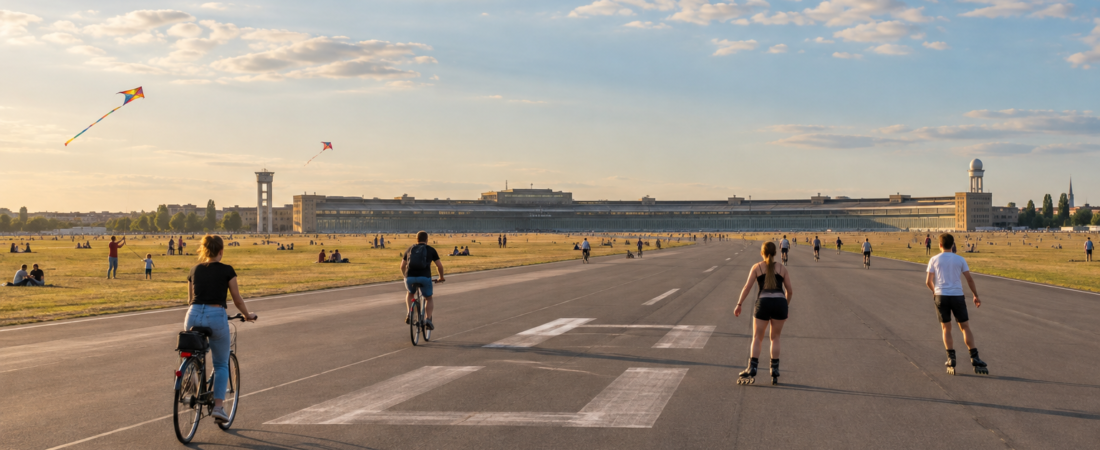
Tempelhofer Feld is one of Berlin’s most unusual public spaces. The enormous park occupies the airfield of the former Tempelhof Airport, and its broad runways are now used by cyclists, runners, skaters and people flying kites.
The open landscape feels remarkably spacious for a site surrounded by dense city neighbourhoods. Community gardens, picnic areas and wide grassy sections make it easy to spend several hours here without buying anything.
Entry to the public park is free. Its gates follow seasonal opening and closing times, so check the posted schedule and allow enough time to reach an exit before closing.
Bring water and sun protection during warm weather because much of the former airfield is exposed. Renting equipment or joining a guided airport-building tour costs extra, but simply walking, exercising or relaxing on the field does not.
10. Wander around Museum Island and Unter den Linden
The museums on Museum Island normally charge admission, but exploring the surrounding architecture and riverbanks is free.
Walk around the Berlin Cathedral, the Neues Museum, the Alte Nationalgalerie and the reconstructed Berlin Palace, now home to the Humboldt Forum. Even without entering, the area provides an impressive overview of Berlin’s monumental architecture.
Continue along Unter den Linden to see Bebelplatz, Humboldt University and the Neue Wache memorial. The route eventually leads toward Brandenburg Gate, making it easy to include in a larger central-Berlin walk.
If museums are a priority, compare individual tickets with the relevant museum passes before paying at several separate attractions. Our Berlin travel budget covers the main costs to consider when planning the rest of your trip.
11. Spend time in Mauerpark
Mauerpark occupies part of the former Berlin Wall border zone between Prenzlauer Berg and Gesundbrunnen. Its name literally means “Wall Park,” and remnants of the city’s divided past remain visible around it.
The park is popular for picnics, informal performances and people-watching. Sundays are usually the liveliest time, when the surrounding market and public activities attract large crowds.
Entering and walking through the park is free, although food, drinks, market purchases and some organised activities cost money. If you prefer a calmer experience, visit on a weekday or earlier in the morning.
From Mauerpark, you can walk to the Berlin Wall Memorial on Bernauer Strasse, creating a longer route through sites connected to the former border.
12. Discover Berlin’s neighbourhoods on foot
One of the best free things to do in Berlin is simply choosing a neighbourhood and exploring it without a rigid checklist.
Kreuzberg offers street art, canals and busy multicultural streets. Friedrichshain combines remnants of East Berlin with creative spaces and nightlife. Prenzlauer Berg has restored residential streets, courtyards and relaxed squares, while Charlottenburg presents a more elegant western side of the city.
Walking through these areas reveals details easily missed from a tour bus: memorial plaques, small parks, architectural contrasts and traces of the former East–West divide.
Use our guide to where to stay in Berlin to understand the character and transport advantages of the main neighbourhoods.
Book Your Berlin Experiences
Ready to start planning? Compare popular Berlin tours and activities, check current prices and availability, and book the experiences that suit your trip.
Affiliate disclosure: If you book through these links, we may earn a commission from Viator. This does not increase the price you pay.
A one-day free Berlin route
If you have only one day, begin at the Reichstag with a pre-booked dome visit. Continue to Brandenburg Gate and the Memorial to the Murdered Jews of Europe before walking along Unter den Linden toward Museum Island.
After lunch, take public transport to the East Side Gallery. Follow the wall to Oberbaum Bridge and cross into Kreuzberg for an evening neighbourhood walk.
This route includes several major attractions without admission fees, although you will still need to budget for transport and food. For a fuller schedule combining free and paid sights, follow our 3 days in Berlin itinerary.
Tips for enjoying Berlin for free
Reserve the Reichstag dome as early as possible, especially if you are visiting at a busy time. Free admission does not guarantee last-minute availability.
Group attractions by area to reduce transport costs. Brandenburg Gate, the Reichstag, Tiergarten and the Holocaust Memorial are close together, while the East Side Gallery pairs naturally with Oberbaum Bridge.
Carry a refillable water bottle and use public drinking fountains where available. Packing a picnic is also an easy way to enjoy Tiergarten or Tempelhofer Feld without paying restaurant prices.
Remember that “free” does not always mean “open at all hours.” Museums, visitor centres, memorial exhibitions and gated parks may have fixed or seasonal schedules. Check current opening information shortly before your visit.
Finally, leave some unplanned time. Berlin’s courtyards, canals, neighbourhood streets and public spaces are an essential part of its character, and discovering them costs nothing.
Explore more places through our destinations page or browse our complete collection of itineraries.