
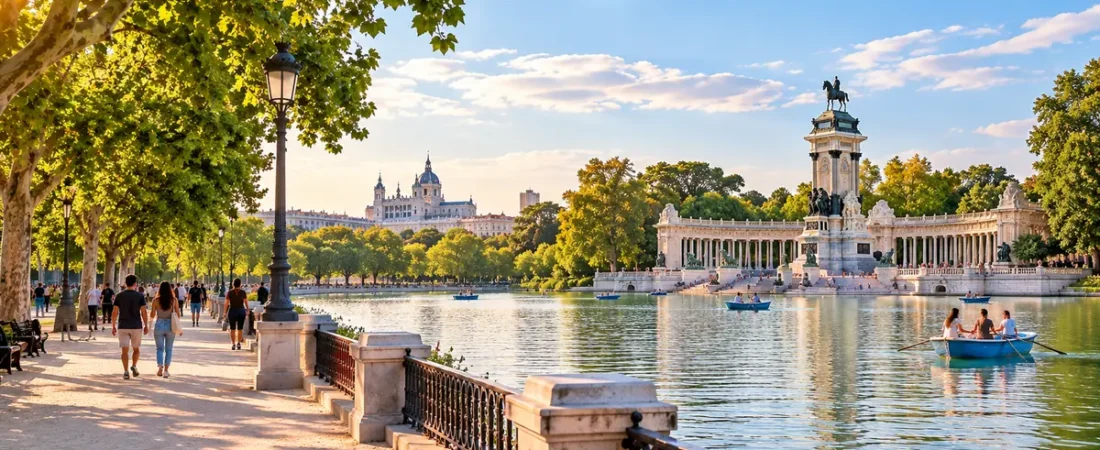
Madrid may be famous for world-class museums, grand palaces and lively restaurants, but you do not need to spend heavily to enjoy Spain’s capital. Some of the best free things to do in Madrid include beautiful parks, historic squares, panoramic viewpoints, neighbourhood walks, museums and even masterpieces by artists such as Goya, Picasso and Velázquez during designated free-entry periods.
Whether you are visiting Madrid on a tight budget or simply want to balance paid attractions with free experiences, there is enough to fill several days without paying admission.
Price note: All prices in this article are approximate and were checked at the time of publication. Prices may change.
If this is your first visit, start with our Madrid Travel Guide for an overview of the city’s attractions, neighbourhoods and transport. You can also follow our 3 Days in Madrid Itinerary to organise these sights efficiently.
1. Walk Through El Retiro Park
El Retiro is one of Madrid’s greatest free attractions and one of the easiest places to spend several hours without spending anything.
The huge historic park contains tree-lined avenues, monuments, fountains, gardens and the famous lake beside the Monument to Alfonso XII.
Walking around the lake and exploring the quieter paths costs nothing.
The park and nearby Paseo del Prado form part of Madrid’s UNESCO-listed Landscape of Light.
Cost: Free.
Optional paid activity: Hiring a rowing boat on the lake costs extra.
2. Watch the Sunset at the Temple of Debod
The Temple of Debod is one of Madrid’s most unusual landmarks.
The ancient Egyptian temple was donated to Spain and reconstructed near Parque del Oeste. The surrounding viewpoint is particularly popular around sunset because it faces west across Casa de Campo.
Entry to the temple itself is also free, although capacity is limited and advance reservation is recommended.
Current general opening hours vary between winter and summer, and the interior may occasionally close for conservation or security reasons.
Even if you do not enter the temple, the surrounding gardens and sunset viewpoint make this one of Madrid’s best free evening activities.
Cost: Free.
3. Explore Plaza Mayor
Plaza Mayor is one of Madrid’s essential historic squares.
Walk through its arched entrances, admire the red façades and see the equestrian statue of Philip III in the centre.
The square has hosted markets, celebrations and public events throughout its long history.
Simply exploring the plaza costs nothing.
Cost: Free.
Optional paid activity: Restaurants, cafés and souvenir shops around the square charge separately.
4. Experience Puerta del Sol
Puerta del Sol is one of Madrid’s busiest meeting places and a natural starting point for exploring the centre.
Look for the famous Bear and Strawberry Tree statue, the equestrian statue of Charles III and the Kilometre Zero marker.
The square is also home to the clock whose bells mark Spain’s traditional New Year’s Eve celebrations.
From here you can easily walk toward Plaza Mayor, Gran Vía or the Royal Palace.
Cost: Free.
5. Walk Along Gran Vía
Madrid’s most famous commercial avenue is an attraction in itself.
Gran Vía is lined with elaborate early-20th-century architecture, theatres, cinemas, shops and rooftop buildings.
Walk the avenue during daylight and return after dark to see its illuminated signs and busy evening atmosphere.
Window-shopping is completely free.
Cost: Free.
6. Explore the Royal Palace Surroundings
Entering the Royal Palace normally requires a ticket, but exploring its surroundings costs nothing.
Walk through Plaza de Oriente, admire the palace exterior and continue toward Almudena Cathedral.
The area is especially attractive in the early morning when the streets are quieter.
You can combine this part of Madrid with several other free attractions nearby.
Cost: Free outside.
Optional paid activity: Entry to the main Royal Palace visitor route costs extra.
7. Visit the Mirador de la Cornisa
Between the Royal Palace and Almudena Cathedral is one of central Madrid’s most accessible free viewpoints.
The Mirador de la Cornisa overlooks Campo del Moro and Casa de Campo and provides a completely different perspective from Madrid’s busy central streets.
It is particularly attractive later in the day.
Cost: Free.
8. Visit Almudena Cathedral
Madrid’s cathedral stands immediately opposite the Royal Palace and can be visited without a standard admission fee for the main cathedral space.
Its relatively modern interior differs considerably from many of Europe’s older Gothic cathedrals.
Take time to look at the colourful ceiling and contemporary details.
Cost: Main cathedral generally free.
Optional paid activity: Separate museum or dome areas may have admission charges. Donations may also be invited.
9. Relax in the Sabatini Gardens
The formal Sabatini Gardens sit beside the Royal Palace and offer carefully arranged hedges, sculptures and impressive views of the palace façade.
They are a good place for a quiet break while exploring central Madrid.
Because the gardens are close to Plaza de España, the Royal Palace and Temple of Debod, they fit easily into a walking itinerary.
Cost: Free.
10. Explore Campo del Moro Gardens
Behind the Royal Palace, Campo del Moro feels surprisingly peaceful considering its central location.
The landscaped gardens cover more than 20 hectares and provide one of the most impressive ground-level views of the palace.
Admission is free.
Opening hours vary according to the season, weather and official events, so check before visiting.
A restored section of the historic Bonaparte Tunnel also became accessible free of charge in 2026 during garden opening hours.
Cost: Free.
11. Walk Through Plaza de España
Plaza de España underwent a major redesign that made the area much more pleasant for pedestrians.
The square features the monument to Miguel de Cervantes with figures of Don Quixote and Sancho Panza.
It also provides an easy pedestrian connection between Gran Vía, the Royal Palace area and Temple of Debod.
Cost: Free.
12. Explore Madrid Río
Madrid Río follows the Manzanares River and offers kilometres of paths, landscaped areas, bridges, playgrounds and recreational spaces.
It is a particularly good free activity for families or travellers who want a break from museums and historic streets.
Walking and relaxing in the park cost nothing.
Cost: Free.
Optional paid activities: Food, bicycle rentals and some nearby entertainment venues cost extra.
13. Visit Casa de Campo
Casa de Campo is Madrid’s enormous western park and one of the best places to escape the city without actually leaving it.
Walking trails, open landscapes and the lake area provide plenty of free recreation.
It is large enough that you can spend several hours here.
Cost: Free.
Optional paid activities: Madrid Zoo, the amusement park, cable-car journeys and other commercial attractions require tickets.
14. Discover the Goya Frescoes at San Antonio de la Florida
One of Madrid’s most remarkable free cultural experiences is hidden inside a relatively modest chapel near Madrid Río.
The San Antonio de la Florida Chapel contains original frescoes painted by Francisco de Goya in the late 18th century. Goya’s remains are also buried here.
Admission is free.
It is generally open Tuesday to Sunday, although summer hours differ and the chapel closes on Mondays and certain holidays.
Cost: Free.
15. Visit the History of Madrid Museum
The Museo de Historia de Madrid provides an excellent introduction to how the city developed after becoming Spain’s capital in 1561.
Its large collection includes paintings, maps, photographs, sculptures, decorative arts and a remarkable historic scale model of Madrid.
Most importantly for budget travellers, admission is free.
The museum is generally open Tuesday to Sunday, with seasonal variations.
Cost: Free.
16. Visit the Museum of San Isidro
The Museo de San Isidro focuses on Madrid’s earliest history, archaeology and the story of the city’s patron saint.
Located in La Latina, it makes an excellent addition to a walking tour through one of Madrid’s oldest neighbourhoods.
The museum includes archaeological objects as well as surviving historic sections of the original building.
Admission is free.
Cost: Free.
17. Visit the Naval Museum
Madrid’s Naval Museum contains an extensive collection devoted to Spain’s maritime history.
Displays include historic maps, ship models, paintings, navigational instruments and objects connected with centuries of naval exploration.
The Spanish Navy currently lists museum admission as free.
The museum is normally open Tuesday to Sunday and closes during August for maintenance.
Cost: Free.
18. Visit the Prado During Free Hours
The Prado Museum normally charges admission, but individual visitors can access the museum free during designated evening periods.
Current free hours are:
Monday to Saturday: 6:00 pm–8:00 pm
Sundays and public holidays: 5:00 pm–7:00 pm
This gives budget travellers the opportunity to see works by Velázquez, Goya, El Greco and other major European artists without paying the normal admission price.
Expect queues, especially during busy travel periods.
If art is one of your main reasons for visiting Madrid, paying for a normal daytime visit may still be worthwhile because two hours is not enough to explore the enormous collection thoroughly.
Cost during designated free period: Free.
19. Visit the Reina Sofía During Free Hours
Madrid’s major modern-art museum also provides regular free-entry periods.
The Reina Sofía’s collection includes Picasso’s Guernica along with works by Dalí, Miró and many other artists.
Current free access at the main site is:
Monday and Wednesday to Saturday: 7:00 pm–9:00 pm
Sunday: 12:30 pm–2:30 pm
The museum is closed on Tuesdays.
A ticket is still required during the free period, and free access is for individual visitors.
Cost during designated free period: Free.
20. Walk Through Barrio de las Letras
Madrid’s Literary Quarter was associated with some of Spain’s greatest writers, including Miguel de Cervantes and Lope de Vega.
Today it is an atmospheric neighbourhood of narrow streets, historic buildings, cafés and small squares.
Look down as you walk along Calle de las Huertas to find literary quotations incorporated into the pavement.
Cost: Free.
21. Explore La Latina
La Latina is one of Madrid’s most enjoyable neighbourhoods for wandering without a fixed itinerary.
Its streets lead through historic plazas, churches and traditional buildings.
Plaza de la Paja and the surrounding lanes are particularly atmospheric.
You can combine La Latina with the nearby Museum of San Isidro for a completely free morning.
Cost: Free.
22. Browse El Rastro
Madrid’s famous open-air flea market takes place in the La Latina area, traditionally on Sundays and public holidays.
You do not need to buy anything to enjoy walking among stalls selling antiques, clothes, artwork, household items and collectibles.
Arrive relatively early if you prefer a calmer experience.
Cost: Free to browse.
Optional paid activity: Anything you purchase from the market.
23. Explore Malasaña
Malasaña offers a different side of Madrid from the monumental centre.
The neighbourhood is known for independent shops, street life, cafés and connections with Madrid’s post-Franco cultural movement known as La Movida Madrileña.
Walking through streets around Plaza del Dos de Mayo makes an easy free activity.
You can combine Malasaña with the free History of Madrid Museum nearby.
Cost: Free.
24. Walk the Paseo del Prado
Paseo del Prado forms part of Madrid’s UNESCO-listed Landscape of Light.
Walking the boulevard lets you see monumental fountains, historic buildings and the exteriors of some of Spain’s most important museums.
Look for the Neptune and Cibeles fountains as you explore the area.
Combine the walk with El Retiro for several hours of sightseeing without admission costs.
Cost: Free.
25. See Plaza de Cibeles
Plaza de Cibeles is one of Madrid’s most recognisable urban scenes.
The ornate Cibeles Fountain sits at the centre, surrounded by impressive architecture including the Palacio de Cibeles.
It is particularly photogenic in the evening when the surrounding buildings are illuminated.
Walking around the plaza and viewing the buildings from outside costs nothing.
Cost: Free.
Optional paid activity: Some interior exhibitions and viewpoint access may require tickets.
Book Your Madrid Experiences
Ready to start planning? Compare popular Madrid tours and activities, check current prices and availability, and book the experiences that suit your trip.
Affiliate disclosure: If you book through these links, we may earn a commission from Viator. This does not increase the price you pay.
How to Spend a Completely Free Day in Madrid
You can combine many of these attractions into a full day without paying admission.
Start at Puerta del Sol, walk to Plaza Mayor, continue toward the Royal Palace, visit Almudena Cathedral, stop at the Mirador de la Cornisa, and explore the Sabatini Gardens.
Continue through Plaza de España to the Temple of Debod.
Alternatively, spend the morning exploring Paseo del Prado and El Retiro, walk through the Barrio de las Letras, and finish with the Prado or Reina Sofía during their designated free-entry periods.
Our 3 Days in Madrid Itinerary can help you combine these areas without wasting time travelling back and forth across the city.
How to Keep Your Madrid Trip Affordable
Free attractions can significantly reduce your overall spending, but accommodation and food will still make up much of your trip cost.
Our Madrid Travel Budget explains typical costs for accommodation, meals, public transport and sightseeing, along with practical ways to reduce daily spending.
Where you stay also affects how much you spend. Choosing accommodation within walking distance of central attractions can reduce your dependence on public transport. Compare the main neighbourhoods in our Where to Stay in Madrid guide.
The season matters too. Accommodation rates, weather and crowd levels change throughout the year, so check our Best Time to Visit Madrid guide before deciding when to travel.
Tips for Visiting Madrid’s Free Attractions
Free museum periods are popular, so arrive early and expect queues.
Opening hours can change for public holidays, special events, maintenance or weather conditions. This is particularly relevant for gardens and outdoor attractions.
Do not try to visit every free attraction simply because it costs nothing. Madrid is best enjoyed at a relaxed pace, with time for neighbourhood walks, parks and cafés between major sights.
Plan geographically. Madrid’s historic centre is highly walkable, and grouping nearby attractions reduces both transport costs and wasted time.
Finally, remember that “free entry” does not always mean every activity at a location is free. Boat rentals, guided experiences, observation decks, exhibitions and other optional activities can carry separate charges.
Are Madrid’s Free Attractions Worth It?
Absolutely. Madrid is unusually rewarding for travellers who enjoy exploring on foot.
Some of the city’s defining experiences—walking through Plaza Mayor, watching sunset near the Temple of Debod, relaxing in Retiro Park, exploring La Latina and seeing the Royal Palace from its surrounding gardens—cost nothing.
Add Madrid’s permanently free municipal museums and carefully planned visits during the Prado and Reina Sofía free-entry periods, and you can experience an impressive amount of the Spanish capital without spending money on admission.
The best approach is to combine these free experiences with one or two paid attractions that genuinely matter to you. That keeps your Madrid trip affordable without feeling restrictive.
Explore more places through our destinations page or browse our complete collection of itineraries.