
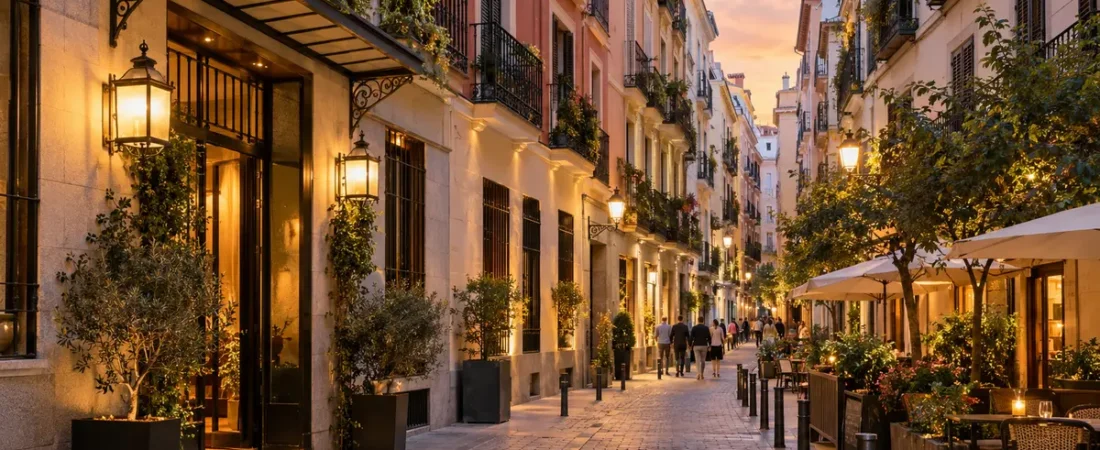
Choosing where to stay in Madrid can significantly affect your experience because each neighbourhood offers a different combination of sightseeing convenience, nightlife, restaurants, atmosphere and accommodation prices. First-time visitors will usually prefer the historic centre, while families, nightlife seekers and travellers looking for a quieter stay may be happier in other districts.
Price note: All prices in this article are approximate and were checked at the time of publication. Prices may change.
This guide compares Madrid’s best areas and explains which travellers each neighbourhood suits. For additional planning information, read our complete Madrid travel guide.
Where to Stay in Madrid: Quick Answer
Centro is the best overall area for first-time visitors. Staying near Puerta del Sol, Gran Vía or Plaza Mayor places Madrid’s historic streets, Royal Palace, restaurants and transport connections within easy reach.
However, Centro is busy, tourist-oriented and sometimes noisy. Consider these alternatives:
- Barrio de las Letras: Best for museums and culture
- La Latina: Best for tapas and historic atmosphere
- Chueca: Best for restaurants and nightlife
- Malasaña: Best for younger travellers and creative energy
- Salamanca: Best for luxury hotels and shopping
- Chamberí: Best for a quieter local experience
- Retiro and Atocha: Best for families, parks and train connections
Best Madrid Areas at a Glance
| Area | Best for | Main advantage | Possible drawback |
|---|---|---|---|
| Sol and Gran Vía | First-time visitors | Extremely central | Busy and potentially noisy |
| Barrio de las Letras | Art and culture | Walkable to major museums | Higher prices in popular periods |
| La Latina | Tapas and historic character | Lively local atmosphere | Weekend noise |
| Chueca | Dining and nightlife | Central and energetic | Active late into the night |
| Malasaña | Younger travellers | Cafés and independent shops | Nightlife noise |
| Salamanca | Luxury travellers | Elegant and quieter | Expensive |
| Chamberí | Longer stays | Residential atmosphere | Fewer major sights nearby |
| Retiro and Atocha | Families and rail travellers | Park and transport access | Less historic atmosphere |
1. Sol and Gran Vía: Best for First-Time Visitors
Sol and Gran Vía form the most convenient base for a first visit to Madrid. Puerta del Sol sits at the centre of the city, while Gran Vía provides shops, theatres, restaurants and excellent transport connections.
From this area, you can walk to Plaza Mayor, Mercado de San Miguel, the Royal Palace, Plaza de España, Chueca and Barrio de las Letras. Several metro lines also make journeys to Retiro Park and the Santiago Bernabéu straightforward.
Why Stay Near Sol or Gran Vía?
- Many attractions are within walking distance.
- Excellent metro and bus connections.
- Large selection of hotels, hostels and apartments.
- Restaurants and shops remain open late.
- Convenient for short visits and first-time travellers.
Possible Drawbacks
This is one of Madrid’s busiest districts. Streets around Sol, Callao and Gran Vía can remain noisy late into the evening, especially on weekends.
Before booking, check whether the room faces a major road or pedestrian street. Double glazing and interior-facing rooms can make a major difference.
Typical Accommodation Prices
- Hostel bed: €30–€60
- Budget private room: €90–€150
- Mid-range hotel: €150–€260
- Luxury hotel: From approximately €280
Best for: First-time visitors, short stays and travellers who want maximum convenience.
2. Barrio de las Letras: Best for Museums and Culture
Barrio de las Letras is one of Madrid’s most attractive central neighbourhoods. Its streets are associated with celebrated Spanish writers, including Miguel de Cervantes and Lope de Vega.
The Prado Museum, Thyssen-Bornemisza Museum and Reina Sofía Museum are all within walking distance. Retiro Park, Puerta del Sol and Plaza de Santa Ana are also nearby.
This area is particularly suitable for travellers following our 3 days in Madrid itinerary, because it sits between the historic centre and the main museum district.
Why Stay in Barrio de las Letras?
- Walkable to Madrid’s leading museums.
- Attractive historic streets and traditional buildings.
- Strong selection of restaurants and tapas bars.
- Central without feeling as intensely commercial as Gran Vía.
- Convenient for Retiro Park and Atocha station.
Possible Drawbacks
The streets around Plaza de Santa Ana and Calle de las Huertas can be lively at night. Accommodation prices also rise during weekends, holidays and major cultural events.
Typical Accommodation Prices
- Hostel bed: €30–€55
- Budget private room: €85–€145
- Mid-range hotel: €140–€240
- Boutique or luxury hotel: From approximately €240
Best for: Museum visitors, couples, culture lovers and travellers who want a central but atmospheric neighbourhood.
3. La Latina: Best for Tapas and Historic Character
La Latina is known for winding streets, traditional taverns, attractive squares and one of Madrid’s strongest tapas scenes. Calle de la Cava Baja is lined with restaurants and bars, while Plaza de la Paja offers a quieter historic setting.
The neighbourhood is close to Plaza Mayor and the Royal Palace but feels more residential than Sol. On Sunday mornings, the nearby El Rastro market brings large crowds to the surrounding streets.
Why Stay in La Latina?
- Excellent tapas bars and traditional restaurants.
- Easy walk to Plaza Mayor and the Royal Palace.
- Historic streets with plenty of character.
- Active evening atmosphere.
- Good choice for travellers who enjoy eating out.
Possible Drawbacks
Cava Baja and nearby streets can become noisy on Friday and Saturday nights. El Rastro also makes parts of the neighbourhood particularly crowded on Sunday mornings.
The area contains slopes, cobbled streets and older buildings. Check whether your accommodation has a lift if stairs or luggage could be difficult.
Typical Accommodation Prices
- Hostel bed: €25–€50
- Budget private room: €75–€135
- Mid-range hotel or apartment: €130–€220
- Upscale accommodation: From approximately €220
Best for: Food lovers, couples, repeat visitors and travellers seeking historic atmosphere.
4. Chueca: Best for Restaurants and Nightlife
Chueca is a central, inclusive and energetic neighbourhood known for restaurants, cafés, independent shops and nightlife. It is within walking distance of Gran Vía, Malasaña, Salamanca and Puerta del Sol.
Plaza de Chueca forms the neighbourhood’s social centre, while Mercado de San Antón provides food counters and rooftop dining. The area is particularly welcoming to LGBTQ+ travellers and hosts some of Madrid’s most prominent Pride celebrations.
Why Stay in Chueca?
- Outstanding choice of restaurants and cafés.
- Very central location.
- Easy access to several metro stations.
- Vibrant and inclusive atmosphere.
- Good connection between Centro and Salamanca.
Possible Drawbacks
Chueca remains active late into the night. Rooms close to bars, clubs or busy squares may experience noise, especially at weekends.
Accommodation demand can increase substantially during Madrid Pride and other major events, so reserve early if travelling during a festival period.
Typical Accommodation Prices
- Hostel bed: €30–€60
- Budget private room: €90–€150
- Mid-range hotel: €150–€250
- Boutique or luxury hotel: From approximately €250
Best for: Nightlife, dining, LGBTQ+ travellers, couples and visitors who want a lively central base.
5. Malasaña: Best for Younger Travellers and Creative Energy
Malasaña has a youthful atmosphere built around independent cafés, vintage shops, casual restaurants, street art and nightlife. Plaza del Dos de Mayo is one of its main gathering places.
The neighbourhood is close to Gran Vía and Chueca but feels less focused on traditional sightseeing. It suits travellers who enjoy exploring local businesses and spending evenings in relaxed bars.
Why Stay in Malasaña?
- Independent cafés, shops and restaurants.
- Energetic nightlife.
- Walkable to Gran Vía, Chueca and Plaza de España.
- Good selection of hostels and apartments.
- Creative, informal atmosphere.
Possible Drawbacks
Noise is the main concern. Ask whether your room faces the street, a courtyard or an internal lightwell. Older buildings may also have small lifts or no lift at all.
The nightlife-focused atmosphere may not suit travellers seeking early evenings or complete quiet.
Typical Accommodation Prices
- Hostel bed: €25–€55
- Budget private room: €80–€145
- Mid-range hotel: €135–€225
- Boutique accommodation: From approximately €220
Best for: Younger travellers, friends, solo visitors and people interested in nightlife and independent businesses.
6. Salamanca: Best for Luxury and Shopping
Salamanca is Madrid’s most polished accommodation area, with elegant residential streets, luxury hotels, designer shops and refined restaurants. Calle de Serrano is the district’s best-known shopping avenue.
The neighbourhood lies northeast of Retiro Park. Metro connections make it easy to reach the historic centre, while the calmer streets provide a welcome break from Sol and Gran Vía.
Why Stay in Salamanca?
- Excellent luxury and upscale hotels.
- Elegant, orderly streets.
- Premium shopping and restaurants.
- Quieter evenings than the historic centre.
- Convenient access to Retiro Park.
Possible Drawbacks
Salamanca is one of Madrid’s most expensive areas. Budget accommodation is limited, and most historic attractions require a metro journey or a longer walk.
The neighbourhood also feels more modern and residential than Plaza Mayor or La Latina, so it may not deliver the classic old-Madrid atmosphere some visitors expect.
Typical Accommodation Prices
- Budget private room: €110–€170
- Mid-range hotel: €170–€280
- Luxury hotel: €300–€600 or more
Best for: Luxury travellers, shopping trips, business visitors and couples seeking a quieter upscale base.
7. Chamberí: Best for a Quieter Local Experience
Chamberí is a largely residential district north of the city centre. It offers traditional taverns, neighbourhood markets, cafés and good metro connections without the constant tourist traffic found around Sol.
The district is spread across several smaller neighbourhoods. Areas near Bilbao, Alonso Martínez, Iglesia and Quevedo stations are particularly convenient.
Why Stay in Chamberí?
- More local and residential atmosphere.
- Good restaurants without central-tourist crowds.
- Convenient metro connections.
- Often quieter at night.
- Suitable for longer visits.
Possible Drawbacks
Most major attractions are not immediately outside your hotel. You will use the metro more frequently, although the journey into Centro is usually short.
Chamberí also covers a large area, so verify the walking distance to the nearest metro station rather than relying only on the district name.
Typical Accommodation Prices
- Budget private room: €70–€130
- Mid-range hotel: €120–€210
- Upscale accommodation: From approximately €210
Best for: Longer stays, repeat visitors, couples and travellers who prefer residential neighbourhoods.
8. Retiro and Atocha: Best for Families and Train Travellers
The areas surrounding Retiro Park and Atocha station offer convenient accommodation for families, museum visitors and travellers arriving by train.
Retiro provides open space, playgrounds, walking paths and the boating lake. Atocha offers rail connections to cities including Barcelona, Seville, Valencia and Málaga, as well as suburban Cercanías services.
Why Stay Near Retiro or Atocha?
- Easy access to Retiro Park.
- Convenient for the Prado and Reina Sofía museums.
- Excellent rail connections from Atocha.
- More open space than the compact historic centre.
- Useful for families and early train departures.
Possible Drawbacks
The immediate surroundings of Atocha feel more functional than atmospheric. Some streets experience heavy traffic, and the area does not offer the same evening character as La Latina or Chueca.
Choose accommodation closer to Retiro or Barrio de las Letras if ambience is more important than station access.
Typical Accommodation Prices
- Hostel bed: €25–€50
- Budget private room: €75–€135
- Mid-range hotel: €130–€220
- Upscale accommodation: From approximately €220
Best for: Families, museum visitors, rail travellers and people taking day trips.
Best Madrid Area by Traveller Type
Best for First-Time Visitors
Choose Sol, Gran Vía or Barrio de las Letras. These areas minimise transport time and provide straightforward access to the major attractions.
Best for Families
Choose Retiro, eastern Barrio de las Letras or quieter streets in Salamanca. These areas provide more space and easier access to parks.
Check whether the hotel offers family rooms, lifts, breakfast and soundproofing. Older central buildings sometimes have small rooms and limited lift access.
Best for Couples
Choose Barrio de las Letras, La Latina or Salamanca. Barrio de las Letras offers the strongest balance of restaurants, atmosphere and sightseeing convenience.
Best for Nightlife
Choose Chueca, Malasaña or La Latina. Always read recent reviews mentioning street noise before confirming a booking.
Best for Budget Travellers
Look around Lavapiés, Atocha, Malasaña or the outer parts of Centro. Staying near a metro station outside the most famous streets can reduce costs while keeping travel times short.
Best for Luxury Travellers
Choose Salamanca, Gran Vía or the area around Paseo del Prado. These districts contain many of Madrid’s leading luxury and boutique hotels.
Best for Longer Stays
Choose Chamberí or a residential area near Retiro. Apartments, supermarkets and less tourist-oriented restaurants make daily life easier.
Areas Requiring Extra Consideration
Madrid is generally manageable for visitors, but accommodation choice should account for noise, building access and the immediate street environment.
Parts of Sol, Gran Vía, Chueca, Malasaña and La Latina remain active late at night. A property can have excellent reviews and still be unsuitable for light sleepers.
Lavapiés offers multicultural restaurants, creative venues and some affordable rooms. However, the atmosphere varies from street to street. Read recent accommodation reviews and check the precise location before booking.
Areas far outside the M-30 ring road may provide lower rates, but daily transport time can outweigh the savings during a short trip.
How Far in Advance Should You Book?
For spring, autumn, public holidays and major events, reserve accommodation approximately two to four months ahead. Luxury hotels, family rooms and highly rated budget properties can sell out earlier.
Summer can produce a mixture of lower business-travel demand and high leisure demand. Air conditioning is essential during July and August.
December weekends, football matches, trade fairs, festivals and Madrid Pride can increase prices substantially. Always check the city’s event calendar before deciding that a particular weekend is unusually expensive.
Madrid Accommodation Booking Tips
- Check the exact address rather than relying only on the neighbourhood name.
- Measure the walking distance to the nearest metro station.
- Read recent reviews about noise, air conditioning and cleanliness.
- Confirm that older buildings have a lift.
- Choose refundable rates when your travel plans are uncertain.
- Check whether taxes and service charges are included.
- Confirm reception hours if arriving late.
- Look for luggage storage when your flight or train departs in the evening.
- Avoid transferring payment outside the official booking platform.
- For apartments, review check-in procedures and local registration requirements.
- During summer, confirm that the room has proper air conditioning rather than only a fan.
- If driving, ask about parking and Madrid’s low-emission restrictions before arrival.
Getting From Madrid Airport to Your Hotel
The Airport Express bus operates throughout the day and night and costs approximately €5. Its central stops are most convenient for accommodation near Cibeles and Atocha.
Metro Line 8 connects the airport with Nuevos Ministerios. From there, transfer to other lines for Centro, Chueca, Malasaña and Chamberí. The ordinary metro fare requires an airport supplement unless your travel product includes it.
Cercanías trains connect Terminal 4 with stations including Chamartín, Nuevos Ministerios and Atocha.
Official taxis charge a fixed fare of approximately €33 between the airport and destinations inside the M-30 ring road. Use the designated taxi rank rather than accepting unsolicited transport offers inside the terminal.
Which Madrid Area Should You Choose?
For a first trip of 3 or 4 days, Barrio de las Letras is the strongest all-round choice. It provides walking access to museums, Retiro Park, Puerta del Sol and excellent restaurants while offering more character than the busiest part of Gran Vía.
Choose Sol or Gran Vía if convenience is your highest priority. Choose La Latina for food and historic character, Chueca or Malasaña for nightlife, Salamanca for luxury, and Chamberí for a quieter local stay.
The best Madrid neighbourhood is ultimately the one that matches how you intend to spend your evenings. A highly central room may save transport time, but a quieter residential base may provide better sleep and a more relaxed experience.
Explore more places through our destinations page or browse our complete collection of itineraries.