
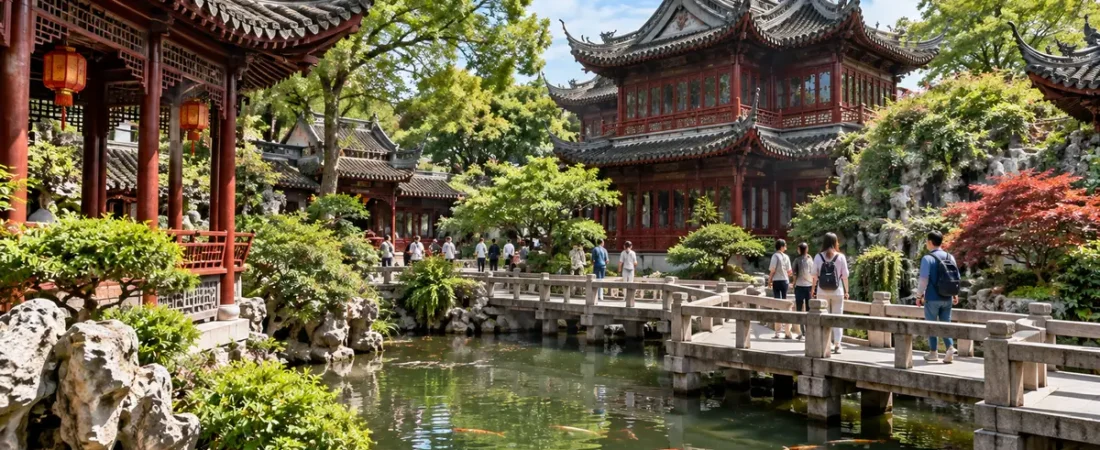
This 3 Days in Shanghai Itinerary is designed for first-time visitors who want to experience the city’s biggest contrasts without spending half their trip travelling between distant neighbourhoods. In 3 days, you can explore traditional gardens, historic streets, the Bund, Shanghai’s futuristic Pudong skyline, museums and the leafy neighbourhoods west of the Huangpu River.
Shanghai is enormous, so the key to a successful short visit is grouping nearby attractions together rather than jumping between opposite sides of the city.
Before your trip, our Shanghai travel guide covers transport, food and essential practical information. If you haven’t booked accommodation yet, our guide to where to stay in Shanghai compares the most convenient neighbourhoods.
Price note: All prices in this article are approximate and were checked at the time of publication. Prices may change.
Day 1: Old Shanghai, Nanjing Road and the Bund
Your first day introduces both historic and modern central Shanghai.
Start among traditional architecture before gradually making your way towards the city’s famous waterfront.
Morning: Yu Garden
Begin at Yu Garden and the surrounding Old City.
This classical Chinese garden offers an immediate contrast to Shanghai’s skyscrapers. Inside you’ll find traditional pavilions, ponds, rockeries, bridges, courtyards and carefully arranged landscaping.
Give yourself enough time to appreciate the garden rather than rushing through it.
The surrounding streets are also worth exploring for traditional-style architecture, shops and food.
This area becomes extremely busy during weekends and Chinese public holidays, so arriving early is worthwhile.
Check the garden’s current opening hours and admission arrangements shortly before visiting because seasonal schedules can change.
Explore the Old City
After Yu Garden, spend some time walking through the surrounding area.
The neighbourhood has changed considerably over the years, but it remains one of the easiest places in central Shanghai to experience traditional architectural styles beside the modern city.
Stop for an early lunch nearby.
Shanghai is particularly famous for xiaolongbao, the delicate soup dumplings associated with the region.
Another local favourite is shengjianbao, pan-fried buns with a crisp base and juicy filling.
Afternoon: People’s Square
After lunch, travel towards People’s Square.
This enormous central area provides an important reference point for navigating Shanghai.
You’ll find major cultural institutions, shopping districts and Metro connections nearby.
Don’t try to visit every museum today. Day 2 includes Shanghai Museum East, allowing you to keep your first afternoon focused on exploring central Shanghai on foot.
Walk Along Nanjing Road
From People’s Square, make your way east along Nanjing Road.
The central pedestrian section is one of Shanghai’s best-known commercial streets.
Expect department stores, large signs, restaurants, shops and substantial crowds.
Even if shopping isn’t part of your plans, walking Nanjing Road gives you a useful introduction to the scale and energy of central Shanghai.
Continue east and you’ll eventually reach the Huangpu River.
Sunset at the Bund
Time your arrival at the Bund for late afternoon if possible.
The Bund is lined with grand historic buildings that reflect Shanghai’s importance as an international trading city during the nineteenth and early twentieth centuries.
Across the Huangpu River, the view couldn’t be more different.
Pudong’s skyline includes the Oriental Pearl Tower, Shanghai World Financial Center and Shanghai Tower.
Stay as daylight fades.
Watching the Pudong skyline illuminate across the river is one of Shanghai’s classic experiences, and walking along the Bund promenade itself is free.
Evening: Bund and Huangpu River
After dark, continue walking along the waterfront.
You can finish your first day with dinner nearby or take an optional Huangpu River sightseeing cruise.
Cruise prices vary according to the operator, vessel and experience, so compare current options rather than relying on a fixed price.
Budget travellers can simply remain on the Bund and enjoy the illuminated skyline without spending anything.
Day 2: Pudong, Shanghai Museum and Modern Shanghai
Day 2 takes you across the Huangpu River to explore Shanghai’s futuristic side.
Morning: Lujiazui
Begin in Lujiazui, Shanghai’s famous financial district.
Standing beneath its skyscrapers gives you a completely different perspective from viewing them across the river.
Walk around the Oriental Pearl Tower area and through the elevated pedestrian network linking parts of the financial district.
Shanghai Tower dominates the skyline nearby.
If you want to visit an observation deck, morning can be a good time, but check visibility first.
Cloud, rain or haze can dramatically reduce the value of paying for a high-level view.
Optional Observation Deck
Shanghai has several high-rise viewing experiences.
Rather than trying to visit multiple towers, choose one if panoramic views are important to you.
Check the current ticket price and opening arrangements before purchasing.
On a clear day, the views demonstrate just how enormous Shanghai really is.
If visibility is poor, skip the observation deck and save the money for another experience.
Late Morning or Early Afternoon: Shanghai Museum East
Next, head towards Shanghai Museum East at 1952 Century Avenue in Pudong.
This is the main location for Shanghai Museum’s extensive permanent collections.
The museum contains galleries dedicated to Chinese bronzes, sculpture, calligraphy, painting, ceramics, jade, seals, currency, archaeology and other areas of Chinese art and history.
At the time of writing, Shanghai Museum East is open Wednesday to Monday from 10:00 to 18:00, with last entry at 17:00.
It normally closes on Tuesdays except national holidays.
Individual visitors currently do not need an advance reservation for ordinary entry, although special interactive spaces and certain exhibitions can have separate booking or ticket requirements.
Allow at least two hours if museums interest you.
You could easily spend longer.
Important Shanghai Museum Planning Tip
Shanghai Museum also operates its historic People’s Square building.
During the current Ancient Civilizations of the Americas exhibition, running from July 2026 to November 2027, the People’s Square building operates differently and the major exhibition requires a ticket.
Most travellers wanting the museum’s broad permanent collections should therefore prioritise Shanghai Museum East.
Always check the museum’s official information shortly before your visit because exhibition arrangements change.
Afternoon: Pudong Riverside
After the museum, return towards the Huangpu River.
Explore part of Pudong’s waterfront and look back towards the historic buildings of the Bund.
This reverses the view you enjoyed on Day 1.
From the Bund, Shanghai appears futuristic.
From Pudong, the older waterfront architecture becomes the focus.
Evening: Xintiandi
Cross back to Puxi for the evening and head to Xintiandi.
This pedestrian district incorporates restored shikumen architecture into a modern neighbourhood of restaurants, cafés and shops.
Walking around is free, although restaurants here can be relatively expensive.
It’s a comfortable place to finish Day 2 because you can have dinner without needing another major sightseeing plan.
If you’re watching your budget, explore the architecture before eating elsewhere.
Day 3: Historic Neighbourhoods, Temples and Local Shanghai
Your final day moves away from the most famous skyline attractions and focuses on Shanghai’s street-level character.
Morning: Former French Concession
Begin with a walk through the historic neighbourhoods commonly described as the Former French Concession.
Tree-lined streets, villas, lane houses and smaller-scale architecture make this part of Shanghai feel very different from Pudong.
Wukang Road is one of the best-known streets.
The area around the Wukang Mansion is particularly popular with photographers and visitors.
However, don’t restrict yourself to one landmark.
Walk into the surrounding streets and allow yourself time to explore.
Explore Historic Streets
One of the pleasures of this area is that there isn’t a rigid sightseeing route.
You might find cafés, boutiques, older residential buildings and quiet side streets within a few blocks of busy commercial roads.
This is also a good place for a slower breakfast or coffee.
Shanghai rewards travellers who leave room in their itinerary for ordinary neighbourhood exploration.
Late Morning: Tianzifang
Continue towards Tianzifang.
This network of narrow lanes contains shops, cafés, studios and restaurants within a historic residential setting.
It is heavily visited and commercialised, but the scale and layout remain an interesting contrast to Shanghai’s wide modern avenues.
Walking through the lanes is free.
You only need to spend money if you choose to shop or eat.
Lunch
Use this opportunity to try another Shanghai speciality or explore a casual local restaurant.
Shanghai’s food scene extends far beyond famous dumplings.
Noodles, braised dishes and regional Chinese cuisines are widely available throughout the city.
Restaurant prices vary enormously, so checking menus before sitting down is an easy way to control your spending.
Afternoon: Jing’an Temple
Travel north towards Jing’an.
The golden roofs of Jing’an Temple stand dramatically against modern towers and shopping centres.
The temple has a long history, although much of the complex has undergone reconstruction and restoration.
Check current opening hours and admission arrangements before visiting.
Even if you decide not to enter, the surrounding neighbourhood is worth exploring.
Explore Jing’an
Spend the remainder of the afternoon walking through Jing’an.
This is one of Shanghai’s most convenient mixed-use districts, combining shopping centres, restaurants, offices and residential streets.
It also gives you a useful look at everyday modern Shanghai away from the Bund’s concentrated tourist crowds.
Final Evening in Shanghai
For your final evening, choose the experience you enjoyed most.
Return to the Bund if you want one last skyline view.
Head back into the historic neighbourhoods for dinner if you prefer a quieter atmosphere.
Or spend the evening around Jing’an or Xintiandi for restaurants and nightlife.
There is no need to squeeze another major attraction into the final few hours.
A relaxed dinner and neighbourhood walk can be a much better ending to a busy 3-day trip.
Getting Around During This Shanghai Itinerary
The Shanghai Metro is the easiest way to cover longer distances.
Use it between major sightseeing districts, then explore individual neighbourhoods on foot.
This itinerary deliberately groups attractions geographically.
Day 1 concentrates on the Old City, central Shanghai and the Bund.
Day 2 focuses mainly on Pudong before returning to Xintiandi.
Day 3 covers the historic neighbourhoods west of the river and Jing’an.
This approach reduces unnecessary cross-city journeys.
Keep in mind that Shanghai Metro stations can be enormous. Changing lines sometimes involves considerably more walking than the map suggests.
Allow extra time when travelling to a timed attraction or railway station.
What Should You Book in Advance?
Most neighbourhood walks and public spaces require no booking.
However, check current requirements for:
- Yu Garden
- Observation decks
- Huangpu River cruises
- Special museum exhibitions
- Popular tours or experiences
Shanghai Museum East currently permits individual visitors to enter its standard galleries without advance reservations, but some interactive areas and special exhibitions operate separately.
Rules can change, particularly during public holidays.
Avoid Major Holiday Crowds When Possible
China’s major national holidays can transform the travel experience.
National Day in early October is particularly important because domestic tourism demand can become extremely high.
Chinese New Year and other major holiday periods can also affect opening schedules, transport and visitor numbers.
If your trip overlaps a major holiday, book accommodation and long-distance transport well ahead and expect busy attractions.
What If You Have Only 2 Days in Shanghai?
With two days, simplify the itinerary.
Day 1
Visit Yu Garden and the Old City, walk Nanjing Road and finish at the Bund.
Day 2
Explore Lujiazui, choose either Shanghai Museum East or an observation deck, then spend the late afternoon and evening exploring the historic neighbourhoods around the Former French Concession.
Skip attractions that require long detours.
Two days isn’t enough to see Shanghai comprehensively, but it is enough to experience its major contrasts.
What If You Have 4 Days?
A fourth day gives you much more flexibility.
You could spend additional time exploring Shanghai’s museums and neighbourhoods or take a day trip.
Zhujiajiao is a historic water town within Shanghai municipality known for canals, bridges and traditional architecture.
Alternatively, China’s high-speed railway network makes destinations such as Suzhou and Hangzhou possible additions to a longer Shanghai stay.
Don’t add a day trip simply because you have an extra day, though.
Shanghai itself easily contains enough to occupy four or five days.
Practical Tips for 3 Days in Shanghai
Wear comfortable shoes. Even with extensive Metro use, you will walk substantial distances.
Carry your passport or other required identification when visiting attractions that require it.
Save your hotel’s address in Chinese as well as English.
Prepare your phone before travelling and research which apps and online services will function in mainland China.
Mobile payments are widely used, so international visitors should check the latest procedures for linking eligible foreign bank cards to supported payment platforms.
Keep a backup payment method available.
Finally, don’t over-schedule your days.
Shanghai’s scale means attractions often take longer to reach than expected, and some of the best experiences come from simply walking through a neighbourhood.
Is 3 Days in Shanghai Enough?
3 days is enough for a strong introduction to Shanghai.
You can see the Bund and Pudong skyline, explore Yu Garden, visit a major museum, experience Shanghai’s historic neighbourhoods and spend time in modern districts such as Lujiazui and Jing’an.
What 3 days won’t give you is a complete picture of the city.
Shanghai is too large and varied for that.
But by organising your trip geographically and resisting the temptation to visit every attraction, you’ll experience several very different sides of Shanghai without turning your holiday into a race.
Explore more places through our destinations page or browse our complete collection of itineraries.