
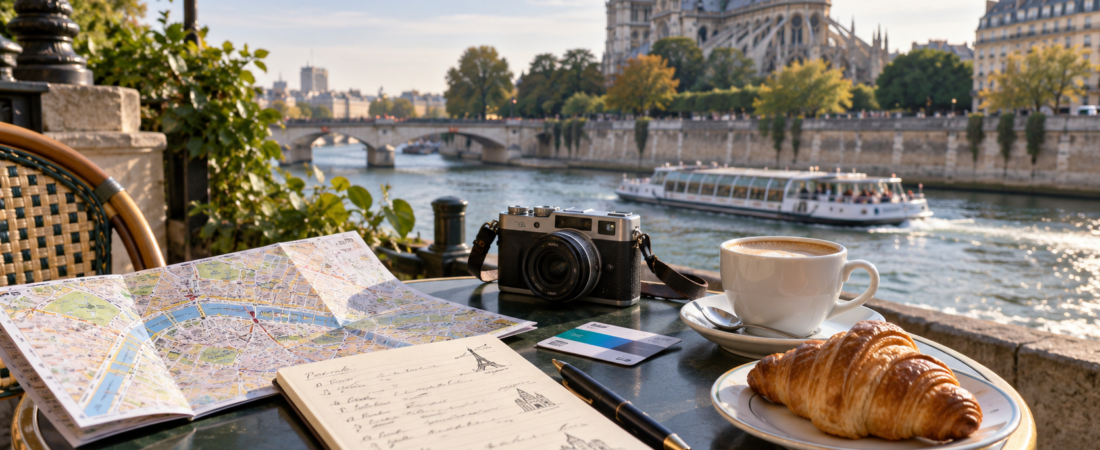
3 days in Paris gives you enough time to experience the Eiffel Tower, Louvre Museum, Notre-Dame Cathedral, Montmartre and several historic neighborhoods without turning the trip into a race. The key is to group nearby attractions together, reserve high-demand tickets and leave space for walks, meals and unexpected discoveries.
This 3 days in Paris itinerary organizes the city geographically: western Paris and the Eiffel Tower on day one, the Louvre and historic center on day two, and Montmartre with the Left Bank on day three. It is designed for first-time visitors but can easily be adjusted around museum closing days, weather and personal interests.
Price note: All prices in this article are approximate and were checked at the time of publication. Prices may change.
3 Days in Paris at a Glance
Day 1: Eiffel Tower and Western Paris
- Trocadéro
- Eiffel Tower
- Champ de Mars
- Seine riverfront
- Pont Alexandre III
- Champs-Élysées
- Arc de Triomphe
Day 2: Louvre and Historic Paris
- Louvre Museum
- Tuileries Garden
- Île de la Cité
- Notre-Dame Cathedral
- Sainte-Chapelle
- Latin Quarter
- Seine evening walk
Day 3: Montmartre and the Left Bank
- Montmartre
- Sacré-Cœur Basilica
- Musée d’Orsay
- Saint-Germain-des-Prés
- Luxembourg Garden
- Le Marais or a final evening cruise
Before your trip, read our complete Paris travel guide for additional information about neighborhoods, food, transport and practical planning.
Top Tours & Experiences in Paris
Discover popular Paris tours and experiences. Check current availability, ratings and prices before you book.
Affiliate disclosure: If you book through these links, we may earn a commission from Viator. This does not increase the price you pay.
Important Planning Notes
This itinerary assumes that you have 3 full sightseeing days. If you arrive during the afternoon or leave early on the third day, reduce the number of ticketed attractions rather than rushing between them.
Museum closing days are particularly important:
- The Louvre is normally closed on Tuesdays.
- Musée d’Orsay is normally closed on Mondays.
- The Palace of Versailles is normally closed on Mondays.
- Some smaller museums and restaurants close on either Monday or Tuesday.
If your second day falls on a Tuesday, move the Louvre to another day. If your third day falls on a Monday, replace Musée d’Orsay with another attraction or rearrange the first and third days.
Book the Eiffel Tower, Louvre Museum and Sainte-Chapelle before arriving. Timed reservations provide structure, but avoid booking consecutive attractions so closely that one security line disrupts the entire day.
How to Get Around During This Itinerary
Most of this route combines walking with the Métro. Central Paris is compact, but three days of sightseeing involves considerable time on your feet.
In 2026, a single Metro–Train–RER ticket costs €2.55. A separate Bus–Tram ticket costs €2.05. Airport journeys require a special €14 Paris Region–Airports ticket.
The all-zone Navigo Day pass costs €12.30 and excludes airport journeys. It becomes useful only when you expect to take several separate journeys in one day. Because this itinerary groups nearby attractions, individual tickets may cost less.
Load eligible tickets onto a Navigo Easy card or compatible smartphone. Keep your validated fare media until you have fully exited the transport system because ticket inspections are common.
Day 1: Eiffel Tower, Seine and Arc de Triomphe
Day one focuses on western Paris. Begin with the city’s most famous view, visit the Eiffel Tower and gradually move toward the Arc de Triomphe.
8:00 a.m. — Start at Trocadéro
Take the Métro to Trocadéro station and walk toward the elevated terraces overlooking the Eiffel Tower.
Trocadéro provides one of the clearest full-length views of the tower. Early morning usually brings fewer visitors and softer light than the middle of the day. The public viewpoint is free.
After taking photographs, descend through the gardens and cross Pont d’Iéna toward the tower. Watch your belongings around the viewpoint, bridge and ticket entrances because these crowded areas can attract pickpockets.
Recommended time: 45 minutes
Admission: Free
Nearest Métro: Trocadéro
9:00 a.m. — Visit the Eiffel Tower
Reserve an Eiffel Tower entry for approximately 9:00 or 9:30 a.m. Morning tickets help you avoid some of the day’s largest crowds while leaving the afternoon flexible.
Official 2026 adult prices include:
- €23.50 for the elevator to the second floor
- €36.70 for the elevator to the summit
- €14.80 for stairs to the second floor
- €28 for stairs to the second floor followed by the summit elevator
Children and young people may qualify for lower prices, while children under four require a free ticket. Book through the official Eiffel Tower website whenever possible.
Allow time for security screening before entering. Summit access may be suspended because of weather, technical conditions or crowding, even when the tower remains open.
The second floor already provides an excellent view of the Seine, Champ de Mars, Trocadéro and central Paris. Choose the summit if reaching the highest public level is personally important, but the additional time and cost are not essential for enjoying the monument.
Recommended time: 2–2½ hours
Admission: From €14.80 for adults
Advance booking: Strongly recommended
11:30 a.m. — Walk Through Champ de Mars
After leaving the tower, walk into Champ de Mars for views from the opposite direction. This open green space is free and offers a relaxed transition after the structured tower visit.
Continue toward École Militaire or find a nearby bakery for lunch. A baguette sandwich, pastry and drink will generally be faster and less expensive than eating immediately beside the Eiffel Tower.
If the weather is pleasant, buy lunch from a bakery and have a simple picnic where permitted. Dispose of rubbish properly and follow any temporary lawn restrictions.
Recommended time: 30–45 minutes
Admission: Free
12:30 p.m. — Lunch Near Rue Cler or Invalides
Rue Cler is a pedestrian-friendly market street with bakeries, food shops, cafés and small restaurants. It is convenient for lunch without traveling far from the day’s route.
Another option is the area around École Militaire or Invalides. Check displayed menus before choosing, particularly when restaurants offer tourist-oriented fixed menus.
Approximate lunch costs:
- Bakery lunch: €7–€15
- Casual café meal: €15–€30
- Mid-range restaurant lunch: €25–€45
Allow approximately one hour unless you prefer a longer seated meal.
1:45 p.m. — Les Invalides or Seine Walk
Choose one of two afternoon options.
Option 1: Visit Les Invalides
Les Invalides is known for its golden dome, military collections and Napoleon’s tomb. This is the better choice for travelers interested in French history.
A complete museum visit can take two or three hours, which may make the remainder of the day rushed. For this itinerary, either admire the exterior or choose a focused visit.
Option 2: Walk Toward Pont Alexandre III
For a lighter schedule, walk past Les Invalides toward Pont Alexandre III. The bridge is decorated with elaborate lamps, sculptures and gilded figures and provides excellent views toward the Grand Palais and the Invalides dome.
Crossing the bridge is free. This option leaves more time for the Champs-Élysées and Arc de Triomphe.
Recommended time: 1–1½ hours
Admission: The walk and bridge are free; museum admission costs extra
3:30 p.m. — Walk Through the Champs-Élysées Area
From Pont Alexandre III, continue toward the Champs-Élysées through the gardens near the Grand Palais and Petit Palais.
You do not need to walk every meter of the avenue. The lower section contains gardens and monumental architecture, while the upper section becomes increasingly commercial.
If you enjoy art and need an indoor break, the permanent collection of the Petit Palais is generally free. Temporary exhibitions may require a paid ticket.
Continue toward the Arc de Triomphe on foot or use the Métro if you are tired.
5:30 p.m. — Arc de Triomphe
Use the pedestrian underpass to reach the Arc de Triomphe. Never attempt to cross the traffic circle at street level.
The Tomb of the Unknown Soldier beneath the arch is accessible free of charge. A paid ticket provides entry to the monument and rooftop terrace.
Current individual admission is approximately:
- €22 from April through September
- €16 on Wednesdays during the April-to-September high season
- €16 from October through March
The terrace provides a striking view along the Champs-Élysées, toward La Défense and across the Paris rooftops. The Eiffel Tower is also clearly visible.
Opening hours vary by season, and the monument can close for national ceremonies, severe weather or special events. Last admission is normally 45 minutes before closing.
Recommended time: 1–1½ hours
Advance booking: Recommended around sunset
7:30 p.m. — Dinner and Evening Options
After the Arc de Triomphe, choose between dinner nearby or returning to a neighborhood with a broader range of restaurants.
Restaurants directly around the upper Champs-Élysées can be expensive. Better-value options may be available around the 9th, 11th or 17th arrondissements or near your accommodation.
If you still have energy, return to Trocadéro or the Seine after dark to see the illuminated Eiffel Tower. The sparkling display usually appears for several minutes at the start of the hour after nightfall, although illumination schedules can change.
Day 2: Louvre, Notre-Dame and the Latin Quarter
Day two covers the Louvre and the historic heart of Paris. Wear comfortable shoes because even a selective museum visit involves substantial walking.
8:00 a.m. — Palais Royal and Louvre Courtyard
Arrive before the museum opens and begin at the Palais Royal courtyard. The striped columns of the Colonnes de Buren and surrounding arcades are free to visit.
Walk toward the Louvre’s main courtyard to see the glass pyramid before the area becomes busiest. Even travelers who do not enter the museum can appreciate the architecture and former royal palace from outside.
9:00 a.m. — Louvre Museum
Reserve the first practical entry time. The Louvre is normally open from 9:00 a.m. to 6:00 p.m. and remains open until 9:00 p.m. on Wednesdays and Fridays. It closes on Tuesdays.
Current admission is:
- €22 for citizens or residents of the European Economic Area
- €32 for visitors who are neither citizens nor residents of the EEA
- Free for visitors under 18 and qualifying EEA residents under 26
Timed reservations are recommended, including for visitors eligible for free admission.
The Louvre is far too large to cover comprehensively in one morning. Choose a limited route based on your interests. A first visit might combine:
- Mona Lisa and major Italian paintings
- Winged Victory of Samothrace
- Venus de Milo
- French large-format paintings
- Egyptian antiquities
- Napoleon III Apartments
Check the official museum map because gallery access can change. Do not spend most of the visit following signs to a single famous painting while ignoring the collections around you.
Recommended time: 3 hours
Advance booking: Strongly recommended
Closing day: Tuesday
12:15 p.m. — Tuileries Garden
Exit the Louvre and walk into the Tuileries Garden. The central paths, ponds, sculptures and green chairs provide a welcome rest after the museum.
General entry is free, while seasonal rides, kiosks and organized activities cost extra.
Walk only as far as your energy allows. You will return toward the historic center afterward, so there is no need to continue all the way to Place de la Concorde unless it is a priority.
Recommended time: 30–45 minutes
Admission: Free
1:00 p.m. — Lunch Near the Louvre
Avoid choosing the first restaurant beside a major entrance. Walk toward Palais Royal, Rue Sainte-Anne or the streets east of the Louvre for more variety.
A bakery or casual lunch keeps the day moving, while a longer restaurant meal can provide a useful rest after the museum.
Allow approximately €12–€25 for a casual lunch or more for a full restaurant meal.
2:15 p.m. — Walk Along the Seine to Île de la Cité
Walk east beside the Seine toward Pont Neuf and Île de la Cité. The route passes bridges, historic façades and the riverside booksellers known as bouquinistes.
Pont Neuf is, despite its name, the oldest surviving bridge across the Seine in Paris. From the bridge, descend toward Square du Vert-Galant if it is open and weather conditions are suitable.
Continue along the island toward Sainte-Chapelle.
3:00 p.m. — Sainte-Chapelle
Sainte-Chapelle is celebrated for its 13th-century stained glass. The upper chapel is the highlight, especially when daylight illuminates the tall windows.
Because the monument lies within the Palais de Justice complex, visitors pass through security screening. A timed reservation is advisable.
The visit itself is relatively short, but queues and security can increase the total time required. Check the latest official admission price when reserving because rates and combined-ticket options can change.
Recommended time: 45–60 minutes
Advance booking: Recommended
4:15 p.m. — Notre-Dame Cathedral
Walk to Notre-Dame Cathedral, which reopened following its major restoration.
General admission to the cathedral is free. Individual visitors can reserve a free time slot through the official Notre-Dame website, but reservations are optional. Visitors without reservations may still enter by joining the queue.
Do not pay a third-party website for ordinary cathedral admission. Legitimate individual reservations are free.
Notre-Dame is an active place of worship. Services, ceremonies and security arrangements may affect access. Dress respectfully, speak quietly and avoid disrupting worshippers.
The cathedral treasury and certain special areas or activities may have separate charges.
Recommended time: 45–60 minutes
Admission: Free
Reservation: Optional and free
5:30 p.m. — Explore the Latin Quarter
Cross to the Left Bank and explore the Latin Quarter. This historic university district contains narrow streets, churches, bookshops, cinemas and cafés.
A relaxed walking route can include:
- Shakespeare and Company’s exterior
- Church of Saint-Séverin
- The Sorbonne area
- Place de la Contrescarpe
- Rue Mouffetard
- The Panthéon exterior
Avoid restaurants that rely heavily on promoters attempting to draw visitors inside. Compare menus and recent reviews, especially around the most tourist-oriented streets.
7:00 p.m. — Dinner in the Latin Quarter
The Latin Quarter offers everything from crêperies and casual international restaurants to traditional French dining.
For a classic but reasonably priced meal, look for a fixed-price menu and check whether drinks are included. You can also eat around Rue Mouffetard or continue toward Saint-Germain-des-Prés.
9:00 p.m. — Evening Beside the Seine
Finish the day with a walk along the Seine. Pont Neuf, Pont des Arts and the riverbanks around Île de la Cité are especially atmospheric after dark.
A sightseeing cruise is an optional paid alternative. Standard cruises generally last around one hour, but boarding points, schedules and prices differ by operator. Reserve only through an established provider and confirm the departure location carefully.
Day 3: Montmartre, Musée d’Orsay and Luxembourg Garden
The final day begins in Montmartre before its busiest period and then moves to the Left Bank for art, cafés and gardens.
8:00 a.m. — Arrive in Montmartre
Take the Métro to Abbesses or Anvers. Abbesses has a deep station with many stairs, although a lift is available. Anvers provides a more direct approach to Sacré-Cœur but passes through a busier tourist area.
Montmartre is steep, so comfortable shoes are essential. Arriving early provides quieter streets and better conditions for photography.
8:15 a.m. — Explore Montmartre’s Streets
Rather than walking directly to Sacré-Cœur, take a short neighborhood route through some of Montmartre’s most characteristic streets.
Possible stops include:
- Wall of Love near Square Jehan Rictus
- Place des Abbesses
- Moulin de la Galette
- Le Passe-Muraille sculpture
- Place Dalida
- Rue de l’Abreuvoir
- La Maison Rose
- Clos Montmartre vineyard
- Place du Tertre
These exterior sights and streets are free to explore. Place du Tertre becomes increasingly crowded as portrait artists, visitors and restaurant terraces fill the square.
9:30 a.m. — Sacré-Cœur Basilica
Sacré-Cœur stands at one of Paris’s highest points. Entry to the main basilica is generally free, while access to the dome is a separate paid activity.
The public steps outside provide a wide city view. For another perspective, walk around the side streets behind the basilica.
Remain alert on the main stairways and approaches, where persistent bracelet sellers or other unsolicited approaches may occur. Politely refuse and keep moving.
Recommended time: 45–60 minutes
Basilica admission: Free
Optional dome: Paid
10:30 a.m. — Coffee or Early Lunch in Montmartre
Stop at a bakery or café away from the busiest edge of Place du Tertre. A pastry and coffee provide a short break before traveling south.
If you prefer a full lunch, eat around 11:30 a.m. and reserve a later Musée d’Orsay entry. Otherwise, have a light snack and eat near the museum.
11:30 a.m. — Travel to Musée d’Orsay
Take the Métro toward the Left Bank. Allow approximately 35–45 minutes for the transfer, including walking and waiting.
Reserve Musée d’Orsay for around noon or early afternoon, depending on your lunch plan.
12:30 p.m. — Musée d’Orsay
The Musée d’Orsay occupies a former railway station and contains important Impressionist and Post-Impressionist works. Its collection includes art by Monet, Renoir, Degas, Van Gogh and many other influential artists.
The museum is normally open:
- Tuesday, Wednesday and Friday through Sunday: 9:30 a.m.–6:00 p.m.
- Thursday: 9:30 a.m.–9:45 p.m.
- Monday: Closed
Current general admission is approximately €16 online or €14 when purchased at the museum, subject to availability. Thursday evening rates are lower, and qualifying visitors receive free admission.
Allow two to three hours. Do not miss the upper-level clock faces and their views across Paris toward Montmartre.
If your third day is Monday, replace Musée d’Orsay with the Musée de l’Orangerie, Centre Pompidou-area attractions, Musée Carnavalet or another museum after checking its current opening schedule.
Recommended time: 2½–3 hours
Advance booking: Recommended
Closing day: Monday
3:30 p.m. — Saint-Germain-des-Prés
Walk or take a short bus journey into Saint-Germain-des-Prés. The neighborhood is known for literary history, churches, galleries, cafés and elegant streets.
You can see the historic cafés from outside without paying their premium terrace prices. If visiting one is important to you, treat it as an experience and check the menu before ordering.
Walk past the Church of Saint-Germain-des-Prés and continue through side streets toward the Luxembourg Garden.
4:45 p.m. — Luxembourg Garden
The Luxembourg Garden contains formal lawns, fountains, sculptures, tree-lined paths and the Luxembourg Palace.
General entry is free. Opening and closing hours change throughout the year according to daylight, so winter visitors should arrive earlier.
Use this stop to slow down after three busy sightseeing days. Sit beside the central basin, walk beneath the trees or simply rest in one of the garden’s movable chairs.
Recommended time: 45–75 minutes
Admission: Free
6:00 p.m. — Choose Your Final Evening
Select the option that best matches your interests and energy.
Option 1: Dinner in Saint-Germain-des-Prés
Return toward Saint-Germain for a final French meal. This is the easiest option after a full day of walking.
Option 2: Explore Le Marais
Take the Métro to Saint-Paul or Hôtel de Ville and walk through Le Marais. Include Rue des Rosiers, Place des Vosges and the surrounding historic streets.
For help selecting accommodation in these central neighborhoods, see our guide to where to stay in Paris.
Option 3: Seine Cruise
Finish with an evening sightseeing cruise. This provides a final view of illuminated bridges and monuments but is an optional paid activity.
Option 4: Free Eiffel Tower View
Return to Trocadéro, Champ de Mars or another public viewpoint for a final look at the Eiffel Tower. This is the best budget-friendly conclusion to the trip.
Our guide to the best free things to do in Paris contains more no-cost alternatives.
What to Book Before Visiting Paris
Reserve these attractions as soon as your schedule is confirmed:
- Eiffel Tower: Summit and sunset tickets can sell out.
- Louvre Museum: Select a timed entry and avoid Tuesday.
- Sainte-Chapelle: Reservations reduce uncertainty around security queues.
- Musée d’Orsay: Particularly useful for weekends and major exhibitions.
- Arc de Triomphe: Recommended for popular sunset periods.
- Special restaurants: Reserve if a particular restaurant is important to your trip.
- Airport transport: Advance booking is generally unnecessary for public transport, but check planned engineering work.
Avoid purchasing ordinary admission through unofficial websites without comparing the price with the attraction’s own ticket office.
Estimated Cost for 3 Days in Paris
Excluding accommodation and flights, a traveler following this itinerary might spend approximately:
Attractions
- Eiffel Tower: €14.80–€36.70
- Louvre Museum: €22–€32, depending on eligibility and residency
- Musée d’Orsay: €14–€16
- Arc de Triomphe: €16–€22
- Sainte-Chapelle: Check the current official rate
- Optional cruise or additional museum: Approximately €15–€30 or more
Transport
A traveler using two or three public-transport journeys per day may spend approximately €15–€25 over three days. The total will depend on whether individual tickets or passes provide better value.
Airport journeys cost extra.
Food
Approximate daily food spending might be:
- Budget meals and bakeries: €30–€50
- Combination of cafés and restaurants: €60–€100
- Frequent full-service or upscale dining: €120 or more
For accommodation costs and complete daily estimates, consult our Paris travel budget guide.
How to Save Money on This Itinerary
- View the Eiffel Tower from Trocadéro instead of going inside.
- Choose stairs rather than the elevator at the Eiffel Tower if appropriate.
- Enter Notre-Dame and Sacré-Cœur for free.
- Use bakeries and markets for breakfast or lunch.
- Carry a reusable water bottle.
- Walk between attractions grouped within the same area.
- Visit the free permanent collection at the Petit Palais.
- Enjoy the Tuileries and Luxembourg gardens without admission charges.
- Compare museum-pass prices with the actual attractions you will visit.
- Use public transport instead of taxis.
- Reserve through official websites to avoid unnecessary third-party fees.
Where to Stay for This Itinerary
The most convenient bases for this route include:
- Le Marais: Excellent for the historic center and evening restaurants
- Latin Quarter: Convenient for Notre-Dame, Luxembourg Garden and Left Bank walks
- Saint-Germain-des-Prés: Central, attractive and usually expensive
- 1st arrondissement: Extremely convenient for the Louvre and Seine
- 7th arrondissement: Best for proximity to the Eiffel Tower
- 9th arrondissement: Good transport, restaurants and hotel selection
A less central hotel can offer better value, but choose one close to a Métro station. Parisian hotel rooms can be compact, and elevators or air-conditioning are not guaranteed in older buildings.
Best Time for a 3-Day Paris Trip
April through June and September through October usually provide a good balance of walking weather and seasonal atmosphere. These periods are popular, however, so accommodation and attraction tickets should be reserved early.
Summer offers long days but can bring crowds and heat waves. Winter is colder with shorter daylight, yet museums, cafés and lower off-season hotel rates can make it rewarding.
Review our month-by-month guide to the best time to visit Paris before choosing your dates.
Practical Tips for 3 Days in Paris
- Wear comfortable, broken-in walking shoes.
- Carry a light waterproof layer because conditions can change.
- Begin every polite interaction with bonjour or bonsoir.
- Keep phones, wallets and passports secure in crowded areas.
- Do not accept unsolicited help at ticket machines.
- Keep validated transport tickets until you exit the system.
- Check the final destination displayed on RER trains.
- Allow time for attraction security screening.
- Carry a backup payment card and some euros.
- Ask for une carafe d’eau when you want complimentary tap water in a restaurant.
- Check restaurant opening days before making a special journey.
- Do not schedule more than two major ticketed attractions in one day.
- Save offline copies of reservations and your accommodation address.
- Confirm opening hours again shortly before visiting.
Alternative Activities
If one of the principal attractions does not interest you, use these substitutions.
Instead of the Louvre
Visit Musée de l’Orangerie, Musée Rodin, Musée Picasso or the free permanent collection at the Petit Palais.
Instead of Musée d’Orsay
Explore Le Marais and Musée Carnavalet, visit the Panthéon or spend more time in Saint-Germain and the Luxembourg Garden.
Instead of the Eiffel Tower Summit
Enjoy free exterior views from Trocadéro and pay for the Arc de Triomphe terrace instead.
For Families
Reduce museum time, include playgrounds or garden breaks and avoid scheduling long restaurant meals between major attractions.
For Budget Travelers
Build the itinerary around Notre-Dame, Sacré-Cœur, public gardens, neighborhoods and Seine walks, selecting only one or two paid attractions.
Frequently Asked Questions
Is 3 days enough for Paris?
3 days is enough for a rewarding first visit covering several famous attractions and important neighborhoods. It is not enough to see everything, so prioritize a small number of meaningful experiences.
How much spending money is needed for 3 days?
Excluding flights and accommodation, approximately €180–€350 per person can cover public transport, casual meals and several paid attractions. Budget travelers can spend less by choosing free experiences and bakery meals, while restaurant dining and premium activities increase the total.
Should I buy the Paris Museum Pass?
The pass may offer value if you plan to visit several included attractions. Add up the individual prices of places you genuinely want to enter and confirm reservation requirements before buying it.
Can this itinerary be completed entirely on foot?
Not comfortably. Each day includes walkable clusters, but using the Métro between distant areas such as Montmartre and the Left Bank saves time and energy.
Should I take a Seine cruise?
A cruise is enjoyable but optional. Walking beside the river provides excellent views for free. Choose a cruise if you want to see the city from the water or need a seated break.
What happens if it rains?
Move museum visits to the wettest periods and use covered passages, churches and cafés between attractions. Keep reservations flexible where possible, but do not assume sold-out attractions will allow a time change.
Can I add Versailles?
Versailles normally requires most of a day. Adding it to a three-day first visit means giving up a substantial part of central Paris. It is better suited to a four- or five-day trip unless the palace is one of your highest priorities.
Final Thoughts
A successful 3-day visit to Paris depends on thoughtful selection rather than seeing the largest possible number of attractions. Reserve the Eiffel Tower and major museums, organize each day around one part of the city and protect time for neighborhood walks, gardens and meals.
This route covers Paris’s essential landmarks while remaining flexible enough for weather, closing days and individual interests. If your energy drops, remove an attraction and enjoy the area you are already exploring—the unplanned moments between monuments often become the strongest memories.
Book Your Paris Experiences
Ready to start planning? Compare popular Paris tours and activities, check current prices and availability, and book the experiences that suit your trip.
Affiliate disclosure: If you book through these links, we may earn a commission from Viator. This does not increase the price you pay.
Explore more places through our destinations page or browse our complete collection of itineraries.