
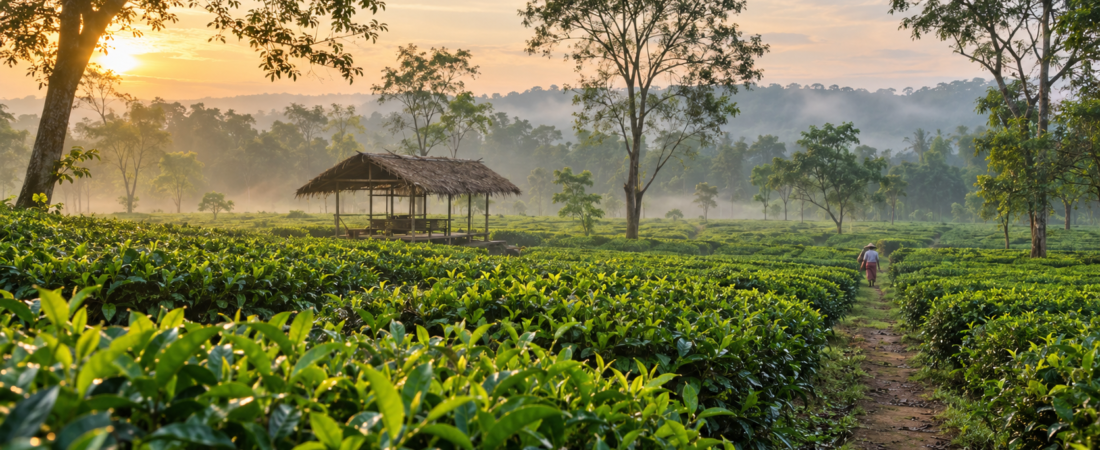
Jorhat is one of the best places to experience the quieter, greener side of Assam. Surrounded by tea estates and connected to wildlife reserves, historic Ahom sites and the river island of Majuli, the city rewards travelers who enjoy culture, nature and unhurried exploration. This Jorhat travel guide covers the city’s best attractions, local food, transportation, accommodation areas and practical planning advice.
Price note: All prices in this article are approximate and were checked at the time of publication. Prices may change.
Why Visit Jorhat?
Jorhat is widely associated with Assam’s tea industry, but its appeal extends well beyond plantations. The surrounding district contains protected forest, Vaishnavite religious institutions, Ahom-era memorials and access points to the Brahmaputra.
Unlike destinations built around a single major landmark, Jorhat is best experienced through a collection of smaller moments: walking beside a tea garden, listening for gibbons at sunrise, eating a traditional Assamese meal and watching boats move across the river at Nimati Ghat.
The city also makes a practical base for visiting Majuli. Travelers can stay in Jorhat, travel to the ferry point in the morning and either return in the evening or spend one or more nights on the island.
Top Tours & Experiences in Jorhat
Discover popular Jorhat tours and experiences. Check current availability, ratings and prices before you book.
Affiliate disclosure: If you book through these links, we may earn a commission from Viator. This does not increase the price you pay.
Best Things to Do in Jorhat
1. Explore Jorhat’s Tea Country
Tea gardens are the defining feature of the landscape around Jorhat. Roads leading beyond the city pass long rows of carefully maintained tea bushes, shade trees and workers’ settlements.
Some heritage properties and tea estates arrange plantation walks, factory visits or tea-tasting experiences. However, working estates are private properties rather than public parks. Access should always be arranged in advance through an accommodation provider, registered operator or the estate itself.
Tea factories may restrict visits during maintenance periods or outside the main production season. Visitors should also avoid entering fields without permission or photographing workers at close range without asking.
2. Visit Hoollongapar Gibbon Sanctuary
Hoollongapar Gibbon Sanctuary is one of the most important wildlife destinations near Jorhat. Located approximately 19 kilometres from the city, the protected forest is known for the western hoolock gibbon—the only ape found in India.
The sanctuary also supports several other primates, including capped langurs and macaques, as well as diverse birdlife. Gibbons are most active and vocal early in the morning, making a morning visit more rewarding than arriving later in the day.
Visits are generally conducted on foot with local or forest-authorized guidance. Wildlife sightings are never guaranteed, and visitors should keep noise to a minimum.
Opening arrangements, guide availability, access rules and applicable charges can change because this is a protected forest. Ask your hotel or the local forest authorities to reconfirm permission and reporting arrangements before leaving Jorhat. Carry water, wear closed shoes and use insect repellent, but do not leave litter inside the sanctuary.
3. Experience Nimati Ghat
Nimati Ghat is a river port on the Brahmaputra and the principal departure area for travelers heading from Jorhat toward Majuli. Even if you are not taking a ferry, the broad river landscape makes the ghat an atmospheric place to visit.
The road journey from central Jorhat usually takes around 40–60 minutes, depending on traffic and road conditions. Allow extra time when connecting with a ferry.
Ferry schedules are influenced by the season, river level, visibility and weather. Services can be delayed, moved to a different landing point or suspended at short notice, especially during the monsoon. Confirm the departure point and last return service locally on the day of travel rather than relying entirely on an older online timetable.
4. Take a Day Trip to Majuli
Majuli is closely linked with Jorhat and is one of the main reasons travelers include the city in an Assam itinerary. The island is known for its satras, mask-making traditions, village landscapes, pottery, weaving and Assamese Neo-Vaishnavite culture.
A day trip is possible, but an overnight stay provides a more relaxed experience. Travelers attempting a same-day visit should take an early ferry, arrange onward transportation in advance and verify the final return departure before beginning sightseeing.
Kamalabari, Auniati and Samaguri are among the areas commonly included in Majuli visits. Dress respectfully inside religious institutions, remove footwear where required and ask before photographing ceremonies, monks or residents.
Ferry tickets, vehicle charges and local transport costs depend on the route and service operating that day. Carry cash because digital payments and mobile connectivity can be inconsistent around ghats and rural areas.
5. Visit Dhekiakhowa Bor Namghar
Dhekiakhowa Bor Namghar is an important Assamese Vaishnavite place of worship outside central Jorhat. The institution is associated with the saint-reformer Madhavdeva and remains an active religious site rather than simply a tourist attraction.
Visitors should wear modest clothing, remove footwear before entering designated areas and avoid disturbing prayers. Admission is generally not treated like a conventional attraction ticket, although voluntary offerings may be accepted.
Religious festivals can make the site especially lively but also considerably busier. Ask locally about appropriate visiting hours before making the journey.
6. See Lachit Borphukan’s Maidam
Lachit Borphukan’s Maidam commemorates the celebrated Ahom military commander remembered for leading Assamese forces during the Battle of Saraighat.
The memorial lies outside the central city and can be combined with other attractions in the surrounding district. It is most convenient to visit by hired car. As facilities may be limited, bring drinking water and plan the visit during daylight hours.
The site is valuable for travelers who want to understand the regional history that shaped Assam rather than viewing Jorhat only as a tea destination.
7. Explore the Sukapha Samannay Kshetra
Sukapha Samannay Kshetra is a memorial and cultural complex dedicated to Chaolung Sukapha, the founder of the Ahom kingdom. The complex introduces visitors to an important chapter of Assam’s political and cultural history.
Because exhibition access and opening arrangements may change during maintenance, events or public holidays, confirm locally before traveling specifically to see indoor displays. The grounds and architecture are best appreciated in daylight.
8. Visit Raja Maidam
Raja Maidam is associated with members of the Ahom royal family and offers another glimpse into Jorhat’s historical character. It is a quieter site than the area’s major religious and wildlife attractions.
The stop does not require a long visit, but it can fit naturally into a half-day exploration of central Jorhat. Treat the grounds respectfully and avoid climbing on protected structures.
9. Learn About Assam’s Tea Research Heritage
Jorhat is home to the Tocklai Tea Research Institute, one of the best-known names in Indian tea research. Its scientific work has contributed to tea cultivation and production for more than a century.
Travelers should understand that this is an active research institution, not a regular public museum. Do not arrive expecting unrestricted entry. Any visit, technical interaction or access to institutional areas should be requested and approved beforehand.
For most visitors, an authorized tea-estate experience is easier to arrange and provides a more suitable introduction to how Assam tea is grown and processed.
10. Walk Through Jorhat’s Local Markets
Exploring a local market offers a closer look at everyday life in Upper Assam. Depending on the season, stalls may carry vegetables, herbs, rice products, pickles, bamboo goods, handloom items and packets of locally produced tea.
Markets are best visited during active morning or early-evening hours. Keep small-denomination cash available and ask permission before taking close-up photographs of vendors.
What to Eat in Jorhat
Assamese food often uses subtle seasoning, fresh herbs and regional vegetables rather than heavy sauces. Rice forms the centre of many meals.
Look for dishes and specialties such as:
- Assamese thali with rice, dal, vegetables and fish or meat
- Masor tenga, a light and tangy fish curry
- Khar, a distinctive Assamese preparation
- Aloo pitika, seasoned mashed potato
- Duck curry, sometimes prepared with ash gourd
- Pork cooked with bamboo shoot
- Seasonal leafy vegetables and fern
- Til pitha and other rice-based snacks
- Jolpan, a traditional light meal or snack
- Locally grown Assam tea
Restaurant versions vary, and not every dish is available throughout the year. If you have dietary restrictions, explain them clearly because fermented ingredients, fish products or meat may be used in preparations that appear vegetable-based.
Best Time to Visit Jorhat
The most comfortable period for visiting Jorhat is generally from November to March. Days are usually pleasant, humidity is lower than during the monsoon, and outdoor sightseeing is easier.
October can also be attractive as the landscape remains green after the rains, although occasional showers are possible.
April is culturally significant because of Rongali Bihu. Visitors may encounter music, dance and community celebrations, but accommodation and transportation should be reserved early around major festival dates.
The monsoon normally affects Assam from roughly June through September. Heavy rain can disrupt roads, outdoor activities and ferry services. The countryside is especially lush during this period, but travelers need flexible plans and extra travel time.
How Many Days Do You Need in Jorhat?
Two full days are suitable for a short introduction to Jorhat:
- Spend one day exploring tea-country landscapes, heritage sites and local food.
- Use the second day for Hoollongapar Gibbon Sanctuary or a carefully planned Majuli excursion.
Three or four days are better if you want to visit Majuli without rushing, arrange a tea experience and include several historic or religious sites around the district.
How to Reach Jorhat
By Air
Jorhat Airport, also known as Rowriah Airport, serves the city with domestic connections. Flight routes and frequencies change, so check the current airline schedule before planning a tight onward connection.
The airport is relatively close to the urban area. Prearranging a hotel pickup can be useful, particularly for an early arrival, late arrival or group carrying substantial luggage.
By Train
Jorhat Town railway station provides access to selected regional services. Mariani Junction, located outside Jorhat, is a larger railway junction used by many long-distance trains.
Check carefully whether your ticket is for Jorhat Town or Mariani Junction. If arriving at Mariani, arrange road transport to Jorhat and allow additional journey time.
By Road
Government and private buses connect Jorhat with Guwahati, Dibrugarh, Sivasagar and other towns in Assam. The Assam State Transport Corporation publishes services from Jorhat, but schedules can be revised.
Shared vehicles are also common on regional routes. Road travel may take longer during rain, roadworks or festival periods, so avoid planning extremely tight connections.
Getting Around Jorhat
Auto-rickshaws and app-based or locally arranged taxis are convenient for short city journeys. For Hoollongapar, Nimati Ghat, Dhekiakhowa Bor Namghar and scattered heritage locations, hiring a car is usually the simplest option.
Discuss the complete fare before beginning an auto-rickshaw trip if a meter is not being used. For a hired car, confirm whether the quotation includes waiting time, parking, tolls and the driver’s allowance.
Travelers planning to cross to Majuli with a vehicle should verify whether the relevant ferry carries vehicles that day. Hiring separate transport on the island may be easier than taking a car across.
Where to Stay in Jorhat
Central Jorhat is convenient for restaurants, markets and local transportation. It works well for travelers staying briefly or using the city as a transit base.
Accommodation near the airport may suit passengers with early departures, while tea-estate stays outside the city offer a quieter atmosphere. Plantation accommodation is usually more expensive and may require advance reservations.
Approximate room categories include:
- Budget guesthouses: ₹800–₹1,800 per night
- Comfortable mid-range hotels: ₹2,000–₹4,500 per night
- Heritage or tea-estate stays: ₹5,000 and above per night
Prices rise during festivals, holidays and popular travel periods. Confirm whether breakfast, taxes and transportation are included before booking.
Suggested Daily Budget
A budget traveler using modest accommodation and local transport may spend approximately ₹1,800–₹3,000 per person per day, excluding flights and major excursions.
A mid-range traveler using a private room, restaurant meals and occasional hired transport may spend around ₹3,500–₹7,000 per person per day.
Private wildlife guiding, a full-day car, tea-estate accommodation or a longer Majuli excursion can increase the total significantly. Couples or small groups can reduce per-person transport costs by sharing a vehicle.
Practical Jorhat Travel Tips
- Carry some cash for rural areas, ferries, markets and small establishments.
- Start wildlife and ferry journeys early in the morning.
- Reconfirm Majuli ferry operations on the day of travel.
- Arrange permission before entering a working tea estate or research facility.
- Pack insect repellent, sunscreen and a light rain layer.
- Wear closed, comfortable shoes for forest walks.
- Keep extra time between a ferry journey and a flight or train.
- Dress modestly when visiting namghars and satras.
- Ask before photographing people, ceremonies or tea workers.
- Avoid single-use plastic and never leave waste in forests, plantations or river areas.
- Download essential maps before rural journeys because mobile coverage can vary.
- During the monsoon, keep at least one flexible day in the itinerary.
Is Jorhat Worth Visiting?
Jorhat is worth visiting for travelers interested in Assam beyond its headline attractions. Its tea landscapes, wildlife, religious heritage, Ahom history and connection with Majuli create a varied destination without the pace or crowds of a major metropolitan city.
It is especially rewarding when treated as more than an overnight transit stop. Allowing two or three days provides enough time to see the surrounding countryside, understand the region’s history and enjoy Assamese food at a comfortable pace.
Book Your Jorhat Experiences
Ready to start planning? Compare popular Jorhat tours and activities, check current prices and availability, and book the experiences that suit your trip.
Affiliate disclosure: If you book through these links, we may earn a commission from Viator. This does not increase the price you pay.
Explore more places through our destinations page or browse our complete collection of itineraries.