
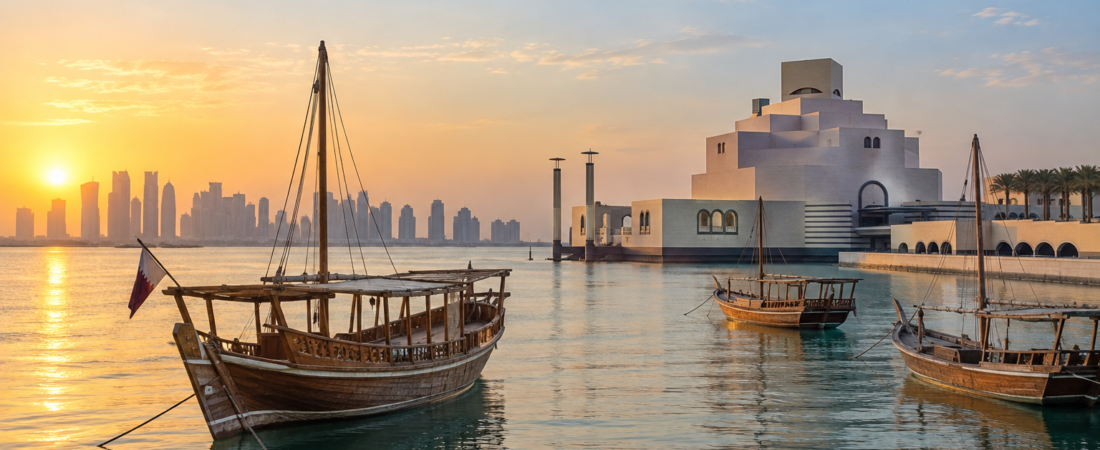
Doha combines traditional markets, ambitious museums, contemporary architecture and a sweeping waterfront within a capital that is relatively easy to explore. You can spend the morning discovering Qatar’s history, wander through Souq Waqif in the afternoon and finish the day looking across Doha Bay at an illuminated skyline.
This Doha travel guide covers the city’s principal attractions, the best areas to stay, transport, food, weather and practical information for planning your first trip.
Price note: All prices in this article are approximate and were checked at the time of publication. Prices may change.
Most first-time visitors should allow at least 3 days. This provides enough time for the historic centre, major museums, Katara Cultural Village and the waterfront without rushing. Add another day if you want to visit the desert or explore more of Qatar.
Best Things to Do in Doha
Explore Souq Waqif
Souq Waqif is the atmospheric heart of old Doha. Its lanes contain spice shops, fabric merchants, perfume stores, souvenir stalls, cafés and restaurants housed in traditional-style buildings.
Although the market can be visited throughout the day, many shops become livelier from late afternoon. After sunset, residents and visitors gather for meals, tea and evening walks.
Allow time to explore the smaller lanes instead of remaining on the main restaurant street. You may find shops selling spices, incense, dates, handicrafts, carpets and traditional clothing.
The Falcon Souq is nearby and provides an unusual introduction to the importance of falconry in Qatari culture. Be respectful when photographing shopkeepers, customers or animals, and ask permission when appropriate.
Top Tours & Experiences in Doha
Discover popular Doha tours and experiences. Check current availability, ratings and prices before you book.
Affiliate disclosure: If you book through these links, we may earn a commission from Viator. This does not increase the price you pay.
Visit the Museum of Islamic Art
The Museum of Islamic Art occupies a geometric waterfront building designed by architect I. M. Pei. Its collection spans more than 1,400 years and includes ceramics, manuscripts, metalwork, jewellery, textiles and glass from across the Islamic world.
The building’s position on Doha Bay also provides excellent views of the West Bay skyline. Outside, MIA Park offers walking paths, lawns and space to enjoy the waterfront.
Advance tickets are recommended. Qatar Museums occasionally closes individual galleries for improvements, and the Museum of Islamic Art has its own weekly closure day, so check the current calendar before visiting.
Even travellers who do not enter the museum can enjoy the park, harbour and exterior architecture.
Discover the National Museum of Qatar
The National Museum of Qatar tells the story of the country through natural history, archaeology, cultural traditions and modern development. Its interlocking architecture was inspired by the desert rose mineral formation.
Inside, immersive galleries use films, historical objects, oral accounts and large-scale displays to explain Qatar’s environment, pearling economy, communities and transformation following the discovery of oil and gas.
Plan approximately 2 to 3 hours for a thorough visit. The restored palace of Sheikh Abdullah bin Jassim Al Thani forms part of the museum complex.
The museum is usually closed on Tuesdays, while hours are different on Fridays and may change during Ramadan or public holidays. Reserve a timed ticket and confirm the schedule before travelling.
Walk along the Doha Corniche
The Doha Corniche follows the curve of Doha Bay for approximately seven kilometres. It connects several central landmarks and offers some of the capital’s best skyline views.
Popular stops include the Pearl Monument, the traditional dhow harbour and the waterfront near the Museum of Islamic Art. The central section looks across the bay towards the towers of West Bay.
Walking the entire Corniche can take considerable time, especially if you stop for photographs. During warmer months, visit early in the morning or after sunset.
Dhow operators offer short cruises from the harbour, but prices and departure arrangements vary. Agree on the total price and duration before boarding.
Visit Katara Cultural Village
Katara Cultural Village brings together galleries, performance venues, restaurants, mosques, public art and waterfront spaces. Its architecture draws on regional design while hosting a changing programme of exhibitions and festivals.
Look for the distinctive pigeon towers, Katara Mosque, Golden Mosque and open-air amphitheatre. General access to the cultural village is free, although particular exhibitions, performances and beach activities may charge admission.
Katara is situated between West Bay and The Pearl. The Red Line of the Doha Metro serves the area, making it easy to combine with other northern districts.
Allow at least two hours for an unhurried visit and longer if an exhibition or festival is taking place.
See The Pearl Island
The Pearl Island is a large man-made development north of central Doha. Its marinas, promenades, restaurants and residential buildings present a polished, modern side of the city.
Porto Arabia is known for its yacht-lined waterfront, while Qanat Quartier has colourful buildings, canals and pedestrian bridges. Walking around these public areas is free, but dining and entertainment can be expensive.
The Pearl is particularly pleasant in the evening when temperatures are cooler and the waterfront is illuminated. It can be combined with Katara Cultural Village because the two areas are close together.
Explore Msheireb Downtown Doha
Msheireb Downtown Doha is a carefully planned central district beside Souq Waqif. Traditional regional ideas have been incorporated into energy-efficient buildings, shaded streets and public squares.
The district is easy to explore on foot and provides a quieter contrast to the nearby souq. A tram circulates through parts of the development, while Msheireb Metro station connects all 3 Doha Metro lines.
Msheireb Museums occupy four restored heritage houses and examine slavery, oil, family life and the development of Doha. Confirm the museums’ current opening schedule before visiting.
Walk through Mina District
Mina District at the Old Doha Port is known for its pastel-coloured buildings, pedestrian streets, cafés and harbour views. Its position near the National Museum makes it easy to include in a central sightseeing day.
The district is especially attractive around sunrise, sunset and early evening. You can walk through the public areas without paying an entrance fee, although restaurants, shops and boat activities cost extra.
Cruise-ship arrival days may make the area busier than usual.
Visit Imam Muhammad ibn Abd al-Wahhab Mosque
Also known as the Qatar State Grand Mosque, this large mosque occupies an elevated location overlooking parts of the city. Its design features repeated arches, domes and broad courtyards.
Non-Muslim visitor access may be limited to particular hours or organised arrangements. Dress modestly, avoid prayer times and confirm current access rules before travelling specifically to see the interior.
Even when interior access is unavailable, the mosque’s exterior is an impressive example of contemporary Qatari religious architecture.
Discover Education City
Education City contains university campuses, cultural institutions, parks and striking modern architecture west of central Doha. The Green Line of the metro provides convenient access.
Qatar National Library is one of the district’s architectural highlights. Visitors can explore its open interior and public collections, subject to current access policies and events.
Education City Mosque is another notable building, while Oxygen Park provides landscaped paths and outdoor space. Mathaf: Arab Museum of Modern Art is also located in the wider district and currently offers free admission, although visitors still need to reserve a ticket.
Take a Desert Trip
A trip beyond Doha reveals an entirely different side of Qatar. Popular excursions travel south towards the dunes around Sealine Beach and Khor Al Adaid, commonly known as the Inland Sea.
Organised tours may include dune driving, desert viewpoints and stops near the coast. The Inland Sea is roughly 80 kilometres south of Doha and requires a suitable four-wheel-drive vehicle and an experienced driver.
Do not attempt to drive across remote dunes in an ordinary rental car. Compare what each tour includes, confirm pickup arrangements and choose a reputable operator.
November through April generally offers more comfortable conditions for desert excursions.
Where to Stay in Doha
Souq Waqif and Msheireb
This is one of the most convenient areas for first-time visitors. Souq Waqif, Msheireb Downtown, the Corniche and several museums are nearby, while the metro provides connections to the airport and other districts.
Choose this area if you want atmosphere, traditional architecture and easy evening dining. Accommodation ranges from boutique hotels around the souq to modern properties in Msheireb.
West Bay
West Bay is Doha’s principal business district and the source of much of its recognisable skyline. It has international hotels, modern towers, shopping centres and access to the northern Corniche.
This area suits travellers who prefer full-service hotels and contemporary surroundings. However, individual blocks can feel spread out, so check the distance from your hotel to the nearest metro station.
Katara and The Pearl
Katara and The Pearl are good choices for waterfront promenades, restaurants and a quieter resort-style environment. These districts work particularly well for travellers who have already seen central Doha or prefer evenings near the marina.
The Pearl does not have the same direct metro coverage as central Doha, so taxis or ride-hailing services may be necessary for part of your journey.
Old Doha and the National Museum Area
Staying near the National Museum places you close to Mina District, the Corniche and the airport. The Gold Line provides access to Souq Waqif and Msheireb.
This area can offer better-value accommodation than West Bay or The Pearl, but the immediate surroundings vary from modern developments to older commercial streets.
Best Time to Visit Doha
The most comfortable time to visit Doha is generally from November through February. Days are usually sunny and mild enough for the Corniche, markets, outdoor dining and desert trips.
March, April and October can also be suitable, although daytime temperatures become warmer. From June through September, intense heat and humidity make long outdoor walks difficult.
Summer visitors should plan museums, malls and indoor attractions during the day, leaving outdoor sightseeing until early morning or evening.
Ramadan dates change each year. During the holy month, opening hours, dining arrangements and entertainment schedules may differ. Visitors should avoid eating, drinking or smoking publicly during fasting hours where restrictions apply.
Getting Around Doha
Doha Metro
The Doha Metro is clean, modern and useful for many major attractions. Its Red, Gold and Green lines meet at Msheireb station.
The Red Line connects Hamad International Airport Terminal 1 with central Doha, West Bay and Katara. The Gold Line serves the National Museum and Souq Waqif, while the Green Line reaches Education City and Qatar National Library.
Standard-class travel is currently capped at QAR 6 per day. Children under five travel free, while older children pay the regular fare. A reusable travel card must normally be purchased separately.
Services pause on Friday mornings for prayers and may operate differently during events and holidays. Check Qatar Rail’s current schedule before making time-sensitive journeys.
Taxis and Ride-Hailing
Karwa taxis are widely available, and ride-hailing applications are commonly used. Taxis are useful for The Pearl, hotel transfers and attractions that are not close to a metro station.
Traffic can increase during weekday commuting periods and major events. Allow extra time when travelling to the airport.
Walking
Souq Waqif, Msheireb, Mina District and individual sections of the Corniche are suitable for walking. However, Doha’s attractions are spread across several districts, and some roads are difficult to cross outside designated areas.
Use the metro or a taxi between neighbourhoods and explore each district on foot. In summer, even short outdoor distances can feel demanding.
From Hamad International Airport
Hamad International Airport is approximately 14 kilometres from central Doha and normally around 20 minutes away by car when traffic is light.
The Red Line offers an inexpensive connection between Terminal 1 and the city. Taxis are available from the official rank and are more convenient for travellers carrying substantial luggage or staying away from a metro station.
What to Eat in Doha
Doha’s dining scene reflects both Qatari traditions and the city’s international population. Look for machboos, a spiced rice dish served with meat or seafood, as well as grilled meats, hummus, kebabs and breads.
Try karak, a sweet tea prepared with milk and spices. Luqaimat—small fried dumplings served with syrup—are a popular dessert.
Souq Waqif provides everything from casual regional meals to more formal restaurants. The city also has extensive Indian, Pakistani, Iranian, Turkish, Filipino and Levantine dining options.
Hotel restaurants and waterfront venues can be expensive. Neighbourhood restaurants and food courts usually provide more affordable meals.
Practical Doha Travel Tips
Currency and Payments
Qatar’s currency is the Qatari riyal, abbreviated QAR. Cards are widely accepted in hotels, malls and restaurants, but some cash is useful for smaller purchases and traditional markets.
ATMs are readily available. When a card terminal offers to convert a transaction into your home currency, paying in QAR may provide a better exchange rate, depending on your bank.
Clothing
Visitors are not expected to wear traditional Qatari clothing, but modest dress is recommended in public areas. Clothing that covers the shoulders and knees is a sensible choice for museums, markets and government buildings.
Mosques may apply stricter requirements. Beachwear should remain at hotel pools and designated beaches.
Language
Arabic is Qatar’s official language, but English is commonly spoken in hotels, restaurants, shops and public attractions. Signs and transport information are generally available in both languages.
Alcohol
Drinking alcohol in public is prohibited. Alcohol is available only at licensed hotels, restaurants and bars, generally to visitors aged 21 or older.
Never carry an open alcoholic drink into a public place, and do not drive after drinking.
Photography
Avoid photographing people without permission, particularly families. Photography may be restricted around government, military or security facilities.
Museums and religious sites may also limit flash, tripods or photography in particular areas. Follow displayed instructions.
Weekly Schedules
Friday is the main prayer day, and many attractions open later than usual. The Doha Metro pauses during Friday morning prayers.
Qatar Museums venues also have different weekly closure days. The National Museum is normally closed on Tuesdays, the Museum of Islamic Art on Wednesdays and Mathaf on Mondays. Schedules can change during Ramadan, holidays and special events.
How Many Days Do You Need in Doha?
3 days is a good length for a first visit:
- Day 1: National Museum of Qatar, Mina District, Souq Waqif and Msheireb.
- Day 2: Museum of Islamic Art, MIA Park, the Corniche and West Bay.
- Day 3: Katara Cultural Village, The Pearl and an evening waterfront walk.
With a fourth day, add a desert excursion or explore Education City. Travellers using Doha as a short stopover can cover Souq Waqif, the Corniche and one museum in a carefully planned day.
If you are combining destinations around the Gulf, our Abu Dhabi travel guide provides practical information for another nearby capital. You can also use our 3 days in Abu Dhabi itinerary to compare how much time to allow there.
Is Doha Worth Visiting?
Doha is worth visiting for travellers interested in architecture, museums, regional food and the contrast between historic trading areas and modern urban development. Its compact country setting also makes it possible to combine city sightseeing with a desert trip.
The metro keeps many journeys inexpensive, while Souq Waqif, the Corniche, Katara and several public spaces can be explored without admission charges. With the right seasonal planning, Doha works equally well as a stopover or a focused 3-to-4-day city break.
Book Your Doha Experiences
Ready to start planning? Compare popular Doha tours and activities, check current prices and availability, and book the experiences that suit your trip.
Affiliate disclosure: If you book through these links, we may earn a commission from Viator. This does not increase the price you pay.
Explore more places through our destinations page or browse our complete collection of itineraries.