
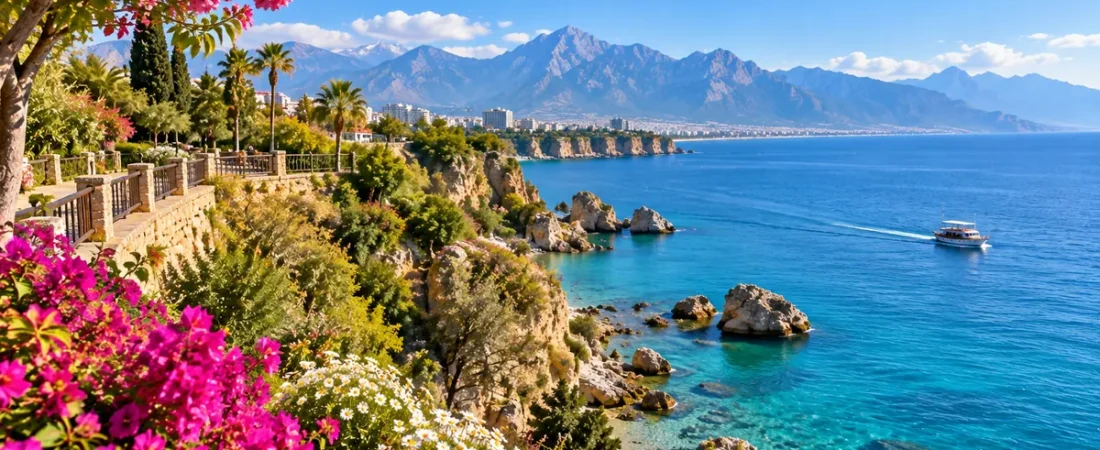
The best time to visit Antalya for most travellers is during April to May or September to October, when the Mediterranean coast is warm but sightseeing is generally more comfortable than during the hottest part of summer.
If your priority is swimming, sunbathing and a classic beach holiday, June through September offers hotter and drier conditions. If you mainly want to explore Kaleiçi, Perge, Aspendos and other historic attractions, spring and autumn are usually easier for long days outdoors.
Winter is quieter and considerably cooler, but Antalya remains a viable destination for cultural sightseeing throughout much of the year.
This guide explains Antalya’s weather, crowds and travel conditions season by season so you can decide when to visit.
For an introduction to the destination, start with our Antalya Travel Guide.
Antalya Weather Overview
Antalya has a Mediterranean climate characterised by hot, dry summers and mild, wetter winters.
The difference between seasons is significant.
Official long-term climate statistics show average daytime highs of around 15°C in January, compared with approximately 34–35°C in July and August.
Rainfall follows almost the opposite pattern.
July and August receive very little average rainfall, while December and January are among the wettest months.
This means there is no single perfect month for every traveller.
Your ideal time depends on whether you prioritise beaches, sightseeing, archaeological sites, lower temperatures or fewer visitors.
Antalya in Spring: March to May
Spring is one of Antalya’s most attractive seasons for sightseeing.
Temperatures rise steadily while the landscape is generally greener than it is after months of dry summer weather.
March
March marks the transition from winter towards warmer spring conditions.
The average temperature is around 13°C, with average daytime highs of approximately 18°C.
You can comfortably explore Kaleiçi, Hadrian’s Gate and archaeological sites without summer heat.
However, March is not a guaranteed beach month.
Cooler days and rain are still possible, and many travellers will find the Mediterranean too cool for extended swimming.
Choose March if sightseeing matters much more than swimming.
April
April is an excellent month for active sightseeing.
Average daytime highs reach approximately 21–22°C, making long walks around Antalya considerably more comfortable than during midsummer.
This is a particularly good time for visiting Perge, Aspendos and Termessos, where much of your day may be spent outdoors with limited shade.
Rain is still possible, but April is considerably drier than winter.
Beach days may be pleasant when the weather is sunny, although sea conditions will not feel as warm as they do later in the year.
May
May is one of the strongest all-round months for Antalya.
Average daytime highs rise to approximately 26°C, while average rainfall falls considerably compared with early spring.
The weather is warm enough for coastal activities while generally remaining more comfortable for sightseeing than July or August.
Visitors who want a combination of Kaleiçi, beaches, waterfalls and ancient sites should seriously consider May.
If I were planning a first Antalya trip focused equally on sightseeing and relaxation, May would be one of my preferred periods.
Antalya in Summer: June to August
Summer is Antalya’s classic beach season.
Expect long sunny days, very little rain and high temperatures.
This is ideal for swimming and resort holidays but less comfortable for intensive archaeological sightseeing.
June
June provides a useful transition between spring and peak summer.
The average daytime high is approximately 31–32°C, and rainfall becomes uncommon.
Beach conditions are much more dependable than during spring.
June can therefore work extremely well for travellers who want a summer holiday but would prefer to avoid the most intense heat of July and August.
Outdoor sightseeing is still best scheduled for morning or later afternoon.
July
July is hot, dry and intensely summery.
Average daytime highs are close to 35°C, while the average number of rainy days is extremely low.
For travellers staying at a resort or spending most of the trip swimming, July delivers classic Mediterranean summer conditions.
For sightseeing, however, the heat can become tiring.
Walking around exposed archaeological sites such as Perge in the middle of the afternoon is far less comfortable than visiting during spring or autumn.
If travelling in July, start outdoor sightseeing early and reserve the hottest hours for lunch, shade, swimming or indoor attractions.
August
August is similarly hot.
Official climate normals show an average temperature of around 29°C and average daytime highs close to 35°C.
Rainfall is minimal.
In fact, August has historically averaged fewer than one rainy day across the month under the 1991–2020 climate normals.
Recent conditions reinforce the need to take summer heat seriously: the Turkish State Meteorological Service reported that August 2026 temperatures around Antalya were above seasonal normals.
For a beach-focused holiday, August remains attractive.
For archaeology-heavy itineraries, it requires careful planning.
Antalya in Autumn: September to November
Autumn is another excellent season in Antalya.
September remains very summery, while October offers a particularly attractive combination of warmth and more comfortable sightseeing conditions.
September
September is one of the best months for travellers who want warm beach conditions without visiting at the height of midsummer.
Average daytime highs remain around 31–32°C, and rainfall is still relatively limited.
The Mediterranean has also had the entire summer to warm up.
That makes September particularly appealing for travellers who want swimming as well as sightseeing.
Start archaeological visits early in the day because afternoons can still be hot.
October
October is one of my favourite months for a balanced Antalya trip.
Average daytime highs are approximately 27°C, while nights are noticeably more comfortable than in summer.
This can be excellent weather for exploring Kaleiçi, visiting waterfalls and walking around ancient sites.
Beach time can still be enjoyable during warm, sunny periods.
Rain becomes more likely than in September, so the weather is not quite as consistently dry as during summer.
Nevertheless, October offers one of Antalya’s strongest combinations of warmth and comfortable sightseeing.
November
November feels much more like late autumn.
Average daytime highs fall to around 21–22°C.
The month can still produce beautiful sunny days, particularly for sightseeing, but rainfall increases substantially compared with September and October.
Choose November if you care more about culture and archaeology than guaranteed beach weather.
Antalya in Winter: December to February
Winter is Antalya’s quietest season.
The city does not experience the severe winters found in many inland or northern European destinations, but conditions are much wetter than in summer.
December
December has an average daytime high of approximately 17°C.
It is also historically Antalya’s wettest month by total average rainfall.
That does not mean it rains constantly, but visitors should be prepared for wet days.
Swimming is unlikely to be the main attraction for most travellers.
Instead, concentrate on Kaleiçi, restaurants, museums and archaeological sites when conditions are dry.
January
January is generally Antalya’s coolest month.
Average temperatures are around 10°C, with average daytime highs near 15°C.
Rain is relatively frequent compared with summer.
The advantage is that extreme summer heat is completely absent.
Travellers interested primarily in Roman ruins and local culture may appreciate being able to explore without midsummer temperatures.
February
February begins the gradual transition towards spring.
Average daytime highs are around 16°C.
Rain remains possible, but sightseeing can be pleasant during sunny periods.
Like January, February is better suited to cultural trips than conventional beach holidays.
Best Time to Visit Antalya for Beaches
For a classic beach holiday, choose approximately June through September.
July and August provide the most consistently hot and dry summer conditions.
June is slightly less intense while still offering strong beach weather.
September remains hot and is particularly attractive because the Mediterranean has warmed throughout summer.
Travellers wanting a balance between swimming and sightseeing should consider June or September rather than the hottest weeks of July and August.
Antalya’s two best-known urban beach areas offer different experiences.
Konyaaltı has a pebble shoreline and dramatic mountain backdrop, while Lara is known for sandy beach areas.
Our Where to Stay in Antalya guide compares both districts.
Best Time for Sightseeing
For sightseeing, I would favour April, May, October and parts of November.
These months generally avoid the most intense summer temperatures.
This matters particularly if you plan to visit archaeological sites.
Perge, Aspendos and Termessos all involve substantial outdoor walking.
At Perge, for example, you may spend several hours walking through exposed ruins with relatively little shade.
Our 3 Days in Antalya Itinerary combines the city, beaches, waterfalls, Perge and Aspendos. Following that itinerary is generally easier in spring or autumn than during the hottest part of summer.
Best Time for Perge and Aspendos
Spring and autumn are particularly good for archaeological excursions.
April and May provide warming conditions before peak summer.
October and November bring cooler temperatures after the hottest months.
If you visit during June, July, August or September, go early.
Carry water, sunscreen and a hat.
Avoid assuming that because you are visiting ancient ruins rather than a beach, sun exposure is less important. Archaeological sites can be among the most exposed places on your Antalya itinerary.
Best Time to Visit Antalya for Fewer Crowds
Winter generally brings fewer leisure visitors than the main summer season.
March, parts of April and November can also feel calmer than peak beach season.
However, fewer visitors come with trade-offs.
Beach weather becomes less reliable and winter rainfall is significantly higher.
For travellers wanting reasonable weather without the strongest summer demand, shoulder-season periods such as April–May and October are particularly attractive.
Best Time for Families
Families planning a traditional beach holiday often favour the school summer period.
July and August provide dependable hot weather, but parents should take the heat seriously, particularly with younger children.
June can offer a useful alternative where school schedules allow.
September can also be excellent for families not restricted by school holidays.
Families primarily interested in sightseeing may find April, May or October considerably more comfortable.
Best Time for Couples
Couples can enjoy Antalya throughout much of the year.
For a combination of Old Town dinners, coastal walks, beach time and day trips, May, June, September and Octoberare particularly attractive.
Kaleiçi is atmospheric in the evening, while Lara and Konyaaltı provide easy access to the Mediterranean.
For resort-focused couples, the summer season offers the widest choice of beach-oriented experiences.
Best Time for Budget Travellers
Accommodation prices vary significantly by property, booking date and demand.
Peak summer can be expensive in popular beach and resort areas.
Travellers focused on keeping costs down should compare dates in spring, late autumn and winter.
However, do not choose the cheapest period without considering what you want to do.
Saving money on a January hotel will not help if your main reason for visiting Antalya is a hot beach holiday.
The best value often comes from matching the season to your priorities rather than simply choosing the lowest room rate.
We will examine accommodation, food, transport and attraction costs in our upcoming Antalya Travel Budget guide.
Antalya Rainfall by Season
Antalya’s rainfall pattern is extremely seasonal.
Official climate normals show average monthly rainfall of only around 4–5 mm in July and August.
December, by comparison, averages well over 250 mm, while January also receives substantial rainfall.
This is one of the clearest differences between Antalya’s summer and winter.
Summer visitors should be more concerned about heat and sun exposure.
Winter visitors should be prepared for rain and maintain flexibility in their itinerary.
Spring and autumn sit between those extremes.
How Hot Is Antalya in Summer?
Very hot.
Official long-term data puts average daytime highs around 35°C in July and August.
Temperatures can occasionally climb significantly above those averages.
Historical records include readings above 40°C.
That does not mean every summer day reaches extreme levels, but visitors should plan around heat rather than treating it as an unusual event.
Avoid strenuous outdoor sightseeing at midday, stay hydrated and use sun protection.
Is Antalya Warm in Winter?
Compared with many European destinations, Antalya’s winters are mild.
That does not make winter a beach season in the conventional sense.
January’s average daytime high is around 15°C, and wet weather is considerably more common.
Sunny winter days can feel pleasant for walking and sightseeing, but evenings can be cool.
Pack layers and a waterproof outer layer.
What to Pack by Season
Spring
Bring lightweight daytime clothing, comfortable walking shoes, sun protection and a light jacket.
A waterproof layer is useful, particularly earlier in spring.
Summer
Prioritise lightweight breathable clothing, sunscreen, sunglasses, a hat and a reusable water bottle.
Comfortable footwear remains important because Antalya’s historic streets and archaeological sites involve substantial walking.
Autumn
Early autumn still requires summer clothing.
By November, add warmer evening layers and rain protection.
Winter
Bring layers, closed walking shoes and waterproof clothing.
You may still experience sunny mild afternoons, so avoid packing only heavy winter clothes.
Best Month to Visit Antalya Overall
If I had to choose a period for a first trip combining beaches and sightseeing, I would look closely at May, late September or October.
May provides warm spring weather before the strongest summer heat.
Late September retains summer warmth while moving beyond the heart of midsummer.
October offers more comfortable sightseeing temperatures while still providing plenty of opportunities to enjoy Antalya’s Mediterranean setting.
Travellers who want maximum heat and guaranteed summer atmosphere should instead choose July or August.
Antalya Month-by-Month Summary
January: Cool and relatively wet; best for quiet sightseeing.
February: Mild winter conditions with rain possible.
March: Improving weather; good for sightseeing but early for a beach holiday.
April: Excellent for walking and archaeological sites.
May: One of the best all-round months.
June: Hot, dry and excellent for beaches.
July: Very hot and extremely dry; peak summer conditions.
August: Very hot, dry and ideal for resort holidays.
September: Hot with excellent beach conditions.
October: Warm and particularly good for mixed sightseeing and coastal time.
November: Mild but wetter; good for culture and archaeology.
December: Mild compared with northern Europe but Antalya’s rainiest period.
Final Thoughts on the Best Time to Visit Antalya
The best time to visit Antalya depends on what you want from the trip.
For a balanced first visit, choose April–May or September–October.
For beaches and hot Mediterranean weather, choose June–September.
For archaeology and long days of walking, spring and autumn are more comfortable.
For lower-season sightseeing without beach expectations, winter can still be rewarding.
Whatever season you choose, Antalya offers more than a beach holiday. Kaleiçi, waterfalls, ancient cities and the Mediterranean coastline make it a destination that changes character throughout the year.
Use our Antalya Travel Guide for complete trip planning, compare neighbourhoods in Where to Stay in Antalya, and follow our 3 Days in Antalya Itinerary for a practical first-time route.
Explore more places through our destinations page or browse our complete collection of itineraries.