
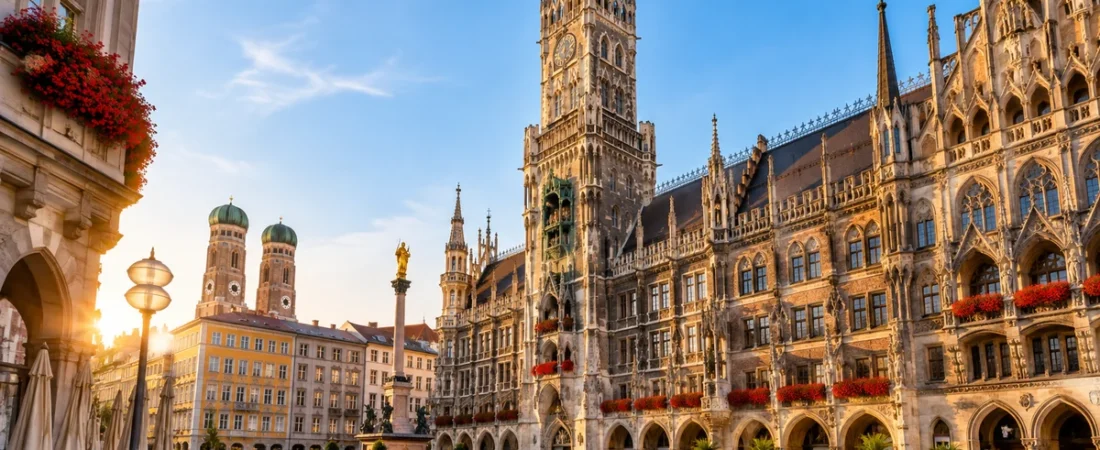
Munich blends grand royal architecture, lively beer halls, excellent museums, green parks and centuries of Bavarian tradition into one of Germany’s most rewarding city breaks. Whether you want to explore historic palaces, wander through the Old Town, relax in the English Garden or experience Oktoberfest, this Munich travel guide covers the essential sights, transport, neighbourhoods, food and practical information you need for a first visit.
Price note: All prices in this article are approximate and were checked at the time of publication. Prices may change.
Why Visit Munich?
Munich is the capital of Bavaria and Germany’s third-largest city. Despite its size, many of its most famous attractions are concentrated around a compact historic centre that is easy to explore on foot.
The city is particularly appealing because it combines several different travel experiences. One morning can be spent among royal rooms and historic churches, followed by lunch at a traditional market and an afternoon beside lakes and lawns in the English Garden.
Munich also makes a convenient base for exploring more of Bavaria. Castles, Alpine scenery, historic towns and lakes are accessible on day trips, although the city itself deserves at least 3 full days.
If you are planning a longer trip through Germany, our Berlin travel guide can help you combine Bavaria with the German capital.
Top Tours & Experiences in Munich
Discover popular Munich tours and experiences. Check current availability, ratings and prices before you book.
Affiliate disclosure: If you book through these links, we may earn a commission from Viator. This does not increase the price you pay.
Best Things to Do in Munich
Start at Marienplatz
Marienplatz is the natural starting point for a first visit to Munich.
The square has been at the centre of city life for centuries and is dominated by the elaborate Neues Rathaus, or New Town Hall. Its neo-Gothic façade is one of Munich’s most recognisable sights.
Walk through the surrounding pedestrian streets to discover churches, cafés, shops and historic buildings. Early morning is particularly pleasant if you want to see the square before the busiest sightseeing hours.
From Marienplatz, many Old Town attractions are within easy walking distance.
Explore Viktualienmarkt
A short walk from Marienplatz brings you to Viktualienmarkt, Munich’s famous food market.
Stalls sell fruit, vegetables, cheese, meat, flowers, spices and regional specialities. It is a good place to see a more everyday side of central Munich while trying Bavarian food.
The market also has a traditional beer garden. Rather than rushing through, allow time to browse the stalls and stop for something to eat.
Visit the Munich Residence
The Munich Residence was the city palace of Bavaria’s rulers and today forms one of the most important palace complexes in Germany.
Its rooms reveal several centuries of royal history through elaborate halls, apartments, art collections and decorative objects. The Antiquarium, with its long Renaissance hall, is among the highlights.
For 2026, regular admission to the Residence Museum is €10, while the Treasury also costs €10. A combined Residence Museum and Treasury ticket is €15. A larger combination including the Cuvilliés Theatre costs €20.
Allow at least two hours if you want to explore the interiors without rushing.
See the Frauenkirche
The twin towers of the Frauenkirche are an unmistakable part of Munich’s skyline.
Located close to Marienplatz, the cathedral is easy to include while exploring the Old Town. Its relatively restrained interior contrasts with some of Bavaria’s more ornate churches.
The surrounding pedestrian streets are also worth exploring slowly rather than moving directly from one landmark to another.
Spend Time in the English Garden
Munich’s English Garden provides an enormous green escape close to the city centre.
Walking and cycling paths pass through lawns, wooded areas and alongside waterways. One of its most unusual attractions is the Eisbach wave, where experienced surfers ride a permanent river wave.
Watching the surfers costs nothing and has become a classic Munich experience.
Farther into the park, the Chinese Tower and surrounding beer garden provide a completely different atmosphere. On a warm day, the English Garden can easily fill an entire afternoon.
Discover Munich’s Best Museums
Deutsches Museum
The Deutsches Museum is one of Munich’s most impressive attractions for anyone interested in science and technology.
Its exhibitions cover subjects including aviation, astronomy, physics, engineering, chemistry and transport. The scale means trying to see everything in one visit is unrealistic, so choose the sections that interest you most.
The main Museum Island location is open daily from 9:00 to 17:00. In 2026, a regular adult day ticket costs €16, while a family ticket costs €33.
Families should allow several hours because many exhibits reward slower exploration.
Alte Pinakothek and the Kunstareal
Art lovers should make time for Munich’s Kunstareal museum district.
The area brings together several important museums and galleries within walking distance of one another. The Alte Pinakothek is particularly known for European Old Master paintings.
Rather than attempting multiple large museums in a single day, choose one or two according to your interests and leave time for the surrounding neighbourhood.
Visit Nymphenburg Palace
Nymphenburg Palace lies west of central Munich and provides an impressive contrast to the compact Old Town.
The former summer residence of Bavaria’s rulers is surrounded by extensive palace grounds, canals and smaller park buildings.
In 2026, admission to Nymphenburg Palace itself is €10 for adults. The combined ticket costs €20 from 1 April to 15 October and €16 during the winter period. The smaller park palaces are closed during winter.
The palace and Marstallmuseum generally open from 9:00 to 18:00 between April and 15 October, changing to 10:00–16:00 from 16 October through March.
Note that the Lacquer Cabinet remains closed for restoration until the end of 2027. The palace park is still well worth exploring, but visitors in 2026 should also be aware that fountain operations are affected by repair work.
Experience Munich’s Beer Culture
Beer is deeply connected with Munich’s identity, but you do not need to visit during Oktoberfest to experience the tradition.
Historic beer halls and beer gardens can be found throughout the city. Hofbräuhaus is the most famous and attracts large numbers of visitors, while numerous other establishments offer a less tourist-focused experience.
Try traditional Bavarian dishes such as Weißwurst, pretzels, Schweinshaxe, Obatzda or regional dumplings.
Beer gardens become especially enjoyable in warmer weather, when locals gather at communal tables beneath chestnut trees.
Oktoberfest in Munich
Oktoberfest is Munich’s biggest annual event and dramatically changes the atmosphere of the city.
In 2026, Oktoberfest runs from 19 September to 4 October at Theresienwiese.
Entry to the main festival grounds and beer tents is free, although food, drinks and rides are paid separately. The historic Oide Wiesn section has a €4 admission charge for visitors aged 15 and over, while children aged 14 and under enter free. Admission to Oide Wiesn becomes free after 9 p.m.
Accommodation prices and demand rise significantly during the festival, so visitors travelling specifically for Oktoberfest should organise their stay well in advance.
Where to Stay in Munich
Altstadt-Lehel
Altstadt-Lehel is an excellent choice for first-time visitors who want to stay close to Marienplatz, Viktualienmarkt, the Residence and major churches.
The central location reduces transport time, although accommodation can be expensive.
Maxvorstadt
Maxvorstadt suits travellers interested in museums, cafés and a slightly less tourist-heavy environment.
The Kunstareal museum district is nearby, while central Munich remains easily accessible.
Ludwigsvorstadt-Isarvorstadt
This broad area includes neighbourhoods south and southwest of the historic centre and can provide convenient access to restaurants, nightlife and Theresienwiese.
It is particularly useful for Oktoberfest visitors, although prices can rise dramatically during the festival.
Schwabing
Schwabing offers cafés, restaurants and convenient access to the English Garden. It can be a good choice for travellers who prefer staying outside the busiest tourist centre while remaining well connected by public transport.
Getting Around Munich
Munich has an extensive integrated public transport system using U-Bahn trains, S-Bahn trains, trams and buses.
For most visitors staying within the city, Zone M covers the principal central areas.
From January 2026, an adult single ticket starts at €4.20, while a Zone M single-day ticket costs €10.10 and allows unlimited journeys in the selected area until 6:00 the following morning.
If you expect to make several journeys during one day, compare the day-ticket price with individual fares before purchasing.
Munich is also highly walkable in the centre. Marienplatz, Viktualienmarkt, Frauenkirche and the Residence can comfortably be combined on foot.
Getting From Munich Airport to the City
Munich Airport lies outside the central city fare zone in Zone 5.
S-Bahn services provide a straightforward public-transport connection between the airport and central Munich.
For visitors who plan to continue using public transport after arriving, the Airport-City-Day-Ticket is particularly convenient. In 2026, the individual ticket costs €17.50 and covers Zones M–5, including travel between the airport and Munich city area plus further journeys until 6:00 the following morning.
Check your destination and ticket validity before boarding, particularly if your accommodation is outside central Munich.
Best Time to Visit Munich
Late spring and early autumn are excellent periods for walking, parks and outdoor sightseeing.
Summer brings warm weather and long daylight hours, making it particularly suitable for beer gardens and the English Garden, although major attractions can be busier.
September and early October are dominated by Oktoberfest. This can be an unforgettable time to visit if the festival is your priority, but expect greater demand for accommodation.
Winter brings colder weather but also Christmas markets and a more atmospheric indoor focus on museums, cafés and historic beer halls.
If you are building a wider Central European itinerary, consider combining Munich with our Vienna travel guide or Prague travel guide.
How Many Days Do You Need in Munich?
3 days is a good starting point for a first visit.
Spend the first day exploring Marienplatz, the Old Town, Viktualienmarkt and the Residence. Use the second for museums and the English Garden, then dedicate the third to Nymphenburg Palace and neighbourhood exploration.
Four or five days give you more flexibility and make it easier to add a day trip without sacrificing important Munich attractions.
Browse our Travel Guides for more city-planning ideas across Europe and beyond.
Practical Tips for Visiting Munich
Book major attractions in advance when timed admission is available, particularly during busy travel periods.
Comfortable shoes are essential because central Munich is best experienced on foot. Carry a light waterproof layer even in warmer months because weather can change quickly.
Check your public transport ticket’s zones and validation requirements before travelling. Airport journeys require more zones than ordinary central-city trips.
During Oktoberfest, expect crowded transport around Theresienwiese and allow extra time for journeys. Accommodation should be reserved much earlier than for an ordinary Munich visit.
Finally, avoid packing every hour with attractions. Munich is a city where sitting in a beer garden, exploring a market or walking through a park can be just as memorable as visiting another museum.
Is Munich Worth Visiting?
Munich is an excellent destination for travellers who enjoy history, architecture, museums, food and outdoor spaces.
Its historic centre is manageable for a short trip, while attractions such as Nymphenburg Palace, the Deutsches Museum and English Garden provide enough variety to fill several days.
Add Bavarian food, traditional beer gardens, efficient public transport and convenient connections to the rest of southern Germany and Central Europe, and Munich works equally well as a weekend destination or part of a longer European journey.
Top Tours & Experiences in Munich
Discover popular Munich tours and experiences. Check current availability, ratings and prices before you book.
Affiliate disclosure: If you book through these links, we may earn a commission from Viator. This does not increase the price you pay.
Explore more places through our destinations page or browse our complete collection of itineraries.