
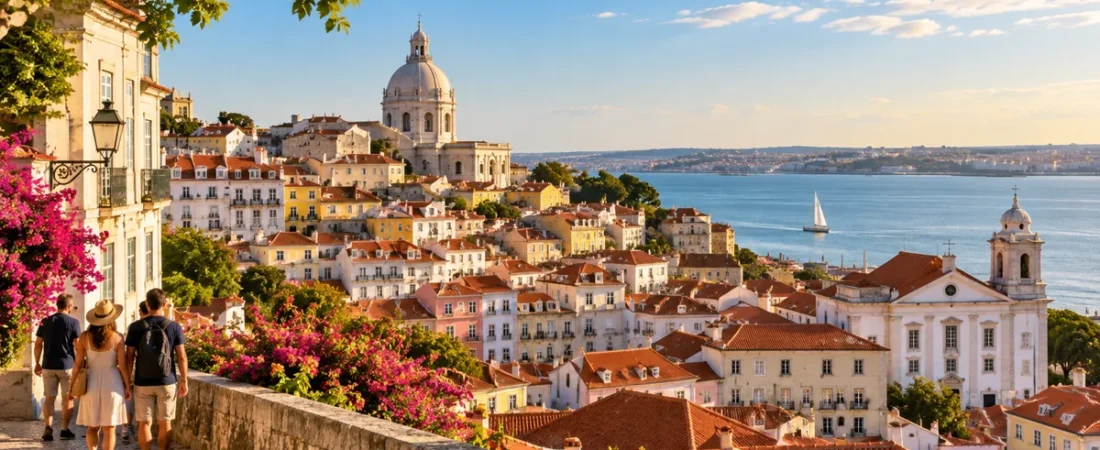
3 days is enough time to experience many of Lisbon’s highlights if you organise your sightseeing geographically. This 3 days in Lisbon itinerary combines the historic streets of Alfama, central Baixa and Chiado, the monuments of Belém, famous viewpoints, Portuguese food and plenty of time to enjoy the atmosphere of Portugal’s capital.
Instead of rushing between attractions, this itinerary groups nearby places together. Day one focuses on Lisbon’s historic centre and Alfama, day two explores Belém and the riverfront, and day 3 combines central neighbourhoods, viewpoints and modern Lisbon.
For a broader introduction to the city before planning each day, read our Lisbon Travel Guide.
Still deciding which neighbourhood to use as your base? Read our Where to Stay in Lisbon guide to compare the best areas for first-time visitors, couples, families and nightlife.
Price note: All prices in this article are approximate and were checked at the time of publication. Prices may change.
Top Tours & Experiences in Lisbon
Discover popular Lisbon tours and experiences. Check current availability, ratings and prices before you book.
Affiliate disclosure: If you book through these links, we may earn a commission from Viator. This does not increase the price you pay.
3 Days in Lisbon at a Glance
Day 1: Baixa → Praça do Comércio → Alfama → São Jorge Castle → Lisbon viewpoints
Day 2: Belém → Jerónimos Monastery → Pastéis de Belém → Monument to the Discoveries → Belém Tower → riverside sunset
Day 3: Avenida da Liberdade → Chiado → Bairro Alto → São Pedro de Alcântara → Parque das Nações
This schedule works particularly well for first-time visitors because it covers Lisbon’s major historic areas without requiring constant travel across the city.
Day 1: Historic Lisbon, Alfama and São Jorge Castle
Your first day introduces you to the oldest and most atmospheric parts of Lisbon.
Wear comfortable shoes. Today’s route includes cobbled streets, hills and staircases.
Morning: Start at Praça do Comércio
Begin your Lisbon itinerary beside the Tagus River at Praça do Comércio.
This enormous square is surrounded by distinctive yellow buildings and provides an impressive introduction to the city.
Walk toward the river first and enjoy the view before heading beneath the monumental Rua Augusta Arch.
You can admire the arch from street level for free.
There is also a paid observation platform if you want an elevated view, but Lisbon has plenty of excellent free viewpoints later in today’s itinerary.
Walk Along Rua Augusta
Continue north along pedestrianised Rua Augusta.
The street runs through the heart of Baixa and is lined with shops, cafés and restaurants.
Rather than stopping at the first restaurant you see, use this part of the morning mainly for sightseeing.
Eventually you will reach Rossio Square.
Explore Rossio Square
Rossio has served as one of Lisbon’s principal meeting places for centuries.
Look for its distinctive wave-pattern paving and fountains before exploring the surrounding streets.
From here, start making your way east toward Alfama.
Late Morning: Enter Alfama
Alfama is where Lisbon becomes particularly atmospheric.
Narrow streets twist up the hillside between traditional houses, churches and small squares.
Do not worry about following the most direct route.
Part of Alfama’s appeal comes from wandering.
As you climb, look for tiled façades, laundry hanging between buildings and glimpses of the Tagus between rooftops.
Stop at Miradouro de Santa Luzia
One of the best stops on the climb is Miradouro de Santa Luzia.
This free terrace overlooks Alfama and the river.
Decorative tiles and greenery make the viewpoint almost as attractive as the panorama itself.
Spend a little time here rather than simply taking a photograph and leaving.
Continue to Portas do Sol
Just nearby is Miradouro das Portas do Sol.
The view opens across Alfama’s red rooftops toward the Tagus.
Because these two viewpoints are so close together, it makes sense to visit both during the same walk.
Lunch in Alfama
Stay in Alfama for lunch.
Look for a small Portuguese restaurant rather than automatically choosing somewhere directly beside the busiest viewpoints.
Good options to look for include grilled fish, bacalhau dishes, soup or a bifana.
Allow around an hour before continuing uphill.
Afternoon: Visit São Jorge Castle
After lunch, continue toward Castelo de São Jorge.
The castle occupies one of Lisbon’s most prominent hills and provides extensive views over the historic centre and Tagus.
Current adult admission is approximately €17. Discounted tickets are available for eligible younger visitors and seniors.
The castle is currently open:
March–October: 9:00 am–9:00 pm, last admission 8:30 pm.
November–February: 9:00 am–6:00 pm, last admission 5:30 pm.
It closes on several specified public-holiday dates.
Allow approximately 1½–2 hours.
The ticket also currently includes access to selected guided activities, subject to availability.
Walk Back Through Alfama
After leaving the castle, do not immediately take transport downhill.
Walk through a different section of Alfama.
Descending is considerably easier than climbing, and you will probably discover streets you missed earlier.
If you hear fado coming from restaurants as evening approaches, you are in one of the neighbourhoods most closely associated with the music.
Evening: Sunset from a Miradouro
Finish your first day at one of Lisbon’s hilltop viewpoints.
Good choices include:
- Miradouro da Senhora do Monte
- Miradouro da Graça
- Portas do Sol
- Santa Luzia
Sunset times change significantly throughout the year, so check the local sunset time on the day of your visit.
Afterwards, have dinner in Alfama, Graça or central Lisbon.
Day 2: Belém and Lisbon’s Waterfront
Day two is dedicated primarily to Belém, home to some of Portugal’s most important monuments.
Starting early is worthwhile.
Morning: Travel to Belém
Belém lies west of central Lisbon.
Public transport connects the district with the centre, and the journey itself gives you a different view of the city.
Try to arrive early enough to enjoy the major monuments before the busiest part of the day.
Visit Jerónimos Monastery
Start with Mosteiro dos Jerónimos.
The UNESCO-listed monastery is one of Portugal’s most celebrated examples of Manueline architecture.
Its extraordinary stonework reflects the wealth and influence associated with Portugal’s maritime era.
The monastery is also closely connected with Portuguese exploration, and Vasco da Gama’s tomb is located in the church.
Allow approximately 1–1½ hours depending on queues and which areas you visit.
Opening arrangements can change, so check current conditions shortly before visiting.
Travellers using the Lisboa Card should be aware that Jerónimos currently requires a reserved date and time after the physical card has been redeemed.
Try Pastéis de Belém
After visiting the monastery, take a break for one of Lisbon’s most famous pastries.
Pastéis de nata are sold throughout Portugal, but Belém has a particularly strong connection with the custard tart.
Order one with coffee and, if you like, sprinkle a little cinnamon on top.
This is a good point in the itinerary to slow down rather than immediately rushing to the next monument.
Walk Through Belém
Continue toward the Tagus.
Belém is relatively flat compared with Alfama, making this one of the easiest parts of your 3-day itinerary to explore on foot.
Walk through the landscaped areas and toward the waterfront.
Visit the Monument to the Discoveries
The Padrão dos Descobrimentos, or Monument to the Discoveries, stands prominently beside the Tagus.
You can see the exterior and surrounding waterfront without paying admission.
A paid viewpoint is available for visitors who want to go inside.
Look down at the large compass rose in the pavement in front of the monument before continuing along the river.
Walk Along the Tagus
The waterfront promenade between the Monument to the Discoveries and Belém Tower is one of the most enjoyable walks in this part of Lisbon.
You will have broad river views and opportunities to see the 25 de Abril Bridge in the distance.
Allow time simply to enjoy the setting.
Afternoon: See Belém Tower
Continue to Torre de Belém.
The UNESCO-listed tower is one of Lisbon’s best-known landmarks.
Even if you decide not to enter, seeing it from the waterfront is worthwhile.
Because access arrangements and restoration work can change, verify the current opening situation before your trip.
Lisboa Card holders currently need a reserved date and time for Belém Tower after obtaining the physical card, with availability subject to daily capacity.
Relax Beside the River
Do not immediately return to central Lisbon after seeing the tower.
Spend some time walking or sitting beside the Tagus.
This slower period helps prevent a 3-day city itinerary from becoming a continuous sequence of monuments.
Late Afternoon: Return Toward Central Lisbon
Head back toward the centre during late afternoon.
If you still have plenty of energy, stop around Cais do Sodré and walk part of the riverfront.
Otherwise, return to your accommodation for a short break before dinner.
Evening: Explore Chiado
Spend the evening around Chiado.
This elegant district has historic cafés, shops, restaurants and theatres.
Walk around Rua Garrett and the surrounding streets before dinner.
If you want nightlife afterwards, neighbouring Bairro Alto is only a short walk away.
Day 3: Central Lisbon, Viewpoints and Modern Lisbon
Your final day combines several different sides of Lisbon.
You will begin around the elegant central avenues, explore Chiado and Bairro Alto, and then finish in modern Parque das Nações.
Morning: Avenida da Liberdade
Start at Avenida da Liberdade.
The broad, tree-lined avenue feels very different from Alfama’s narrow medieval streets.
Walk south toward the historic centre, enjoying the shaded pedestrian areas and architecture.
Continue toward Rossio.
Explore Chiado
From the centre, make your way toward Chiado.
If you passed through quickly the previous evening, this morning gives you time to explore properly.
Browse the streets, stop for coffee and appreciate the mix of historic architecture and contemporary city life.
See the Santa Justa Lift
Walk toward the Elevador de Santa Justa.
The iron lift is one of central Lisbon’s distinctive landmarks.
However, the official Lisboa Card information currently lists the Santa Justa Lift as temporarily closed, so do not build your itinerary around riding it without checking whether it has reopened.
You can still explore the surrounding Baixa and Chiado streets.
Continue to Bairro Alto
Climb toward Bairro Alto.
The neighbourhood is famous for nightlife, but during the daytime its narrow streets provide a much quieter experience.
Street art, traditional buildings and small businesses make it interesting even if you have no interest in bars.
Miradouro de São Pedro de Alcântara
Continue to Miradouro de São Pedro de Alcântara.
This free viewpoint provides an excellent panorama across central Lisbon toward São Jorge Castle.
It is particularly useful on day 3 because you can look back across many of the neighbourhoods you explored on your first day.
Lunch Around Chiado or Príncipe Real
Choose Chiado, Bairro Alto or nearby Príncipe Real for lunch.
This is a good opportunity to try another Portuguese dish.
Consider bacalhau, grilled fish, octopus, a bifana or one of the city’s modern interpretations of traditional Portuguese food.
Afternoon: Parque das Nações
After lunch, use the Metro to travel to Parque das Nações.
The area was transformed for Expo ’98 and provides a completely different Lisbon experience.
Instead of narrow historic streets, you will find contemporary architecture, broad public spaces and a modern riverside promenade.
Walk the Modern Waterfront
Spend some time walking beside the Tagus.
The open riverfront makes a relaxing contrast to the crowded historic centre.
You can simply explore the district for free or choose one of its paid attractions.
Optional: Lisbon Oceanarium
Families and travellers interested in marine life can visit the Oceanário de Lisboa.
If the Oceanarium is not a priority for you, use the time to explore Parque das Nações at a slower pace instead.
There is no need to add a paid attraction simply to fill the afternoon.
Evening: Final Lisbon Sunset
Return toward central Lisbon for your final evening.
Choose a viewpoint you have not visited yet.
Miradouro da Senhora do Monte is particularly good for broad city views, while the riverside provides a completely different sunset experience.
Then finish your trip with a relaxed Portuguese dinner.
Getting Around During Your 3 Days in Lisbon
Lisbon’s public transport network includes Metro, buses, trams and funiculars.
For 2026, the standard Carris/Metro ticket costs €1.90 and is valid under its stated 60-minute conditions.
A Metro journey using zapping costs €1.72.
Contactless bank-card Metro travel currently costs €1.92 per journey.
The 24-hour Carris/Metro ticket costs €7.25 and allows unlimited travel on participating Carris and Metro services for 24 hours after first validation.
If you expect to use several trams, buses and Metro journeys during one sightseeing day, compare the 24-hour ticket with paying individually.
Walking will still account for a large part of this itinerary.
Should You Ride Tram 28?
Tram 28E is one of Lisbon’s most famous experiences because it passes through several historic neighbourhoods.
It can also become extremely crowded.
If riding Tram 28 is important to you, try travelling earlier in the day rather than during the busiest sightseeing periods.
Alternatively, experience one of Lisbon’s other historic trams.
You do not need Tram 28 to complete this itinerary successfully.
Where to Stay for This Lisbon Itinerary
For a first 3-day visit, Baixa and Chiado are particularly convenient because of their central location.
Alfama provides more historic atmosphere but involves considerably more climbing.
Bairro Alto works well for nightlife, while Avenida da Liberdade provides larger hotels and convenient transport.
When we publish our upcoming Where to Stay in Lisbon guide, we will compare these neighbourhoods in much more detail.
How Much Will 3 Days in Lisbon Cost?
Your total cost depends heavily on accommodation and how many paid attractions you visit.
Transport is comparatively manageable, especially if you walk extensively.
Many of Lisbon’s best experiences—including historic neighbourhoods, public squares, riverside walks and miradouros—cost nothing.
São Jorge Castle is one of the significant paid attractions in this itinerary, with current adult admission at approximately €17.
Food costs vary considerably between simple cafés and restaurants in heavily visited areas.
Our upcoming Lisbon Travel Budget guide will provide detailed estimates for budget, mid-range and more comfortable trips.
Is the Lisboa Card Worth It for 3 Days?
Possibly, but calculate before buying.
The Lisboa Card combines public transport with admission or discounts at participating attractions.
It becomes more attractive if your itinerary contains several included paid sights and you intend to use public transport frequently.
If your plans focus heavily on walking, viewpoints and free attractions, buying individual tickets may be better.
Remember that current Lisboa Card arrangements require date-and-time reservations for both Belém Tower and Jerónimos Monastery after redeeming the physical card.
Tips for Following This 3 Days in Lisbon Itinerary
Start early. This is particularly useful for Belém and major paid attractions.
Wear comfortable shoes. Lisbon’s hills and cobblestones make footwear unusually important.
Do not over-plan meals. Leave room to stop somewhere appealing during your walks.
Use public transport strategically. Walking is excellent within neighbourhoods, but there is little reason to exhaust yourself crossing the city on foot.
Keep some flexibility. Opening arrangements, weather and queues can affect your schedule.
Check major attractions shortly before visiting. Temporary closures and reservation systems can change.
Can You See Lisbon in 3 Days?
Yes.
3 days gives first-time visitors enough time to experience Lisbon’s historic centre, Alfama, Belém, several viewpoints and at least part of the modern city.
The key is not trying to see everything.
Lisbon rewards slower exploration. Spending twenty minutes at a miradouro or wandering an unexpected Alfama street can be more memorable than squeezing another attraction into your schedule.
If you have a fourth day, consider a day trip to Sintra or Cascais.
For more background on Lisbon’s attractions, neighbourhoods, food and transport, return to our Lisbon Travel Guide.
Book Your Lisbon Experiences
Ready to start planning? Compare popular Lisbon tours and activities, check current prices and availability, and book the experiences that suit your trip.
Affiliate disclosure: If you book through these links, we may earn a commission from Viator. This does not increase the price you pay.
Explore more places through our destinations page or browse our complete collection of itineraries.