
Planning 3 days in Kuala Lumpur gives you enough time to experience Malaysia’s capital without rushing from attraction to attraction. Over 3 days, you can see the Petronas Twin Towers, climb the colourful steps at Batu Caves, explore Chinatown and Merdeka Square, discover Kuala Lumpur’s multicultural heritage and spend an evening enjoying the food and atmosphere around Bukit Bintang.
This 3 days in Kuala Lumpur itinerary groups attractions geographically wherever possible, helping you spend more time exploring and less time travelling across the city.
If this is your first visit, read our complete Kuala Lumpur Travel Guide before your trip. For help choosing your base, our Where to Stay in Kuala Lumpur guide compares the city’s most convenient neighbourhoods.
Price note: All prices in this article are approximate and were checked at the time of publication. Prices may change.
Top Tours & Experiences in Kuala Lumpur
Discover popular Kuala Lumpur tours and experiences. Check current availability, ratings and prices before you book.
Affiliate disclosure: If you book through these links, we may earn a commission from Viator. This does not increase the price you pay.
3 Days in Kuala Lumpur at a Glance
Your 3 days will look like this:
Day 1: Petronas Twin Towers, KLCC Park, Bukit Bintang and Jalan Alor
Day 2: Batu Caves, Chinatown, Central Market, Merdeka Square and River of Life
Day 3: Thean Hou Temple, Brickfields, Perdana Botanical Gardens and a relaxed final evening
This route combines Kuala Lumpur’s modern landmarks, religious sites, historic centre, food and green spaces.
Day 1: Petronas Twin Towers, KLCC and Bukit Bintang
Begin your first day with Kuala Lumpur’s most famous landmark before exploring the modern heart of the city.
Morning: Petronas Twin Towers
Start at the Petronas Twin Towers.
The 88-storey towers are Kuala Lumpur’s defining architectural landmark and provide an excellent introduction to the city’s modern side.
You can admire the towers from ground level for free, but first-time visitors may want to purchase admission to the Skybridge and observation areas.
For international visitors, normal adult admission in 2026 is approximately RM127 on weekdays and RM137 on weekends.
PETRONAS uses timed admission, and tickets are subject to availability.
Book ahead if visiting during a weekend, public holiday or busy travel period.
Arrive at least 15 minutes before your allocated entry time.
Late Morning: KLCC Park
After visiting the towers, walk into KLCC Park.
The landscaped park covers a large green area beneath Kuala Lumpur’s skyscrapers and provides some of the best ground-level views of the Petronas Twin Towers.
Take your time walking the paths and photographing the skyline.
Entry is free.
Because Kuala Lumpur becomes hot and humid quickly, morning is generally more comfortable for walking.
Lunch Around KLCC
KLCC offers an enormous range of restaurants.
You can eat inside Suria KLCC or explore nearby restaurants depending on your budget.
A food court meal will generally cost considerably less than dining in a premium restaurant overlooking the towers.
Do not worry about having an elaborate lunch — tonight’s food experience will be more memorable.
Afternoon: Walk Towards Bukit Bintang
After lunch, make your way towards Bukit Bintang.
The two districts are relatively close, and the covered pedestrian connection between the KLCC area and Bukit Bintang can make the journey more comfortable during hot weather or rain.
Bukit Bintang is Kuala Lumpur’s main shopping and entertainment district.
You will find malls, restaurants, cafés and hotels throughout the area.
Even if shopping is not a priority, it is worth experiencing the contrast between modern Bukit Bintang and the historic neighbourhoods planned for Day 2.
Explore Pavilion and the Surrounding Streets
Pavilion Kuala Lumpur is one of the area’s major shopping centres.
You do not need to spend much time inside unless shopping interests you.
Instead, use Bukit Bintang as an opportunity to explore Kuala Lumpur’s modern street life.
Stop for coffee, take a break from the heat or simply wander through the district.
Evening: Jalan Alor
As evening approaches, walk to Jalan Alor.
This famous food street becomes especially lively after dark.
Restaurants and food stalls serve a huge range of Malaysian and Asian dishes.
Look for options such as:
- Satay
- Grilled seafood
- Noodles
- Chicken wings
- Fried rice
- Tropical fruit
- Fresh juices
- Desserts
Check menu prices before ordering, particularly for seafood sold by weight.
Night: Bukit Bintang
After dinner, spend some time exploring Bukit Bintang after dark.
You can walk around the shopping district or visit nearby Changkat Bukit Bintang if nightlife interests you.
Then return to your hotel and get some rest.
Day 2 begins early.
Day 2: Batu Caves and Historic Kuala Lumpur
Your second day combines one of Malaysia’s most famous religious landmarks with Kuala Lumpur’s historic centre.
Early Morning: Travel to Batu Caves
Try to reach Batu Caves early.
The attraction lies outside the immediate city centre in Gombak, Selangor.
Tourism Malaysia confirms that the complex is easily accessible using KTM Komuter, with Batu Caves station approximately a five-minute walk from the attraction.
Going early has several advantages.
Temperatures are generally more comfortable, photography conditions can be better and you may avoid some of the later crowds.
Climb the 272 Steps
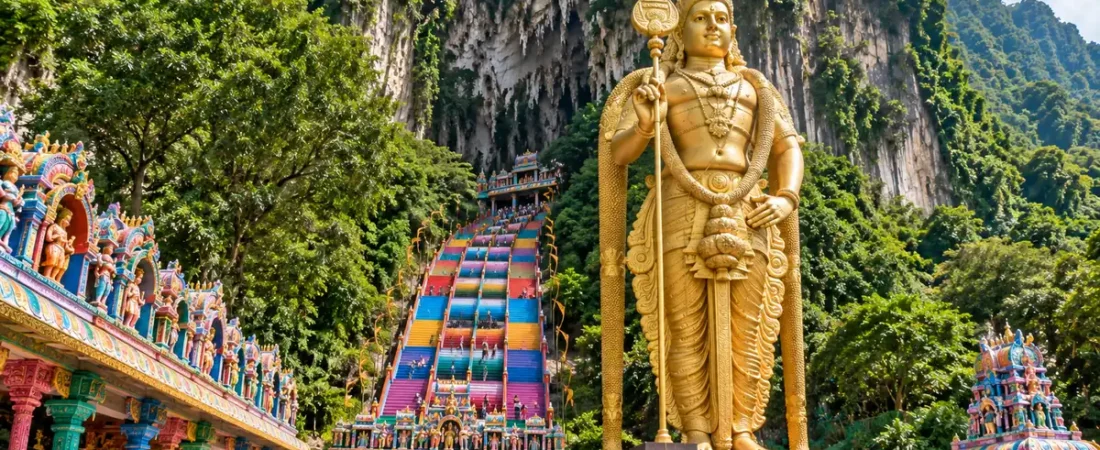
Batu Caves is instantly recognisable because of the enormous golden statue of Lord Murugan and the rainbow-coloured staircase.
There are 272 steps leading towards the main cave.
Take your time climbing, particularly in Kuala Lumpur’s heat.
Once inside, the enormous limestone chamber creates a completely different atmosphere from the city centre.
Batu Caves is an active Hindu religious site.
Dress respectfully and remember that people may be visiting to worship rather than sightsee.
Avoid disturbing ceremonies and follow any posted instructions.
The main temple cave can generally be explored without paying an admission fee, although separate attractions around the complex may charge.
Late Morning: Return to Central Kuala Lumpur
After exploring Batu Caves, return towards central Kuala Lumpur.
Allow roughly half a day for transport, climbing, photography and exploring the complex without rushing.
Your next destination is Chinatown.
Afternoon: Chinatown and Central Market
Explore Petaling Street
Begin around Petaling Street, the centre of Kuala Lumpur’s Chinatown district.
The area is filled with shops, restaurants, market stalls and historic businesses.
Instead of staying only on the main market street, explore some of the surrounding lanes.
Chinatown provides a dramatic contrast with yesterday’s skyscrapers and malls.
Visit Sri Mahamariamman Temple
Near Chinatown stands Sri Mahamariamman Temple, one of Kuala Lumpur’s best-known Hindu temples.
Its colourful entrance tower makes it easy to recognise.
Remember to treat the building as an active religious site.
Dress respectfully and follow instructions concerning footwear and photography.
Central Market
Next, walk towards Central Market.
Originally established as a market, the building is now associated with Malaysian crafts, souvenirs and cultural products.
Browsing is free, although naturally you will need to pay for anything you purchase.
Central Market is also a convenient place to escape Kuala Lumpur’s afternoon heat for a while.
Late Afternoon: Merdeka Square
Continue towards Merdeka Square, one of Kuala Lumpur’s most historically important places.
Malaysia’s independence is closely associated with this area, and the square remains surrounded by notable architecture.
Sultan Abdul Samad Building
Facing the square is the impressive Sultan Abdul Samad Building.
Its domes, arches and clock tower make it one of Kuala Lumpur’s most distinctive historic structures.
The exterior is particularly photogenic.
You do not need an admission ticket simply to enjoy the architecture from the square.
Masjid Jamek and River of Life
From Merdeka Square, continue towards Masjid Jamek and the nearby River of Life area.
Masjid Jamek occupies a significant location near the meeting point of the Klang and Gombak rivers.
If entering, respect dress requirements and prayer arrangements.
The surrounding riverside area is pleasant for an evening walk.
Evening: Dinner in Chinatown
Finish Day 2 around Chinatown.
Choose a restaurant or food stall and enjoy a slower evening after a busy sightseeing day.
If you still have energy, you can return to KLCC or Bukit Bintang later, but there is no need to overload the itinerary.
Day 3: Temples, Little India and Kuala Lumpur’s Green Side
The final day is deliberately slower.
After two busy sightseeing days, explore several cultural areas and one of Kuala Lumpur’s major green spaces.
Morning: Thean Hou Temple
Begin at Thean Hou Temple.
This large Chinese temple is one of Kuala Lumpur’s most visually impressive religious buildings.
Its red pillars, decorative roofs, lanterns and elevated position make it particularly attractive for photography.
Visit in the morning when temperatures are cooler.
Entry arrangements can change during special events and religious celebrations, so follow current notices at the site.
As always, remember that temples are active places of worship.
Late Morning: Brickfields and Little India
Continue towards Brickfields, widely known as Kuala Lumpur’s Little India.
The district provides another glimpse of the city’s multicultural identity.
Expect Indian restaurants, grocery shops, clothing stores and colourful streets.
Brickfields is also close to KL Sentral, Kuala Lumpur’s major transport hub.
Lunch in Brickfields
This is an excellent place to try Indian-Malaysian food.
Consider:
- Banana leaf rice
- Roti canai
- Dosa
- Nasi kandar
- Curries
- Teh tarik
Local restaurants can offer excellent value compared with premium dining districts.
Afternoon: Perdana Botanical Gardens
After lunch, slow the pace at Perdana Botanical Gardens.
The gardens provide a large green escape from Kuala Lumpur’s dense urban environment.
Walking through landscaped areas gives you a different perspective on the capital after two days dominated by skyscrapers, temples and busy streets.
The tropical climate means afternoon heat can be intense.
Bring water, use sun protection and take breaks in shaded areas.
If rain is forecast, adjust the timing or use the afternoon for an indoor attraction instead.
Alternative Day 3: More City Sightseeing
If gardens are not your priority, you can replace the afternoon with additional city attractions.
Options include:
- Museums
- Shopping
- More time around KLCC
- Café hopping
- Exploring additional neighbourhoods
- Returning to a favourite area from Days 1 or 2
A 3-day itinerary should not feel like a checklist.
Leaving some flexibility makes it easier to adapt to weather and energy levels.
Final Evening: Choose Your Favourite Kuala Lumpur Experience
For your last evening, return to whichever area you enjoyed most.
Option 1: KLCC
Choose KLCC for illuminated skyscrapers and another look at the Petronas Twin Towers.
Option 2: Bukit Bintang
Return to Bukit Bintang for restaurants, shopping and nightlife.
Option 3: Chinatown
Stay around Chinatown for a more historic atmosphere and casual food.
For most first-time visitors, I would finish at KLCC.
Seeing the illuminated towers is a memorable way to end 3 days in Kuala Lumpur.
How to Get Around During This Itinerary
Kuala Lumpur’s rail network is extremely useful for this itinerary.
Depending on your route, you may use:
- MRT
- LRT
- KL Monorail
- KTM Komuter
KTM is particularly useful for reaching Batu Caves.
For central sightseeing, MRT, LRT and monorail services connect many of the areas included in this itinerary.
Ride-hailing is useful when rail does not provide a convenient connection, particularly for attractions such as Thean Hou Temple.
Avoid relying exclusively on cars because road congestion can significantly increase journey times.
Should You Buy a Kuala Lumpur Transport Pass?
Visitors expecting to use public transport frequently should compare individual fares with the available Rapid KL travel-pass options when they arrive.
Pass products and eligibility can change, so check current conditions before purchasing.
The most important consideration is convenience rather than trying to save a very small amount on every journey.
Getting From Kuala Lumpur Airport
If you arrive through Kuala Lumpur International Airport, KLIA Ekspres provides a direct connection to KL Sentral.
The scheduled journey between KLIA Terminal 1 and KL Sentral takes approximately 28 minutes.
Current standard fares are approximately:
Adult one way: RM55
Adult return: RM100
Children aged 6–15 currently pay approximately RM25 one way or RM45 return.
Children below six can travel free within the operator’s stated conditions.
Online and promotional discounts may sometimes reduce the price.
Where to Stay for This 3-Day Itinerary
For this particular itinerary, Bukit Bintang is an excellent overall base.
You have restaurants and entertainment nearby while retaining useful public-transport connections.
KLCC is another excellent option, especially for travellers wanting a more upscale environment.
Chinatown can work particularly well for budget-conscious visitors and puts several Day 2 attractions within walking distance.
For a detailed neighbourhood comparison, read our Where to Stay in Kuala Lumpur guide.
How Much Should You Budget for 3 Days?
Costs vary dramatically according to accommodation and dining style.
Kuala Lumpur can be relatively affordable if you:
- Use public transport
- Eat at local restaurants
- Mix paid and free attractions
- Stay outside premium luxury hotels
- Walk between nearby attractions
The Petronas Twin Towers will be one of the more significant sightseeing expenses in this itinerary.
Batu Caves’ main temple area, KLCC Park, Merdeka Square and neighbourhood exploration provide opportunities for free sightseeing.
Our upcoming Kuala Lumpur Travel Budget guide will break down accommodation, meals, transport and sightseeing costs in much greater detail.
What to Pack for 3 Days in Kuala Lumpur
Kuala Lumpur is hot and humid throughout the year.
Useful items include:
- Lightweight clothing
- Comfortable walking shoes
- Compact umbrella
- Sunscreen
- Refillable water bottle
- Hat
- Small day bag
- Modest clothing for religious sites
A lightweight layer can also be useful because air-conditioned shopping centres and trains sometimes feel surprisingly cool.
What If It Rains?
Rain is part of travelling in tropical Kuala Lumpur.
Do not assume a rainy forecast means the entire day will be lost.
Showers can be intense but relatively short.
Keep your itinerary flexible.
Shopping centres, museums, Central Market and restaurants provide convenient alternatives during heavy rain.
Move outdoor attractions to clearer periods whenever possible.
Can You See Kuala Lumpur in 2 Days?
Yes, but you will need to prioritise.
With only two days, concentrate on:
Day 1: Petronas Twin Towers, KLCC, Bukit Bintang and Jalan Alor
Day 2: Batu Caves, Chinatown and Merdeka Square
3 days provides a much more comfortable introduction.
Is 4 Days Better?
Four days gives you more flexibility.
You can add museums, spend longer exploring neighbourhoods or take a day trip beyond central Kuala Lumpur.
However, 3 days in Kuala Lumpur is enough for most first-time visitors who want to experience the city’s essential sights.
3 Days in Kuala Lumpur: Final Tips
Start early on your Batu Caves day.
Book Petronas Twin Towers tickets ahead if visiting the observation areas.
Group nearby attractions together.
Use trains whenever practical.
Keep some flexibility for tropical rain.
Dress respectfully at temples and mosques.
Do not try to see every attraction in the city.
Most importantly, leave enough time for food.
Kuala Lumpur’s restaurants, markets and neighbourhood dining are as important to the experience as its famous landmarks.
Final Thoughts
This 3 days in Kuala Lumpur itinerary gives first-time visitors a balanced introduction to Malaysia’s capital.
Day 1 introduces modern Kuala Lumpur through the Petronas Twin Towers, KLCC and Bukit Bintang. Day 2 combines the spectacular Batu Caves with Chinatown and the historic centre. Day 3 slows the pace with Thean Hou Temple, Brickfields and Kuala Lumpur’s greener side.
The result is 3 days combining architecture, religion, history, food, modern city life and multicultural neighbourhoods without turning the trip into an exhausting race between attractions.
Before travelling, use our Kuala Lumpur Travel Guide for more practical planning advice and our Where to Stay in Kuala Lumpur guide to choose your base.
Book Your Kuala Lumpur Experiences
Ready to start planning? Compare popular Kuala Lumpur tours and activities, check current prices and availability, and book the experiences that suit your trip.
Affiliate disclosure: If you book through these links, we may earn a commission from Viator. This does not increase the price you pay.
Explore more places through our destinations page or browse our complete collection of itineraries.