
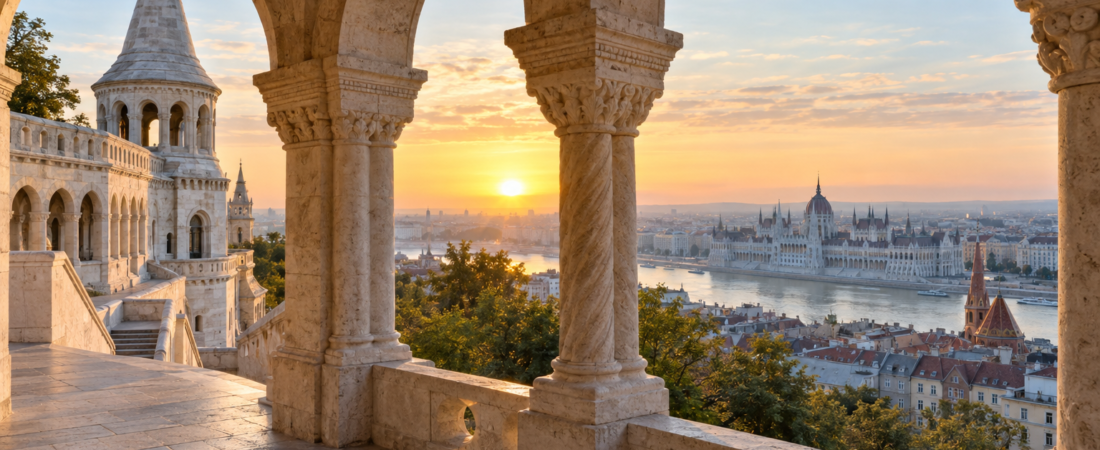
3 days in Budapest provide enough time to experience the city’s historic districts, Danube landmarks, thermal baths and distinctive food.
This 3 days in Budapest itinerary divides the city into manageable areas. The first day explores central Pest, the second focuses on Castle Hill and the Buda riverfront, and the third combines City Park with the Jewish Quarter.
The route is designed for first-time visitors and can be adjusted according to opening hours, weather and personal interests.
Budapest 3-Day Itinerary at a Glance
Day 1: Central Pest and the Danube
- Hungarian Parliament Building
- Shoes on the Danube Bank
- Liberty Square
- St Stephen’s Basilica
- Andrássy Avenue
- Danube riverfront
Day 2: Castle Hill and Historic Buda
- Széchenyi Chain Bridge
- Buda Castle
- Fisherman’s Bastion
- Matthias Church
- Castle District
- Gellért Hill or a Danube cruise
Day 3: City Park and the Jewish Quarter
- Heroes’ Square
- City Park
- Vajdahunyad Castle
- Széchenyi Thermal Bath
- Dohány Street Synagogue area
- Jewish Quarter
Top Tours & Experiences in Budapest
Discover popular Budapest tours and experiences. Check current availability, ratings and prices before you book.
Affiliate disclosure: If you book through these links, we may earn a commission from Viator. This does not increase the price you pay.
Before Starting Your Budapest Itinerary
Budapest is divided by the Danube into Buda and Pest.
Buda is the hillier western side, where visitors will find the Castle District, Fisherman’s Bastion and several panoramic viewpoints. Pest is flatter and contains Parliament, St Stephen’s Basilica, the Jewish Quarter, City Park and most central restaurants.
Although many attractions are within walking distance of one another, using public transport will make this itinerary more comfortable.
Purchase tickets or a suitable travelcard from official BKK sales channels. Single tickets must generally be validated when beginning a journey, while validation rules differ for digital tickets, time-based tickets and travelcards.
The 100E Airport Express uses a special fare and is not covered by an ordinary public-transport single ticket.
Day 1: Central Pest and the Danube
The first day introduces Budapest through its political centre, major religious landmark and famous riverfront.
Most of the route is walkable, although public transport can be used if your accommodation is outside the centre.
Morning: Hungarian Parliament Building
Begin at Kossuth Lajos Square, home to the Hungarian Parliament Building.
The enormous Gothic Revival structure is one of Budapest’s most recognisable landmarks. Walk around the square to appreciate its exterior before continuing towards the Danube for views across to Buda.
Seeing the exterior is free. Visitors who want to explore the interior must join an authorised guided visit.
Parliament tours are popular and may be affected by official events. Reserve in advance through the authorised ticket service and arrive early enough for security procedures.
Allow approximately:
- 30–45 minutes for the exterior and surrounding square
- Around 1½ hours if taking a guided tour and completing security checks
Walk to the Shoes on the Danube Bank
From Parliament, walk south along the river to the Shoes on the Danube Bank.
The memorial commemorates people murdered beside the river during the Second World War. Iron shoes of different styles and sizes represent those who were forced to remove their footwear before being killed.
This is a place of remembrance rather than a conventional sightseeing attraction. Approach quietly and avoid sitting on or moving objects left at the memorial.
Allow approximately 20–30 minutes.
Late Morning: Liberty Square
Continue inland towards Liberty Square.
The square is surrounded by substantial historic buildings and contains monuments reflecting different periods of Hungarian history. It also provides an attractive walking connection between Parliament and St Stephen’s Basilica.
Spend a short time exploring the square before continuing through the surrounding streets.
Lunch Near St Stephen’s Basilica
The streets around the basilica contain numerous restaurants, cafés and bakeries.
For a traditional lunch, consider gulyás, chicken paprikash or pörkölt. Menus in the most tourist-oriented streets can be expensive, so compare prices and check whether a service charge is included.
Allow at least one hour for lunch, particularly if you choose a full-service restaurant.
Afternoon: St Stephen’s Basilica
St Stephen’s Basilica is one of Budapest’s most important religious buildings.
Its grand interior includes marble, mosaics and a large central dome. Visitors can also access the panoramic terrace for views over central Pest.
Different admission arrangements may apply to the church, treasury and panoramic terrace. Religious services and special events can affect tourist access, so check the official schedule before visiting.
Allow approximately 60–90 minutes.
Walk Along Andrássy Avenue
From the basilica, continue towards Andrássy Avenue.
This broad boulevard is lined with nineteenth-century buildings, cafés, cultural institutions and shops. The Hungarian State Opera House is one of its architectural highlights.
You do not need to walk the avenue’s entire length on the first day. Explore the central section and use Metro Line M1 if you want to return without retracing your route.
Optional Stop: Hungarian State Opera House
The opera house can be admired from outside without charge.
Interior visits and performances require tickets. If you are particularly interested in architecture or music, check whether a guided visit or evening performance fits your schedule.
Otherwise, keep the stop brief and continue towards the central riverfront.
Evening: Danube Riverfront
Finish the first day beside the Danube.
Walking between the Chain Bridge and Parliament provides impressive views of Castle Hill across the water. The buildings and bridges become especially attractive after illumination.
Several options work well for the evening:
- Walk along the Pest riverfront
- Cross the Chain Bridge
- Take an evening river cruise
- Have dinner near the basilica
- Watch the illuminated Parliament from the Buda bank
River cruises vary in route, duration and inclusions. Compare departure locations and confirm whether drinks, commentary or meals are included before booking.
Day 2: Castle Hill and Historic Buda
The second day concentrates on Budapest’s elevated historic district.
The Castle District includes courtyards, churches, museums and viewpoints. Cobblestones and slopes make comfortable footwear essential.
Morning: Cross the Chain Bridge
Begin near the Pest end of the Széchenyi Chain Bridge.
Walk across towards Buda while looking back at the Pest riverfront. The crossing provides excellent views of Parliament and the buildings surrounding Castle Hill.
After reaching Buda, continue uphill on foot, use public transport or take the funicular when it is operating.
Walking provides more opportunities to explore, but the climb can be tiring. The bus is practical for travellers with limited time or mobility.
Buda Castle
Buda Castle occupies the southern portion of Castle Hill.
The palace complex contains cultural institutions including the Hungarian National Gallery and Budapest History Museum. Its courtyards and outdoor spaces can be explored independently, although museums require admission.
If you want to visit a museum, choose one rather than trying to see every interior. This leaves enough time for the northern part of the Castle District.
Suggested time:
- 60–90 minutes for the courtyards and exterior
- Two or more hours when including a museum
Walk Through the Castle District
Continue north through the historic streets of Castle Hill.
The neighbourhood contains colourful buildings, quiet lanes and viewpoints over both sides of Budapest. Its atmosphere is most enjoyable when you leave the busiest route for a few side streets.
Remain aware that Castle Hill is also a residential area. Respect private entrances and avoid blocking narrow pavements while taking photographs.
Matthias Church
Matthias Church stands near the centre of the district and is easily recognised by its patterned tiled roof.
The richly decorated interior reflects several periods of Hungarian history. Admission is normally required, and visitor access may change during services or special events.
Allow approximately 45–60 minutes if entering.
Fisherman’s Bastion
Fisherman’s Bastion provides some of Budapest’s best-known views.
Its terraces overlook the Danube, Parliament and the rooftops of Pest. Lower public sections can generally be explored freely, while particular upper terraces may require admission during specified periods.
The area is busiest during late morning and afternoon. Arriving earlier provides a quieter experience, but it remains worthwhile at almost any time in clear weather.
Allow at least 45 minutes.
Lunch on Castle Hill
Castle Hill has cafés and restaurants, but prices can be higher than in less visited districts.
You can eat within the district for convenience or descend towards Batthyány Square, where you will find additional options and an excellent view of Parliament.
Avoid making lunch too long if you plan to visit both a museum and Gellért Hill later in the day.
Afternoon Option One: Hospital in the Rock
The Hospital in the Rock is an underground museum located within the cave system beneath Castle Hill.
Its exhibitions cover its use as an emergency hospital and nuclear bunker. Access is through guided visits, and the enclosed underground environment may not suit every traveller.
Check current schedules and language availability in advance.
Afternoon Option Two: Hungarian National Gallery
Art enthusiasts can spend the afternoon inside the Hungarian National Gallery at Buda Castle.
Its collection traces the development of Hungarian art across different periods. Because the museum is extensive, identify priority galleries before entering.
Check current exhibitions and closing times before planning a late-afternoon visit.
Late Afternoon: Batthyány Square
Descend towards Batthyány Square on the Buda side of the river.
The riverside directly opposite Parliament is one of the best places to photograph the building. Late afternoon light varies by season, while evening provides reflections and an illuminated skyline.
This stop is particularly valuable if you only saw Parliament from the Pest side on the first day.
Evening Option: Gellért Hill
If weather, access conditions and energy levels permit, continue towards Gellért Hill for elevated city views.
The climb is steep, and renovation work can affect paths around the Citadella and Liberty Statue. Check current access conditions before committing to the route.
Carry water during warm weather and begin descending before paths become difficult to navigate.
Alternative Evening: Danube Cruise
A Danube cruise is a more relaxed alternative after a full day of walking.
Evening departures pass illuminated landmarks such as Parliament, Buda Castle and the city’s bridges. Book with a reputable operator and confirm the departure pier before travelling.
Return to Pest for dinner or remain on the Buda side for a quieter evening.
Day 3: City Park and the Jewish Quarter
The final day combines monumental architecture, green spaces, a thermal-bath experience and one of Budapest’s most energetic neighbourhoods.
Begin early if you want to spend several hours at Széchenyi Thermal Bath.
Morning: Travel Along Andrássy Avenue
Take Metro Line M1 towards Heroes’ Square.
This historic underground railway follows Andrássy Avenue and provides a convenient connection between central Pest and City Park.
Check your ticket before entering and validate it according to the current requirements.
Heroes’ Square
Begin sightseeing at Heroes’ Square.
The square contains the Millennium Monument and statues representing major figures from Hungarian history. The Museum of Fine Arts and Hall of Art stand on opposite sides.
The outdoor square is free to visit and requires approximately 30 minutes unless you plan to enter one of the museums.
City Park
Walk from Heroes’ Square into City Park.
The park includes lawns, walking paths, museums, recreational facilities and seasonal activities. It is a good location for a slower morning after two days of intensive sightseeing.
Attractions are spread across the park, so consult a map rather than walking back and forth unnecessarily.
Vajdahunyad Castle
Vajdahunyad Castle was designed to display architectural styles associated with different periods of Hungarian history.
The surrounding grounds provide attractive views and can be explored without entering the museum. Reflections across the neighbouring water are especially photogenic in suitable weather.
Allow approximately 30–45 minutes for the exterior.
Late Morning or Afternoon: Széchenyi Thermal Bath
Continue to Széchenyi Thermal Bath for one of Budapest’s signature experiences.
The complex includes indoor and outdoor pools inside an elaborate neo-Baroque setting. Facilities, temperatures and services differ across the site.
Before visiting, confirm:
- Current opening hours
- Available pools
- Ticket categories
- Locker or cabin arrangements
- Towel availability
- Age restrictions
- Maintenance closures
Bring swimwear and waterproof footwear if required. Remove jewellery before entering strongly mineralised water and keep valuables secured.
Allow 2 to 3 hours for a comfortable visit.
Lunch Near City Park
Have lunch near City Park or return towards central Pest.
A lighter meal may be preferable after spending time in the thermal pools. Keep hydrated, particularly during warm weather.
If you prefer not to visit a thermal bath, use this period for the Museum of Fine Arts, House of Music Hungary or Museum of Ethnography.
Late Afternoon: Dohány Street Synagogue Area
Travel to the Jewish Quarter and begin around Dohány Street.
The Dohány Street Synagogue complex is a major religious and historical site. Entry arrangements can include access to associated memorial and museum areas.
Opening hours vary around religious observances, Jewish holidays and seasonal schedules. Modest clothing may be required, so confirm current visitor guidance beforehand.
Even without entering, walking through the surrounding district provides historical and architectural context.
Explore the Jewish Quarter
Continue through District VII towards Kazinczy Street and nearby neighbourhood streets.
The area includes additional synagogues, courtyards, murals, cafés and restaurants. It also contains Budapest’s best-known ruin bars, which occupy adapted older buildings.
The district changes character throughout the day. Afternoons are suitable for architecture and cafés, while evenings are considerably livelier.
Dinner in the Jewish Quarter
End the itinerary with dinner in or near the Jewish Quarter.
Options range from traditional Hungarian cooking to Middle Eastern food, bakeries and contemporary restaurants. Popular establishments may require reservations during weekends.
Try a Hungarian dessert such as Dobos cake, strudel or chimney cake if you have not already done so.
Optional Evening: Ruin Bar
Travellers interested in nightlife can visit one of Budapest’s ruin bars.
These venues are known for unusual interiors and informal atmospheres. They can become extremely busy, so keep personal belongings secure and remain aware of drink prices.
Visitors who prefer a quieter evening can return to the Danube for one final walk.
Alternative Activities for 3 Days in Budapest
Not every traveller will want to visit thermal baths, museums or nightlife venues. The itinerary can be adapted with these alternatives:
- Margaret Island for walking and green space
- Great Market Hall for food and local products
- Central Café or another historic coffeehouse
- Museum of Fine Arts
- Hungarian National Museum
- House of Terror Museum
- Hungarian State Opera performance
- Rudas Thermal Bath
- Tram ride along the Danube
- Guided food tour
- Margaret Bridge sunset views
Choose replacements within the same general area whenever possible to avoid losing time in transit.
How to Get Around During This Itinerary
Walking and public transport are the most practical ways to follow this route.
Budapest’s network includes:
- Four metro lines
- Trams
- Buses
- Trolleybuses
- Suburban railways
- Night buses
Metro Line M1 is useful for Andrássy Avenue and City Park. Metro Line M2 connects central Pest with Batthyány Square, while trams provide convenient travel along both sides of the Danube.
Purchase tickets only through authorised sources. The BudapestGO application can be used for journey planning and eligible digital tickets.
Single tickets must be properly validated. Buying a ticket without validating it does not necessarily make it valid for travel.
Where to Stay for This Itinerary
Central Pest is the most convenient base for this 3-day route.
District V works well for Parliament, the Danube and central landmarks. District VI provides access to Andrássy Avenue and public transport, while District VII is convenient for restaurants and nightlife.
Castle Hill offers historic surroundings but requires more travel to reach Pest attractions. Travellers sensitive to noise should avoid accommodation directly beside busy nightlife streets.
A hotel close to a metro or major tram stop can be more practical than one located a few streets nearer the centre.
Food to Try During 3 Days in Budapest
Include a mixture of traditional meals, market snacks and pastries.
Popular choices include:
- Gulyás soup
- Chicken paprikash
- Pörkölt
- Stuffed cabbage
- Lángos
- Fisherman’s soup
- Kürtőskalács
- Dobos cake
- Strudel
- Hungarian wine
Check menus and displayed prices before ordering. Some restaurants automatically include a service charge, so inspect the bill before adding another gratuity.
Estimated Pace and Walking Requirements
This itinerary involves substantial walking.
Castle Hill includes slopes and cobblestones, while Gellért Hill is considerably steeper. The remaining central areas are relatively flat.
Expect to walk several kilometres each day even when using public transport. Comfortable shoes are essential, and travellers with limited mobility should replace steep sections with buses, taxis or shorter routes.
Do not attempt to complete every optional attraction. Leaving time for cafés, river views and unplanned stops will make the itinerary more enjoyable.
Budapest Itinerary Tips
- Reserve Parliament tours before arriving.
- Confirm religious-site opening hours.
- Validate public-transport tickets correctly.
- Wear supportive shoes for Castle Hill.
- Carry swimwear for the thermal bath.
- Keep valuables secure in crowded locations.
- Use Hungarian forints when given a currency choice.
- Check whether restaurant bills include service.
- Verify Gellért Hill access before visiting.
- Group attractions by neighbourhood.
- Allow extra time for security checks.
- Adjust outdoor activities during extreme heat or rain.
Is 3 Days Enough for Budapest?
3 days are sufficient for Budapest’s principal landmarks and one thermal-bath visit.
This schedule covers Parliament, Castle Hill, Fisherman’s Bastion, St Stephen’s Basilica, City Park and the Jewish Quarter without requiring a rushed day trip.
Four or five days would allow more museums, Margaret Island, additional baths and quieter neighbourhoods. A longer stay also makes excursions to Szentendre, Gödöllő or the Danube Bend more practical.
For broader planning advice, transport information and additional attractions, read our complete Budapest travel guide.
Final Thoughts
A carefully organised 3-day visit provides an excellent introduction to both sides of Budapest.
Central Pest presents the city’s monumental riverfront, Castle Hill supplies its most memorable historic views, and City Park offers a change of pace before an evening in the Jewish Quarter.
Reserve important timed attractions before travelling, but keep enough flexibility to enjoy the Danube, cafés and neighbourhood streets between scheduled visits.
Book Your Budapest Experiences
Ready to start planning? Compare popular Budapest tours and activities, check current prices and availability, and book the experiences that suit your trip.
Affiliate disclosure: If you book through these links, we may earn a commission from Viator. This does not increase the price you pay.
Explore more places through our destinations page or browse our complete collection of itineraries.