
Deciding where to stay in Dublin can make a big difference to your first visit. Ireland’s capital is relatively compact, but each neighbourhood offers a different experience — from the historic streets around Trinity College to lively Temple Bar, elegant Georgian Dublin and the modern Docklands.
For most first-time visitors, staying within walking distance of the city centre is worth considering. You’ll be able to reach many major attractions on foot while still having access to Dublin Bus, Luas trams and DART trains when you want to explore farther afield.
If you’re still planning the overall trip, our Dublin travel guide covers the city’s major attractions, transport and essential travel information.
Price note: All prices in this article are approximate and were checked at the time of publication. Prices may change.
Quick Guide to the Best Areas in Dublin
If you want a quick answer, these are some of the most useful areas to consider:
- St Stephen’s Green and Grafton Street: excellent for first-time visitors and sightseeing.
- Temple Bar: best for nightlife and an extremely central location.
- Merrion Square and Georgian Dublin: attractive architecture and a more refined atmosphere.
- Docklands: modern hotels and convenient business-oriented accommodation.
- Smithfield: good alternative close to the centre with Luas access.
- Ballsbridge: quieter and more residential.
- Drumcondra: useful for travellers seeking accommodation outside the busiest tourist centre.
There isn’t one neighbourhood that suits everyone. Your best choice depends on whether you prioritise sightseeing, nightlife, quieter evenings, transport connections or accommodation value.
1. St Stephen’s Green and Grafton Street — Best for First-Time Visitors
The area around St Stephen’s Green and Grafton Street is one of the most convenient places to stay on a first visit.
You can walk to Trinity College, the Georgian Quarter, Temple Bar and many central restaurants, shops and attractions.
St Stephen’s Green also gives the neighbourhood a welcome open space, while Grafton Street provides easy access to shopping and entertainment.
Why Stay Here?
The biggest advantage is location.
Many visitors can spend most of their sightseeing day on foot rather than repeatedly using buses or taxis.
The Luas Green Line also serves the St Stephen’s Green area, making journeys beyond the immediate centre easier.
Things to Consider
Convenience comes at a price. Accommodation around Grafton Street and St Stephen’s Green can be expensive, particularly on popular weekends and during major events.
Some streets can also remain busy into the evening.
Best for: first-time visitors, couples, short city breaks and travellers who want to walk to major attractions.
2. Temple Bar — Best for Nightlife
Temple Bar is Dublin’s most famous entertainment district.
Its cobbled streets, colourful buildings, pubs and live music create the atmosphere many international visitors associate with Dublin.
Staying here puts you close to the River Liffey, Dublin Castle, Trinity College and central shopping streets.
Why Stay Here?
Few Dublin neighbourhoods are more central.
If nightlife is a major reason for your visit, staying in Temple Bar means you can walk back to your accommodation rather than arranging late-night transport.
Things to Consider
Temple Bar is not ideal for everyone.
It can be noisy late into the evening, especially on weekends, and some of its most tourist-oriented restaurants and pubs charge higher prices than establishments elsewhere in Dublin.
Light sleepers may prefer a neighbouring district.
Best for: nightlife, live music and visitors who want to be in the middle of the action.
3. Merrion Square and Georgian Dublin — Best for Architecture and Atmosphere
For a more elegant Dublin experience, consider the streets around Merrion Square and the Georgian Quarter.
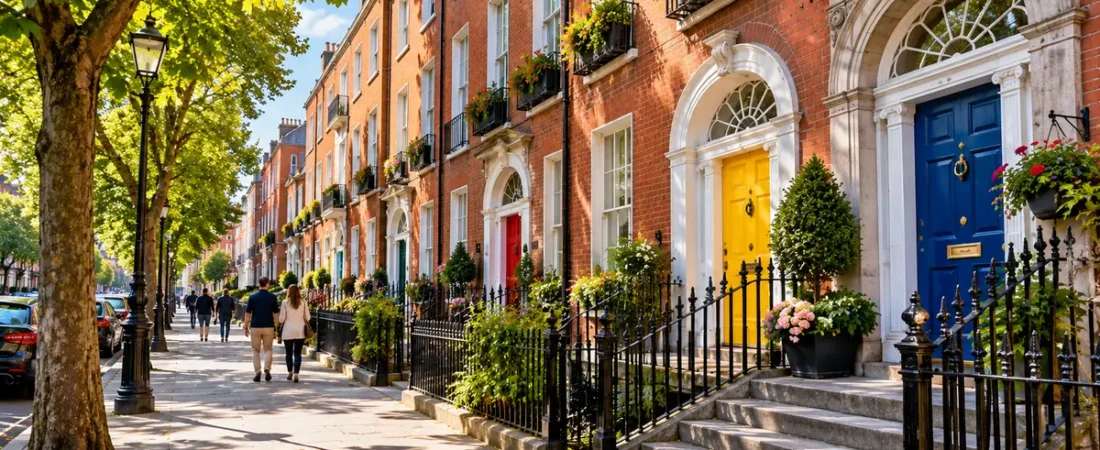
This part of the city is characterised by red-brick townhouses, decorative fanlights, wrought-iron railings and colourful doors.
Merrion Square itself provides green space and has strong connections with Dublin’s literary history.
Why Stay Here?
You’re still within walking distance of central Dublin, but many streets feel calmer than Temple Bar.
The neighbourhood is particularly appealing to travellers interested in architecture, history and photography.
You’ll also be well placed for attractions around Trinity College, St Stephen’s Green and the National Gallery of Ireland.
Things to Consider
Accommodation can lean toward boutique hotels, Georgian guesthouses and higher-end properties, so budget options may be less plentiful.
Best for: couples, architecture lovers and travellers looking for a central but more polished atmosphere.
4. Dublin Docklands — Best for Modern Hotels
East of the traditional city centre, Dublin Docklands presents a more contemporary side of the capital.
Modern offices, apartments, hotels and waterside developments dominate much of the area.
The neighbourhood includes landmarks such as the Samuel Beckett Bridge and the Convention Centre Dublin.
Why Stay Here?
Hotels tend to be modern, and the waterfront setting provides a different experience from historic central Dublin.
Public transport connections make it straightforward to reach other parts of the city.
The Docklands can also be particularly convenient for business travellers and anyone attending an event at the Convention Centre or nearby venues.
Things to Consider
The area doesn’t have the same old-Dublin atmosphere as Temple Bar or the Georgian Quarter.
Depending on the exact hotel, you may also have a longer walk to attractions such as Dublin Castle and St Patrick’s Cathedral.
Best for: business travellers, modern hotels, waterfront surroundings and repeat visitors.
5. Smithfield — Best Central Alternative
Smithfield sits northwest of the traditional tourist centre and has developed into an increasingly popular base.
The large central square is surrounded by apartments, restaurants and cultural venues, while the Luas Red Line provides convenient public transport.
The Jameson Distillery Bow St. is also located here.
Why Stay Here?
Smithfield offers a useful compromise between location and distance from Dublin’s busiest tourist streets.
You can walk toward the River Liffey, Temple Bar and the historic centre while having the Luas nearby for longer journeys.
Things to Consider
The immediate surroundings feel more urban and contemporary than postcard-style Georgian Dublin.
Some travellers may prefer the atmosphere south of the Liffey, but Smithfield can be a practical option when central hotel prices are high.
Best for: travellers wanting a central alternative with good transport.
6. Ballsbridge — Best for a Quieter Stay
Ballsbridge lies southeast of Dublin city centre.
The neighbourhood is known for leafy streets, embassies, hotels and attractive residential architecture.
Aviva Stadium is nearby, and DART services provide connections toward the centre and Dublin’s coastal suburbs.
Why Stay Here?
Ballsbridge offers more distance from the nightlife and crowds of central Dublin.
It can work particularly well for visitors who value quieter evenings or are attending an event at Aviva Stadium.
Things to Consider
You won’t be able to step outside your hotel and immediately reach every major tourist attraction.
Depending on your accommodation, you’ll probably use public transport or taxis more often than someone staying near Grafton Street.
Best for: quieter trips, couples, business travellers and Aviva Stadium events.
7. Drumcondra — Best for Staying North of the Centre
Drumcondra is a residential neighbourhood north of central Dublin.
It can be useful for travellers who prefer staying outside the busiest tourist districts while retaining relatively straightforward access to the centre.
The area has restaurants, pubs and guesthouses and is also convenient for Croke Park.
Why Stay Here?
Accommodation may sometimes provide better value than the most central districts, although Dublin prices vary considerably with demand.
The neighbourhood gives you a more residential base rather than a purely tourist-oriented environment.
Things to Consider
You’ll need to factor transport into your sightseeing routine.
The exact convenience depends heavily on how close your accommodation is to useful bus routes or rail connections.
Best for: Croke Park events, repeat visitors and travellers who don’t need to stay in the historic centre.
Which Side of the River Liffey Should You Stay On?
The River Liffey divides central Dublin into north and south sides, but visitors shouldn’t treat this as a strict boundary.
Many of Dublin’s best-known visitor areas — Trinity College, Grafton Street, St Stephen’s Green and the Georgian Quarter — are south of the river.
North of the Liffey you’ll find O’Connell Street, Smithfield and access toward neighbourhoods such as Drumcondra.
Because central Dublin is compact and crossed by numerous bridges, staying on either side can work well.
The exact street and transport connections usually matter more than simply choosing north or south.
How Much Does Accommodation Cost in Dublin?
Dublin accommodation can be expensive, and prices fluctuate substantially according to season, weekday, major concerts, sporting events and how far ahead you book.
As a broad planning guide, hostel beds and basic accommodation may sometimes start around €35–€70 per night, while a private budget room can commonly cost €90–€160 or more.
Mid-range central hotels frequently fall around €150–€280+ per night, while higher-end properties can easily exceed €300 per night during periods of strong demand.
These are planning estimates rather than fixed rates. Always compare prices for your actual dates before setting your trip budget.
Booking earlier is particularly important for summer weekends and dates involving major sporting events or concerts.
Staying Centrally vs Outside Dublin City Centre
Paying more for a central hotel can sometimes reduce other costs.
If you stay around St Stephen’s Green, Grafton Street or Georgian Dublin, you may walk for much of your trip.
Staying farther away might save money on accommodation but increase your transport use.
Dublin’s current adult TFI 90 Minute fare is €2 with a Leap Card for eligible journeys, covering transfers between participating Dublin Bus, Luas, DART and commuter rail services within the permitted area and time.
The current adult daily Leap fare cap within Dublin Zone 1 is €6, which can make public transport manageable if you choose accommodation outside the immediate centre.
Where to Stay in Dublin Without a Car
Most visitors do not need a car for a Dublin city break.
In fact, a car can create additional parking and traffic complications in the centre.
Choose accommodation within walking distance of attractions or close to Dublin Bus, Luas, DART or commuter rail services.
For a first visit without a car, St Stephen’s Green, Georgian Dublin, Smithfield and other well-connected central areas are particularly convenient.
Where to Stay for Dublin Nightlife
Temple Bar is the obvious choice if being close to nightlife is your priority.
However, you don’t have to sleep directly above Dublin’s busiest pubs.
Staying around Grafton Street, George’s Street or other nearby central areas can keep you within walking distance of evening entertainment while providing some separation from Temple Bar’s busiest streets.
Check recent accommodation reviews for comments about street noise before booking.
Where to Stay in Dublin for Couples
Couples may particularly enjoy Georgian Dublin around Merrion Square, the St Stephen’s Green area or quieter parts of Ballsbridge.
These areas provide attractive surroundings and good access to restaurants and sightseeing.
For a short first visit, the convenience of staying centrally often outweighs the savings available farther out.
Where to Stay in Dublin for Families
Families may prefer accommodation slightly removed from the busiest nightlife streets.
St Stephen’s Green, Georgian Dublin, Ballsbridge and other well-connected residential areas can be more comfortable choices than the heart of Temple Bar.
An apartment or aparthotel can also be useful for longer family stays, particularly when kitchen facilities and extra space are important.
Always check the property’s exact room configuration and public transport access before booking.
Tips for Booking Accommodation in Dublin
Book early when your travel dates are fixed. Dublin has strong demand during weekends, summer, festivals, concerts and major sporting events.
Check the exact location rather than relying only on the neighbourhood name. Two hotels marketed as being in the same general district can have very different walking times to major attractions.
Read recent reviews for noise, room size, heating, lift access and street conditions.
If you plan to use public transport frequently, check the nearest bus stop, Luas stop or DART station before booking.
Finally, compare the total price rather than the headline room rate. Breakfast, cancellation conditions and other booking terms can make a significant difference.
Which Dublin Area Should You Choose?
For a first trip, St Stephen’s Green and the Grafton Street area provide an excellent combination of walkability and access to attractions.
Choose Temple Bar if nightlife is your main priority.
Choose Georgian Dublin if you prefer elegant architecture and a somewhat calmer atmosphere.
Consider Smithfield for a well-connected alternative, Docklands for modern accommodation, or Ballsbridge when quieter surroundings matter more than being directly in the tourist centre.
Wherever you stay, Dublin’s relatively compact centre means you can experience several different neighbourhoods during the same trip.
Explore more places through our destinations page or browse our complete collection of itineraries.