
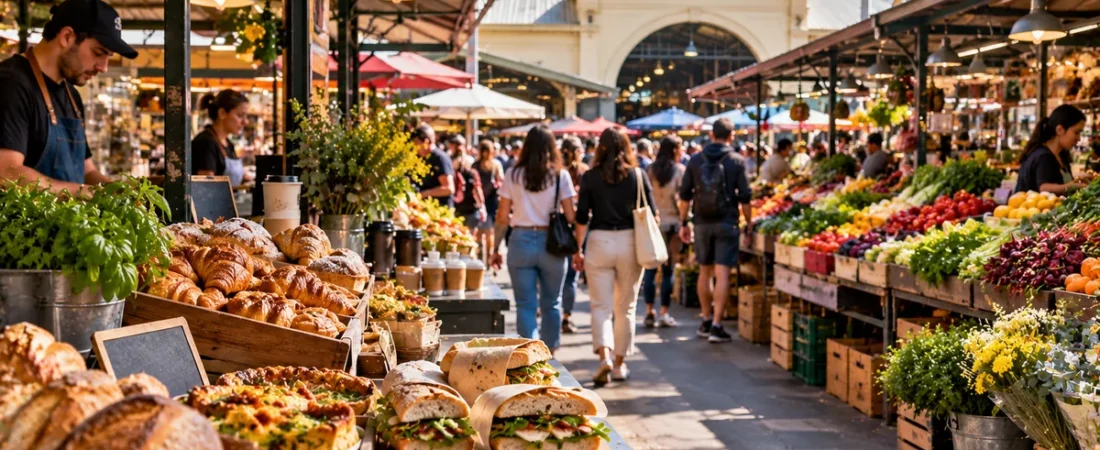
Planning a Melbourne travel budget can be tricky because the city can suit very different spending styles. Accommodation and restaurant dining can be expensive, but Melbourne also has free central trams, free galleries, markets, gardens, neighbourhoods and waterfront areas that allow you to enjoy the city without constantly buying tickets.
For most travellers, accommodation will be the largest expense. Food comes next, while local public transport is comparatively affordable — particularly during the temporary reduced-fare period running through the end of 2026.
A realistic budget traveller can aim for approximately AUD 100–160 per person per day, while a comfortable mid-range traveller sharing accommodation may spend around AUD 170–300 per person per day. Travellers choosing upscale hotels, fine dining and paid experiences can easily spend AUD 450 or more per day.
These estimates exclude international flights because airfare varies enormously depending on where you are travelling from.
For a complete introduction to the city before calculating your costs, read our Melbourne travel guide.
Price note: All prices in this article are approximate and were checked at the time of publication. Prices may change.
Melbourne Travel Budget at a Glance
A useful starting point per person is:
Budget traveller: AUD 100–160 per day
Mid-range traveller sharing a room: AUD 170–300 per day
Comfortable solo traveller: AUD 240–400 per day
High-end traveller: AUD 450+ per day
The biggest variable is accommodation.
Two people sharing one hotel room will normally have a significantly lower per-person cost than a solo traveller booking the same room.
Major sporting events can also dramatically affect hotel prices.
Is Melbourne Expensive?
Melbourne is not generally considered a cheap destination.
Australia has relatively high labour and operating costs, which influence accommodation, restaurants, cafés and entertainment.
However, Melbourne is easier to manage on a budget than its reputation might suggest.
Many of its signature experiences are inexpensive or free.
You can walk through famous laneways.
Explore Fitzroy and Carlton.
Visit the Royal Botanic Gardens.
See the Shrine of Remembrance.
Walk beside the Yarra River.
Explore Queen Victoria Market.
Visit the National Gallery of Victoria’s general collection.
Use free trams within the central Free Tram Zone.
The key is deciding which experiences are worth paying for rather than buying admission everywhere.
Accommodation Costs in Melbourne
Accommodation will usually consume the largest part of your budget.
Prices fluctuate according to location, day of the week, season and major events.
As broad planning ranges:
Hostel Bed
Expect approximately AUD 40–80 per night for a dormitory bed.
Prices can increase during busy periods.
Hostels are one of the easiest ways for solo travellers to control costs because hotel rooms are comparatively expensive when not shared.
Budget Hotel or Private Room
Approximately AUD 110–180 per night is a useful starting range.
Location matters.
A simple room outside the CBD can sometimes cost significantly less than central accommodation.
Mid-Range Hotel
Expect roughly AUD 180–320 per night.
This category includes many comfortable CBD, Southbank and inner-suburban hotels.
Two travellers sharing a AUD 240 room effectively pay AUD 120 each before other expenses.
Upscale Hotel
Expect approximately AUD 300–500+ per night.
Luxury properties and premium rooms can cost considerably more.
Apartments
Apartments often start around AUD 180–300+ per night, depending on size and location.
They can provide excellent value for families or longer stays because kitchen facilities reduce food costs.
How to Save Money on Melbourne Accommodation
Location and timing matter more than almost anything else.
If CBD hotels are expensive, compare:
Carlton.
Docklands.
Southbank.
Richmond.
South Yarra.
Fitzroy.
Good public transport means you do not necessarily need to stay beside Flinders Street Station.
However, do not choose extremely distant accommodation merely to save a small amount.
Extra travel time can reduce the value of a short trip.
Our guide to where to stay in Melbourne compares the most practical neighbourhoods.
Watch Melbourne’s Major Event Calendar
Melbourne’s hotel market can change dramatically when major events take place.
Examples include:
Australian Open.
Formula 1 Australian Grand Prix.
AFL Grand Final.
Major cricket matches.
Large concerts.
Festivals.
Conferences.
A hotel that looks reasonably priced one week may be much more expensive during a major event.
Before booking flights, check what is happening in Melbourne on your dates.
Moving your trip by a few days can sometimes produce meaningful savings.
Melbourne Food Budget
Melbourne’s food scene can fit almost any budget.
You could eat inexpensive market food and casual Asian meals all day or spend hundreds of dollars on a single fine-dining experience.
A practical daily food budget is approximately:
Budget: AUD 35–60 per person
Mid-range: AUD 60–110 per person
Comfortable/high-end: AUD 120+ per person
These amounts assume a mixture of meals rather than three elaborate restaurant experiences every day.
Breakfast Costs
A simple breakfast might cost:
Coffee: approximately AUD 5–7.
Pastry: approximately AUD 5–9.
Toast or simple café breakfast: approximately AUD 10–18.
Full café breakfast or brunch: approximately AUD 20–35.
Melbourne’s brunch culture can become surprisingly expensive if you order a large meal and speciality coffee every morning.
Budget travellers can alternate café breakfasts with supermarket food, bakeries or market purchases.
Lunch Costs
For lunch, expect approximately:
Quick takeaway meal: AUD 12–20.
Market food: AUD 12–22.
Casual restaurant meal: AUD 18–30.
Sit-down lunch with a drink: AUD 30–50+.
Melbourne’s multicultural neighbourhoods are useful for affordable food.
Chinatown, Richmond, Footscray and other areas offer enormous variety.
Dinner Costs
Dinner has the widest price range.
Casual dinner: approximately AUD 20–35.
Mid-range restaurant main course: approximately AUD 30–50.
Dinner with drinks: AUD 50–90+ per person.
Fine dining can cost far more.
Alcohol can increase your Melbourne travel budget quickly.
A few drinks each evening may cost more than several daytime attractions.
Coffee Costs in Melbourne
Coffee is practically part of the Melbourne sightseeing experience.
Expect roughly AUD 5–7 for a typical café coffee.
One coffee per day will not significantly change your trip budget.
Three or four café stops every day will.
Rather than cutting coffee completely, budget for the experience intentionally.
Queen Victoria Market for Budget Food
Queen Victoria Market can help control food costs.
You can browse produce, deli goods, bakery items and prepared food.
It is also useful if your accommodation has kitchen facilities.
Buying fruit, snacks and breakfast ingredients can reduce reliance on restaurants.
Remember that Queen Victoria Market does not operate its regular daytime market every day, so check current opening days before visiting.
Melbourne Public Transport Costs
Melbourne has trains, trams and buses using the myki ticketing system.
Public transport is normally affordable relative to accommodation and food.
In 2026 there is an additional advantage.
Victoria temporarily reduced public-transport fares by 50% from 1 June until the end of 2026.
For a full-fare adult, this means the metropolitan daily cap during the temporary reduction is around AUD 5.70 per day.
That makes transport a relatively small part of a Melbourne travel budget.
Melbourne Free Tram Zone
The CBD’s Free Tram Zone can reduce costs even further.
If your entire tram journey remains within the Free Tram Zone, you do not pay a fare.
You also do not need to touch on with a myki for a journey entirely inside the zone.
This covers many useful parts of central Melbourne.
However, destinations such as Fitzroy and St Kilda are outside the central free zone.
Once you travel beyond it, normal ticketing rules apply.
Staying in the CBD therefore has a hidden financial advantage for short trips.
Melbourne Airport Transfer Costs
Melbourne Airport is outside the CBD and does not currently have a direct passenger rail service to central Melbourne.
SkyBus operates Melbourne City Express services between Melbourne Airport and Southern Cross Station.
At the time of publication, the standard adult online/self-service fare is approximately:
One way: AUD 25.90
Return: AUD 43.40
Buying the return ticket reduces the effective cost per journey.
Children and some eligible Australian seniors have different fares.
Taxi and Rideshare From Melbourne Airport
Taxi and rideshare prices vary according to destination, traffic and demand.
They are normally more expensive than a single SkyBus ticket.
However, groups should compare the total cost.
If three or four people are travelling together, the price difference between several bus tickets and one shared vehicle becomes smaller.
A taxi or rideshare can also take you directly to your hotel rather than requiring another journey from Southern Cross Station.
Melbourne Attraction Costs
One of Melbourne’s advantages is the number of attractions that cost nothing.
You do not need a large sightseeing-ticket budget to experience the city.
National Gallery of Victoria
General entry to the permanent collection is free.
Special exhibitions may require tickets.
Royal Botanic Gardens
General garden entry is free.
Some tours and special activities may cost extra.
Shrine of Remembrance
General entry is free.
Federation Square
Free to explore.
Hosier Lane
Free.
Melbourne Laneways
Free.
Carlton Gardens
Free.
St Kilda Beach
Free.
Brighton Beach and Bathing Boxes
Walking along the beach and viewing the bathing boxes is free.
Queen Victoria Market
Free to enter and browse.
Your cost depends entirely on what you buy.
Melbourne Museum Cost
Melbourne Museum is one of the major paid cultural attractions.
Current general admission is approximately AUD 18 for an adult.
Children aged 16 and under currently receive free general entry.
Special exhibitions can have separate or additional ticket prices.
Families should therefore check current admission arrangements before automatically assuming every person needs a paid ticket.
Melbourne Cricket Ground Costs
Walking around the MCG precinct is free.
Attending a sporting event, taking a stadium tour or visiting the Australian Sports Museum requires a ticket.
Prices depend on the event or experience.
If you are primarily interested in seeing Melbourne’s sporting precinct, you can do so without spending anything.
Sports fans may consider a tour worthwhile.
Free Things to Do in Melbourne
Melbourne is particularly good for travellers who enjoy cities at street level.
Excellent free activities include:
Walking through Hosier Lane.
Exploring Melbourne’s laneways.
Visiting Federation Square.
Walking beside the Yarra River.
Exploring Southbank.
Visiting NGV’s general collection.
Walking through the Royal Botanic Gardens.
Visiting the Shrine of Remembrance.
Exploring Carlton Gardens.
Walking through Fitzroy.
Exploring Chinatown.
Walking along St Kilda Beach.
Seeing Brighton’s bathing boxes.
Exploring Docklands.
Using the Free Tram Zone.
Our final Melbourne article will cover the best free things to do in Melbourne in much more detail.
Sample Budget for 3 Days in Melbourne
Let’s look at realistic totals excluding international flights.
Budget Traveller
Accommodation: AUD 120–210
Food: AUD 105–165
Transport: AUD 15–30
Attractions: AUD 20–60
Airport transport: AUD 43–52
Approximate 3-day total: AUD 300–520 per person
This assumes hostel accommodation and extensive use of free attractions.
Mid-Range Traveller Sharing a Room
Accommodation share: AUD 270–480
Food: AUD 180–300
Transport: AUD 15–30
Attractions: AUD 40–100
Airport transport: AUD 43–80
Approximate 3-day total: AUD 550–990 per person
This provides much more flexibility for restaurants and paid attractions.
Comfortable Traveller
Accommodation share or premium room: AUD 450–750+
Food and drinks: AUD 300–500+
Transport: AUD 30–100
Attractions and entertainment: AUD 100–250+
Airport transfer: AUD 50–100+
Approximate 3-day total: AUD 930–1,700+ per person
Luxury hotels, fine dining and major-event tickets can push spending substantially higher.
Budget for 5 Days in Melbourne
A five-day trip does not necessarily cost five-thirds as much as a 3-day trip.
Airport transfers remain the same.
Longer accommodation stays can occasionally have better nightly rates.
You may also settle into less expensive eating habits after the first couple of days.
Useful approximate totals are:
Budget: AUD 500–800
Mid-range: AUD 850–1,500
Comfortable: AUD 1,200–2,000+
High-end: AUD 2,250+
Again, accommodation is the largest variable.
How Much Cash Do You Need?
Melbourne is highly card-friendly.
Contactless payment is widely accepted in hotels, restaurants, cafés and shops.
You do not need to carry large quantities of Australian cash.
A small amount can still be useful for markets, small purchases or as backup.
Check whether your bank charges foreign transaction fees.
Those fees can quietly increase your total trip cost.
Tipping in Melbourne
Tipping is not compulsory in Australia in the same way it is in some countries.
Restaurant staff receive wages rather than relying primarily on tips.
You may tip for particularly good service, but travellers do not need to automatically add a large percentage to every restaurant bill.
Some restaurants may apply service charges or surcharges in certain circumstances, particularly on public holidays.
Check your bill.
How to Save Money on a Melbourne Trip
Stay near public transport.
Use the Free Tram Zone whenever it genuinely fits your journey.
Walk through the CBD rather than taking transport for very short distances.
Build your itinerary around free attractions.
Use markets and supermarkets for some meals.
Have one substantial restaurant meal rather than three expensive meals every day.
Choose cafés away from the most tourist-oriented waterfront locations.
Travel outside major-event dates if the event is not part of your trip.
Compare accommodation in Carlton, Richmond and other inner suburbs.
Book flights and accommodation early once your dates are fixed.
Carry a reusable water bottle.
Use free galleries and gardens.
Is the Melbourne CBD Worth the Higher Hotel Cost?
Sometimes yes.
A cheaper hotel farther away may require additional transportation and consume more of your limited sightseeing time.
For a 3-day trip, paying slightly more to stay in the CBD can make sense.
You gain:
Walkability.
Free central trams.
Easy access to restaurants.
Convenient sightseeing.
Reduced commuting.
For a longer trip, staying outside the CBD becomes more attractive.
Our 3 days in Melbourne itinerary demonstrates how much of the city you can experience using walking and public transportation.
Budget Melbourne vs Comfortable Melbourne
The biggest difference is not necessarily sightseeing.
Both travellers can see Melbourne’s laneways, gardens, riverfront and neighbourhoods.
The difference usually appears in:
Accommodation.
Restaurant frequency.
Alcohol.
Paid exhibitions.
Sporting events.
Airport transport.
Shopping.
A budget traveller may actually experience many of the same core attractions as someone spending twice as much.
That makes Melbourne reasonably flexible despite Australia’s generally high travel costs.
Does the Time of Year Affect Your Melbourne Budget?
Absolutely.
Hotel prices can vary significantly.
Major events often matter more than weather seasons.
A relatively ordinary weekend may offer reasonable accommodation.
The same room during the Australian Open, Formula 1 Grand Prix or another huge event may cost substantially more.
Our best time to visit Melbourne explains how weather, events and seasons affect trip planning.
How Much Should You Budget Per Day?
For simple planning:
AUD 100–160 per person per day works for a careful budget trip.
AUD 170–300 per person per day provides a comfortable mid-range experience when accommodation is shared.
AUD 240–400 per day is more realistic for a comfortable solo traveller paying for a hotel room alone.
AUD 450+ per day allows upscale accommodation, better restaurants and more paid experiences.
These are planning ranges rather than fixed prices.
Your hotel choice can move the total dramatically.
Final Thoughts on Your Melbourne Travel Budget
A realistic Melbourne travel budget depends far more on accommodation and dining choices than on sightseeing.
The city provides an impressive number of free experiences.
You can explore laneways, visit gardens, walk beside the Yarra River, see street art, visit free gallery collections and explore neighbourhoods without paying admission.
Public transport is also unusually affordable during the temporary 2026 fare reduction, while central tram travel remains free inside the Free Tram Zone.
For most travellers, AUD 170–300 per person per day provides a comfortable starting budget when sharing accommodation.
Budget travellers can reduce that significantly through hostels, markets, casual food and free attractions.
Spend strategically rather than trying to make every part of the trip cheap.
Pay for the experiences that matter most to you, and use Melbourne’s excellent free attractions for the rest.
Explore more places through our destinations page or browse our complete collection of itineraries.