
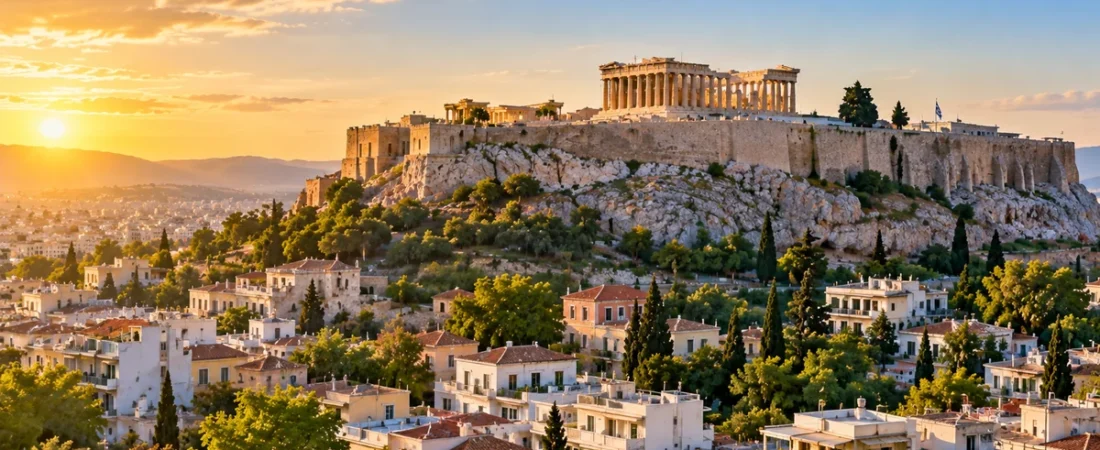
Athens is a city where ancient history and modern Greek life exist side by side. You can stand beneath the Parthenon in the morning, wander through the narrow streets of Plaka in the afternoon, eat traditional Greek food in a lively neighbourhood and watch the sunset from a hill overlooking the entire city.
This Athens travel guide covers the essential attractions, neighbourhoods, transport, food and practical information you need when planning your first visit to the Greek capital.
Athens deserves more than a rushed stop before travelling to the Greek islands. Give the city at least 3 days and you can explore its archaeological treasures while also discovering markets, cafés, neighbourhoods, viewpoints and the everyday character of modern Athens.
Price note: All prices in this article are approximate and were checked at the time of publication. Prices may change.
Why Visit Athens?
Athens is one of Europe’s most historically significant cities.
Its ancient monuments tell the story of classical Greece, but Athens is far more than an archaeological destination.
Modern neighbourhoods such as Koukaki, Psirri, Pangrati and Kolonaki are filled with restaurants, cafés, shops and nightlife. Plaka retains its historic atmosphere beneath the Acropolis, while Monastiraki combines ancient remains with markets and busy city life.
Athens also works well as the beginning or end of a longer Greek holiday.
From the capital, travellers can continue towards the Athens Riviera, archaeological sites elsewhere in mainland Greece or the ferry ports serving the Greek islands.
Top Tours & Experiences in Athens
Discover popular Athens tours and experiences. Check current availability, ratings and prices before you book.
Affiliate disclosure: If you book through these links, we may earn a commission from Viator. This does not increase the price you pay.
Visit the Acropolis
The Acropolis is the essential starting point for most first-time visitors.
Rising above central Athens, this ancient citadel contains some of the world’s most recognisable classical monuments.
The most famous is the Parthenon, built during the fifth century BC and dedicated to the goddess Athena.
Other important structures include the Erechtheion, Temple of Athena Nike and Propylaea.
The official standard admission price for the Acropolis is currently €30.
Tickets use timed entry arrangements, so reserving ahead can be sensible during busy periods.
Summer heat can make the exposed archaeological site uncomfortable around midday. An early visit generally provides better conditions, although the Acropolis is popular throughout the day.
Wear shoes with good grip because some ancient stone surfaces can be slippery.
See the Parthenon
The Parthenon is the defining monument of Athens.
Even after centuries of damage and alteration, its scale and position remain extraordinary.
Take time to walk around the accessible parts of the Acropolis rather than photographing the Parthenon and immediately leaving.
Different viewpoints reveal the relationship between the temple, surrounding monuments and the modern city below.
From the Acropolis you can also identify many other Athens landmarks, helping you understand the geography of the city.
Visit the Acropolis Museum
The Acropolis Museum sits below the archaeological site and provides important context for what you see above.
Its galleries contain sculptures and archaeological discoveries from the Acropolis.
One of the museum’s most impressive spaces is the upper Parthenon Gallery, which is arranged in relation to the actual Parthenon visible through the surrounding glass.
If possible, visit both the archaeological site and museum rather than choosing only one.
They provide very different experiences.
Explore the Ancient Agora
The Ancient Agora was one of the most important public spaces of ancient Athens.
Political, commercial, religious and social activity all took place here.
Today the archaeological site provides a much quieter experience than the Acropolis while still containing remarkable monuments.
The Temple of Hephaestus is a highlight and is among the best-preserved ancient Greek temples.
The reconstructed Stoa of Attalos houses the Museum of the Ancient Agora.
Allow enough time to walk through the site rather than treating it as a quick stop.
Wander Through Plaka
Plaka spreads beneath the Acropolis and is Athens’ most famous historic neighbourhood.
Its narrow streets contain colourful buildings, small squares, restaurants, souvenir shops and traditional architecture.
Some parts are very tourist-oriented, but Plaka remains worth exploring.
Move away from the busiest shopping streets and you can find quieter lanes climbing towards the Acropolis.
Early morning is particularly pleasant before tour groups and day visitors fill the neighbourhood.
Discover Anafiotika
Hidden on the slopes above Plaka, Anafiotika feels surprisingly different from the surrounding city.
Its tiny whitewashed houses and narrow passages were created by builders who came to Athens from the Cycladic island of Anafi.
The neighbourhood has a distinctly island-like atmosphere.
Because Anafiotika is residential, explore quietly and respect homes and private entrances.
It is a small area and does not require a long visit, making it easy to combine with Plaka.
Experience Monastiraki
Monastiraki is one of the liveliest parts of central Athens.
The main square sits close to ancient sites, markets, shops and restaurants.
From here you can walk towards Plaka, Psirri, the Ancient Agora or Ermou Street.
The surrounding flea-market area is interesting even if you do not intend to buy anything.
Rooftop venues around Monastiraki also provide excellent Acropolis views, although prices naturally vary according to location.
Walk Through Psirri
Neighbouring Psirri offers another side of central Athens.
The district has restaurants, bars, street art and small shops.
It becomes particularly lively in the evening.
Walking through Monastiraki and Psirri together is an easy way to see how quickly Athens changes from ancient ruins to contemporary city life.
Visit Syntagma Square
Syntagma Square is one of modern Athens’ most important public spaces.
The Hellenic Parliament occupies the eastern side of the square.
In front of the parliament building is the Tomb of the Unknown Soldier, guarded by the Evzones in their distinctive ceremonial uniforms.
Visitors can watch the changing of the guard without paying admission.
Syntagma is also a useful transport hub and an easy reference point when navigating central Athens.
Walk Through the National Garden
Immediately behind the parliament lies the National Garden.
This green space provides a welcome break from Athens’ busy streets, particularly during warmer weather.
Shaded paths wind among trees and plants, creating a completely different atmosphere from nearby Syntagma Square.
Entry to the garden is free.
It can easily be combined with Syntagma, the Panathenaic Stadium area and nearby central neighbourhoods.
See the Panathenaic Stadium
The Panathenaic Stadium is one of Athens’ most distinctive landmarks.
Built entirely of marble, the stadium occupies a site associated with athletic competition since antiquity.
The modern structure is closely connected with the revival of the Olympic Games and hosted events during the first modern Olympics in 1896.
You can see part of the stadium from outside without paying.
Visitors who want to enter the stadium and explore more closely require admission.
Explore the Temple of Olympian Zeus
The Temple of Olympian Zeus was once among the largest temples of the ancient world.
Although only a fraction of its enormous columns survive, the remaining structures demonstrate the extraordinary scale of the original monument.
The site is located close to Hadrian’s Arch and within walking distance of both Plaka and Syntagma.
You can see parts of the ruins from outside, while entry to the archaeological site requires a ticket.
See Hadrian’s Arch
Hadrian’s Arch stands beside one of the busiest sightseeing routes in central Athens.
The Roman-era monument was constructed in honour of Emperor Hadrian.
It sits close to the Temple of Olympian Zeus and can be viewed freely from the surrounding public area.
Because of its convenient location, it makes an easy stop while walking between Syntagma, Plaka and the Acropolis area.
Climb Philopappos Hill
For excellent Acropolis views without paying for an observation deck, walk up Philopappos Hill.
The hill provides green walking paths and panoramic perspectives over Athens.
It is especially attractive around late afternoon and sunset.
Wear comfortable footwear because the paths and surfaces can be uneven.
Nearby viewpoints also provide beautiful perspectives towards the Acropolis.
Visit Lycabettus Hill
Mount Lycabettus rises dramatically above central Athens.
The summit provides one of the widest panoramas of the city, extending from the Acropolis towards the surrounding mountains and, on clear days, towards the coast.
You can walk to the summit for free.
The climb is steep, so allow enough time and carry water during warm weather.
There is also a funicular for travellers who prefer not to walk, but that option requires a fare.
Sunset is particularly popular.
Explore Koukaki
Koukaki sits close to the Acropolis Museum and has developed into one of central Athens’ most appealing neighbourhoods.
Its streets contain cafés, restaurants and residential buildings while remaining conveniently located for major archaeological attractions.
Koukaki can be an excellent base for first-time visitors who want to stay near the Acropolis without being directly in the busiest parts of Plaka.
Take time to walk the pedestrianised streets around the Acropolis rather than travelling everywhere by metro.
Discover Kolonaki
Kolonaki provides a more polished side of Athens.
Located below Lycabettus Hill, the neighbourhood is known for boutiques, cafés, restaurants and attractive streets.
It also provides convenient access to several important museums.
Kolonaki feels noticeably different from Plaka and Monastiraki and demonstrates the variety of central Athens neighbourhoods.
Visit the National Archaeological Museum
Travellers interested in ancient Greek history should consider the National Archaeological Museum.
Its collection extends far beyond Athens itself and contains archaeological treasures from across Greece.
The museum is particularly valuable if Athens is your only stop in the country because it provides a broader introduction to Greek civilisation.
Allow several hours if archaeology is a major interest.
Explore the Athens Central Market Area
For a glimpse of everyday food culture, walk through the central market area around Varvakios Agora.
The surrounding streets contain food shops, produce stalls and traditional businesses.
The atmosphere is very different from the archaeological sites and polished tourist streets around Plaka.
Markets are best visited during active daytime hours.
Even if you do not buy anything, exploring the area provides another perspective on Athens.
Walk Along Ermou Street
Ermou is one of central Athens’ main shopping streets.
It connects Syntagma Square with the Monastiraki area, making it useful even if shopping is not your priority.
The pedestrianised central section is lively throughout much of the day.
Halfway between the major squares, look for the small Byzantine church of Panagia Kapnikarea surrounded by the modern shopping district.
What to Eat in Athens
Greek cuisine is one of the pleasures of visiting Athens.
Start with souvlaki or gyros for an inexpensive and convenient meal.
Traditional tavernas may serve dishes such as moussaka, grilled meats, stuffed vegetables, Greek salad and various mezze.
Look for dishes using feta, olives, tomatoes and seasonal vegetables.
For dessert, try baklava or loukoumades.
Greek yoghurt with honey is another simple favourite.
Coffee culture is important in Athens, and cafés are part of daily social life rather than merely places for a quick drink.
Avoid assuming that restaurants directly beside major landmarks represent the best Greek food. Walking a few streets into surrounding neighbourhoods can provide a more local atmosphere.
Getting Around Athens
Athens has an extensive public transport system incorporating metro, buses, trolley buses and trams.
For visitors, the metro is particularly useful.
A standard 90-minute urban ticket currently costs €1.20 and covers regular metro, bus, trolley and tram travel within the applicable urban network.
The 24-hour ticket costs €4.10, while a 5-day ticket costs €8.20.
These standard tickets do not include normal airport travel.
Contactless bank-card payment is also available for full-fare transport products.
Despite the transport network, central Athens is highly walkable.
Plaka, Monastiraki, Syntagma, Psirri, the Acropolis and several archaeological sites can be connected on foot.
Athens Airport to the City Centre
Athens International Airport lies outside the central city.
The Metro Line 3 airport ticket currently costs €9 one way.
Airport Express buses currently cost €5.50.
The metro is useful for travellers staying near central stations served by Line 3, while airport buses can be convenient depending on your destination and arrival time.
Athens also offers a 3-day tourist ticket for €20, which includes unlimited eligible urban transport for three 24-hour periods plus two airport journeys by metro or Airport Express bus.
Compare the tourist ticket with individual fares before purchasing because the best option depends on how often you plan to use public transport.
How Many Days Do You Need in Athens?
3 days is an excellent starting point for a first visit.
One day can focus on the Acropolis, Acropolis Museum and Plaka.
Another can include the Ancient Agora, Monastiraki, Psirri and central Athens.
A third day allows time for additional museums, neighbourhoods and viewpoints such as Lycabettus or Philopappos Hill.
Four or five days provide a slower pace and make it easier to add the Athens Riviera or a nearby excursion.
Travellers continuing to the Greek islands should still avoid treating Athens as merely an airport connection.
Best Time to Visit Athens
Spring and autumn are particularly attractive for sightseeing.
Temperatures are generally more comfortable for walking and exploring exposed archaeological sites than during the hottest part of summer.
Summer offers long daylight hours but can bring intense heat.
If visiting during hot weather, organise outdoor archaeological sightseeing early in the day and leave museums or shaded activities for hotter afternoon periods.
Winter is cooler and can be a good option for travellers primarily interested in museums, food and archaeological sightseeing with fewer peak-season crowds.
Where to Stay in Athens
For a first visit, staying centrally makes sightseeing considerably easier.
Plaka provides atmosphere and proximity to major ancient attractions.
Koukaki is convenient for the Acropolis and Acropolis Museum while feeling more residential.
Monastiraki places you close to transport, restaurants, shopping and nightlife.
Syntagma provides excellent transport connections and easy access to several neighbourhoods.
Psirri suits travellers looking for restaurants and evening activity.
Kolonaki offers a more upscale environment close to museums and Lycabettus Hill.
We will compare these areas in detail in our upcoming Where to Stay in Athens guide.
Is Athens Expensive?
Athens can still be explored at a moderate cost compared with some major European capitals, although accommodation and attraction tickets can add up quickly.
The Acropolis alone currently costs €30 at the standard full rate, so travellers interested in several archaeological sites should allow a dedicated sightseeing budget.
Food can be controlled by combining tavernas with bakeries, markets and inexpensive souvlaki or gyros.
Walking is another easy way to reduce expenses because many central attractions are relatively close together.
Practical Tips for Visiting Athens
Wear comfortable walking shoes. Athens has hills, uneven pavements and ancient stone surfaces.
Carry water, especially during warm weather.
Protect yourself from the sun when visiting exposed archaeological sites.
Reserve major attractions ahead during busy periods where timed admission applies.
Keep valuables secure in crowded transport and busy tourist areas, as you would in other major European cities.
Respect archaeological barriers even when a photograph appears tempting.
Allow time for neighbourhoods and cafés rather than filling every hour with monuments.
Athens becomes much more interesting when you experience both the ancient city and the modern one.
Is Athens Worth Visiting?
Yes. Athens is much more than the gateway to the Greek islands.
Few cities allow you to experience monuments of such historical importance while simultaneously enjoying vibrant neighbourhoods, excellent food, rooftop views, markets and contemporary culture.
For a first visit, prioritise the Acropolis, Acropolis Museum, Ancient Agora, Plaka, Monastiraki and at least one panoramic hill.
Then leave enough time to wander.
Some of the most enjoyable Athens experiences happen between the famous landmarks — sitting at a neighbourhood café, discovering street art, finding a small Byzantine church or watching the Acropolis change colour as the sun sets.
This Athens travel guide is the starting point for our complete Athens series. Next, we’ll compare the city’s best neighbourhoods in our Where to Stay in Athens guide.
Book Your Athens Experiences
Ready to start planning? Compare popular Athens tours and activities, check current prices and availability, and book the experiences that suit your trip.
Affiliate disclosure: If you book through these links, we may earn a commission from Viator. This does not increase the price you pay.
Explore more places through our destinations page or browse our complete collection of itineraries.