
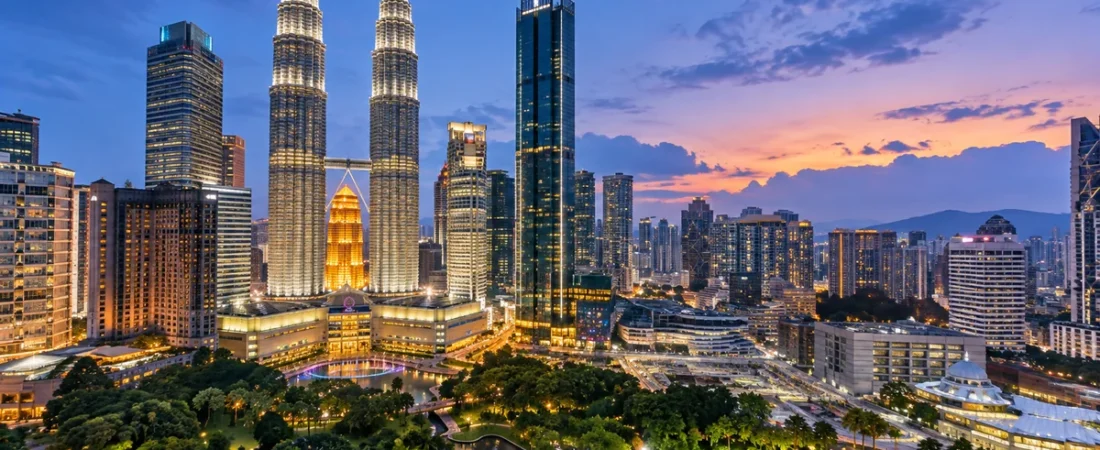
Kuala Lumpur is a city where futuristic skyscrapers, colourful temples, historic neighbourhoods, enormous shopping centres and some of Southeast Asia’s most exciting food scenes come together. This Kuala Lumpur travel guide covers the essential attractions, neighbourhoods, transport and practical tips you need for a first visit to Malaysia’s capital.
The city’s most recognisable landmarks include the Petronas Twin Towers, but Kuala Lumpur offers much more than its modern skyline. You can climb the colourful staircase at Batu Caves, explore the historic streets around Merdeka Square, eat your way through Jalan Alor and discover Chinese, Malay and Indian cultural influences within a relatively compact city.
Kuala Lumpur also works particularly well as a short city break. 3 or 4 days provide enough time for the major attractions without making the trip feel rushed.
Price note: All prices in this article are approximate and were checked at the time of publication. Prices may change.
Why Visit Kuala Lumpur?
Kuala Lumpur combines several advantages that make it particularly accessible for first-time visitors to Southeast Asia.
Modern rail networks connect many major areas, English is widely understood in tourist settings, accommodation covers almost every budget and the food scene is remarkably varied.
The city’s multicultural identity is another major attraction.
Mosques, Hindu temples, Chinese temples and colonial-era buildings sit alongside modern skyscrapers and shopping centres. You can experience dramatically different sides of the city within the same day.
Kuala Lumpur is also a useful base for exploring other parts of Malaysia.
Top Tours & Experiences in Kuala Lumpur
Discover popular Kuala Lumpur tours and experiences. Check current availability, ratings and prices before you book.
Affiliate disclosure: If you book through these links, we may earn a commission from Viator. This does not increase the price you pay.
Best Things to Do in Kuala Lumpur
See the Petronas Twin Towers
The Petronas Twin Towers are Kuala Lumpur’s defining landmark.
The 88-storey towers rise above the KLCC district and are particularly impressive after sunset when the buildings are illuminated.
You can enjoy excellent views of the towers from ground level without paying anything.
For a different perspective, purchase a ticket to visit the Skybridge and observation areas.
As of 2026, normal admission for international adults is approximately RM127 on weekdays and RM137 on weekends. Evening experiences and premium access cost more.
Timed tickets can sell out, so advance booking through the official ticketing system is sensible.
Walk Through KLCC Park
Immediately beside the Petronas Twin Towers is KLCC Park, providing a welcome green space in the centre of the modern city.
Walking paths, landscaped gardens and views of the towers make the park especially attractive for photography.
The area becomes particularly atmospheric towards evening when the towers illuminate.
It is also one of Kuala Lumpur’s easiest free attractions.
Visit Batu Caves
Batu Caves is one of the most famous attractions around Kuala Lumpur.
The enormous golden statue of Lord Murugan and the brightly coloured staircase leading towards the limestone caves create one of Malaysia’s most recognisable scenes.
The main temple cave can generally be visited without an admission fee, although separate attractions within the wider complex may charge.
Remember that Batu Caves remains an active Hindu religious site.
Dress respectfully, follow posted rules and avoid interfering with worshippers.
The stairs can become hot and crowded, so visiting earlier in the morning is usually more comfortable.
Explore Merdeka Square
Merdeka Square, or Dataran Merdeka, is one of Kuala Lumpur’s most historically significant locations.
It was here that the Malayan flag was raised following independence in 1957.
The square is surrounded by important architecture, including the distinctive Sultan Abdul Samad Building.
Walking around the square costs nothing, making it an easy addition to a budget sightseeing day.
See the Sultan Abdul Samad Building
Facing Merdeka Square, the Sultan Abdul Samad Building is one of Kuala Lumpur’s most photographed historic structures.
Its arches, domes and clock tower provide a striking contrast with the city’s modern skyscrapers.
Even if you do not enter the building, the exterior alone is worth seeing.
The area looks particularly attractive when illuminated after dark.
Visit Masjid Jamek
Near the meeting point of the Klang and Gombak rivers stands Masjid Jamek, one of Kuala Lumpur’s most historic mosques.
Its architecture and riverside setting make it an interesting stop while exploring the old centre.
Visitors should dress appropriately and respect prayer times and areas restricted to worshippers.
Walk Around River of Life
The area around Masjid Jamek has been transformed through the River of Life project.
Walkways and viewpoints provide another perspective on Kuala Lumpur’s historic core.
It can easily be combined with Merdeka Square and the nearby heritage district on foot.
Explore Chinatown
Kuala Lumpur’s Chinatown is centred around Petaling Street and the surrounding neighbourhood.
Expect market stalls, restaurants, temples, traditional businesses and newer cafés.
Petaling Street itself can be busy and commercial, but exploring the surrounding streets reveals more of the area’s character.
Chinatown is also conveniently located near several historic attractions.
Visit Sri Mahamariamman Temple
Close to Chinatown stands Sri Mahamariamman Temple, one of Kuala Lumpur’s best-known Hindu temples.
Its elaborate entrance tower is filled with colourful sculpted figures.
Entry arrangements are generally straightforward, but remember that this is an active place of worship rather than simply a tourist attraction.
Dress respectfully and follow instructions regarding footwear.
Visit Central Market
Central Market began as a wet market in the 19th century and has developed into a centre for Malaysian crafts, souvenirs and cultural products.
It is within walking distance of Chinatown and Merdeka Square.
Even if you do not intend to shop, it provides a useful stop during a walking tour of the historic centre.
Explore Bukit Bintang
For modern Kuala Lumpur, head to Bukit Bintang.
This lively district is packed with shopping centres, hotels, restaurants, cafés and nightlife.
It is one of the most convenient neighbourhoods for first-time visitors who want to be surrounded by dining and entertainment options.
Bukit Bintang also connects conveniently with other parts of Kuala Lumpur by rail.
Eat at Jalan Alor
Just off Bukit Bintang, Jalan Alor becomes especially lively in the evening.
Restaurants and food stalls line the street, offering everything from grilled seafood to noodles, satay and desserts.
Prices vary considerably between stalls and restaurants, so checking menus before ordering is sensible.
Even if you do not eat here, an evening walk through Jalan Alor provides a memorable introduction to Kuala Lumpur’s food culture.
What to Eat in Kuala Lumpur
Food is one of the strongest reasons to visit Kuala Lumpur.
Malaysia’s multicultural population has created a dining scene influenced by Malay, Chinese, Indian and regional traditions.
Look for dishes such as:
- Nasi lemak
- Char kway teow
- Roti canai
- Satay
- Laksa
- Hainanese chicken rice
- Nasi kandar
- Mee goreng
- Banana leaf rice
Do not restrict yourself to famous tourist streets.
Food courts, kopitiams and neighbourhood restaurants can provide some of the most enjoyable meals.
Where to Stay in Kuala Lumpur
Choosing the right neighbourhood can make sightseeing much easier.
Bukit Bintang
Bukit Bintang is an excellent all-round choice for first-time visitors.
It offers extensive shopping, restaurants, nightlife and convenient transport.
KLCC
Stay around KLCC if the Petronas Twin Towers and modern skyline are priorities.
The area contains many upscale hotels and provides easy access to KLCC Park and major shopping centres.
Chinatown
Chinatown can suit travellers who want historic atmosphere, food and relatively easy access to central heritage attractions.
Budget accommodation is also widely available.
KL Sentral
KL Sentral is particularly convenient if transport connections are your main priority.
Airport trains terminate here, and the surrounding transport hub connects with several city rail services.
Our next article in this series will cover Where to Stay in Kuala Lumpur in detail.
Getting Around Kuala Lumpur
Kuala Lumpur has several rail systems, including MRT, LRT, monorail and commuter services.
For visitors, rail is often the easiest way to avoid road traffic.
Stations serve areas such as KLCC, Bukit Bintang, Pasar Seni and KL Sentral.
Walking works well within individual neighbourhoods, but Kuala Lumpur’s heat, humidity and large roads can make longer walks uncomfortable.
Ride-hailing services are also widely used.
A practical strategy is to use rail for longer journeys and walk once you reach each sightseeing area.
Getting From Kuala Lumpur Airport to the City
Kuala Lumpur International Airport is a significant distance from the central city.
One of the fastest options is KLIA Ekspres, which connects the airport with KL Sentral.
The current scheduled journey between KLIA Terminal 1 and KL Sentral takes approximately 28 minutes.
As of 2026, the standard adult fare is:
One way: RM55
Return: RM100
Children aged 6–15 currently pay RM25 one way or RM45 return, while qualifying children under six can travel free.
Online discounts and temporary promotions may reduce these fares.
Airport buses and ride-hailing services provide alternatives.
How Many Days Do You Need in Kuala Lumpur?
For most first-time visitors, 3 days is a good starting point.
With 2 Days
Concentrate on:
- Petronas Twin Towers
- KLCC
- Batu Caves
- Chinatown
- Merdeka Square
- Bukit Bintang
With 3 Days
3 days allows you to explore the main sights at a more comfortable pace while dedicating time to food and neighbourhoods.
With 4–5 Days
Extra days allow for museums, shopping, slower exploration or day trips beyond central Kuala Lumpur.
Our upcoming 3 Days in Kuala Lumpur Itinerary will organise the main attractions into an efficient first-time route.
Best Time to Visit Kuala Lumpur
Kuala Lumpur has a tropical climate, meaning temperatures remain warm throughout the year.
Humidity is high, and rain can occur in any month.
Rather than expecting a completely dry season, plan around heat and afternoon showers.
Light clothing, sun protection and an umbrella are useful throughout the year.
Indoor attractions and shopping centres also make Kuala Lumpur relatively easy to explore during periods of rain.
We will examine rainfall, weather and seasonal considerations in detail in our upcoming Best Time to Visit Kuala Lumpur guide.
Kuala Lumpur Travel Costs
Kuala Lumpur can work for both budget travellers and visitors seeking luxury.
Accommodation ranges from hostels and simple hotels to internationally known five-star properties.
Food can be particularly good value when eating at local restaurants and food courts.
Public transport also helps control daily expenses.
Major paid attractions such as the Petronas Twin Towers can increase sightseeing costs, but many historic districts, religious sites and public spaces can be explored for free.
Our upcoming Kuala Lumpur Travel Budget article will provide detailed 2026 spending estimates.
Is Kuala Lumpur Good for Families?
Yes.
Families can combine major landmarks with parks, shopping centres and indoor attractions.
KLCC is particularly convenient because several attractions are concentrated within a relatively small area.
However, Kuala Lumpur’s heat should be considered when travelling with younger children.
Plan outdoor sightseeing for the morning or later afternoon and use indoor attractions during the hottest hours.
Is Kuala Lumpur Good for Couples?
Kuala Lumpur works very well for couples.
Rooftop views, evening walks around KLCC, diverse restaurants and comfortable hotels provide plenty of options for a city break.
Couples can also combine a Kuala Lumpur stay with beaches, islands or other Malaysian destinations.
Is Kuala Lumpur Good for Solo Travellers?
Kuala Lumpur is relatively straightforward for independent travellers.
Public transport makes major sightseeing areas accessible, and the wide choice of accommodation means solo travellers can select anything from hostels to private hotels.
Normal big-city precautions remain important.
Keep valuables secure in crowded places and use established transport services, particularly late at night.
Kuala Lumpur Travel Tips
Carry Water
The combination of tropical heat and humidity can be tiring.
Drink regularly, particularly during long outdoor sightseeing periods.
Prepare for Rain
A compact umbrella can be useful even when the morning looks clear.
Dress Respectfully at Religious Sites
Mosques and Hindu temples may require more modest clothing than you would wear elsewhere.
Some sites provide coverings, but bringing suitable clothing makes visits easier.
Use Rail to Avoid Traffic
Road congestion can substantially increase journey times.
Check whether MRT, LRT or monorail can take you close to your destination before ordering a car.
Allow Time for Batu Caves
Batu Caves is outside the immediate central sightseeing area.
Avoid squeezing it between too many other attractions.
Book Petronas Twin Towers in Advance
Petronas visits operate using timed admission.
Booking ahead is especially worthwhile if visiting during weekends, public holidays or busy travel periods.
Carry Some Malaysian Ringgit
Cards and electronic payments are common, but cash remains useful for small purchases, markets and some food stalls.
Free Things to Do in Kuala Lumpur
Kuala Lumpur offers plenty of sightseeing without admission charges.
Possible free experiences include:
- Viewing the Petronas Twin Towers from outside
- Walking through KLCC Park
- Visiting the main Batu Caves temple area
- Exploring Merdeka Square
- Photographing the Sultan Abdul Samad Building
- Walking around Chinatown
- Exploring Petaling Street
- Visiting religious sites where free entry is permitted
- Exploring public parks
- Walking around the River of Life area
We will expand this into at least 20 genuinely free experiences in our final Best Free Things to Do in Kuala Lumpurarticle.
Is Kuala Lumpur Worth Visiting?
For most first-time visitors to Malaysia, absolutely.
Kuala Lumpur combines landmark architecture, historic districts, religious diversity, excellent food and efficient transport in a destination that can be explored comfortably within several days.
It is modern without losing its cultural character.
The contrast between the Petronas Twin Towers, Batu Caves, Chinatown, mosques, markets and colonial-era architecture gives the city far more variety than its skyline alone suggests.
Final Thoughts
A first trip to Kuala Lumpur works best when you mix its modern and historic sides.
Use this Kuala Lumpur travel guide to begin with the Petronas Twin Towers and KLCC, but make time for Batu Caves, Chinatown, Merdeka Square, local food and the city’s multicultural religious landmarks.
3 days is enough for a strong introduction, while four or five days allow you to slow down and explore beyond the headline attractions.
As our Kuala Lumpur series grows, we’ll connect this guide with detailed articles covering where to stay, a 3-day itinerary, the best time to visit, travel costs and free attractions.
Top Tours & Experiences in Kuala Lumpur
Discover popular Kuala Lumpur tours and experiences. Check current availability, ratings and prices before you book.
Affiliate disclosure: If you book through these links, we may earn a commission from Viator. This does not increase the price you pay.
Explore more places through our destinations page or browse our complete collection of itineraries.