
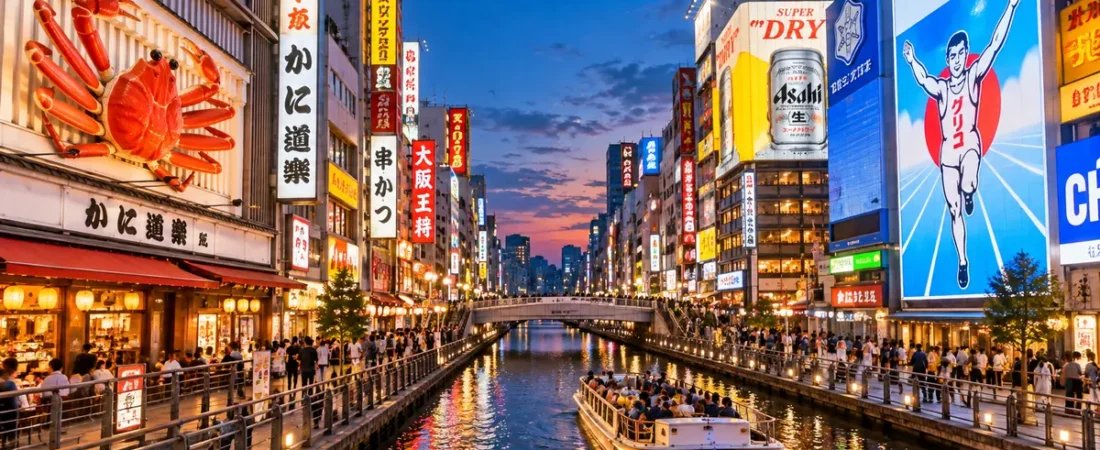
Choosing where to stay in Osaka can make a big difference to your trip. Osaka is a large city, but most visitors spend their time around a handful of well-connected neighborhoods. Namba puts you close to Dotonbori and Osaka’s famous nightlife, Umeda is excellent for transport and day trips, while Tennoji offers convenient connections and a somewhat more relaxed base.
For first-time visitors, the best choice usually depends on what you want to do after leaving your hotel each morning. This guide explains the advantages and disadvantages of Osaka’s main accommodation areas so you can choose a neighborhood that matches your itinerary, budget and travel style.
If this is your first visit, start with our Osaka travel guide for an overview of the city’s attractions, transport, food and essential travel tips.
Price note: All prices in this article are approximate and were checked at the time of publication. Prices may change.
Namba – Best Area for First-Time Visitors
For many first-time visitors, Namba is the most convenient place to stay in Osaka.
Namba sits in the heart of the Minami area and places you close to some of Osaka’s most recognizable streets, restaurants and entertainment districts. Dotonbori, Shinsaibashi and Kuromon Ichiba Market can all be reached easily.
The biggest advantage is being able to explore a large part of central Osaka on foot.
After dinner, you can walk beside the Dotonbori Canal, explore illuminated shopping streets or find somewhere for takoyaki or okonomiyaki without worrying about a long journey back to your accommodation.
Namba is also useful for travelers arriving through Kansai International Airport because Nankai Railway operates services between the airport and Nankai Namba Station.
Who Should Stay in Namba?
Namba works particularly well for:
- First-time Osaka visitors
- Food lovers
- Couples
- Travelers interested in nightlife
- Visitors who enjoy shopping
- Short stays
- Travelers arriving from Kansai International Airport
Things to Consider
Namba is energetic rather than peaceful.
Some streets remain busy late into the evening, particularly around Dotonbori. If you are sensitive to noise, look for accommodation a few blocks away from the busiest entertainment streets rather than directly beside them.
Umeda – Best for Transport and Day Trips
Umeda is the commercial center of northern Osaka and another excellent base for first-time visitors.
The neighborhood surrounds Osaka Station and several connected railway and subway stations. This huge transport hub makes Umeda particularly convenient for travelers planning to explore destinations outside Osaka.
Kyoto and Kobe are straightforward to reach from this part of the city, while Osaka’s extensive transport network connects Umeda with Namba and other sightseeing districts.
Umeda itself is very different from Dotonbori. Expect modern skyscrapers, department stores, enormous underground shopping complexes, restaurants and office towers.
The Umeda Sky Building is one of the area’s best-known landmarks.
Who Should Stay in Umeda?
Choose Umeda if you prioritize:
- Excellent railway connections
- Day trips around Kansai
- Modern shopping centers
- Business-class hotels
- Restaurants and department-store food halls
- Convenient transport over nightlife
Things to Consider
Osaka and Umeda stations form an enormous interconnected transport complex.
It can initially feel confusing because different railway companies use nearby stations with different names. Allow extra time to learn your preferred entrances and exits during the first day.
Once you understand the station layout, however, Umeda becomes an extremely convenient base.
Shinsaibashi – Best for Shopping
Shinsaibashi is a strong alternative to Namba for travelers who want to remain close to the action without necessarily staying beside Dotonbori.
The famous Shinsaibashi-suji covered shopping arcade runs through the neighborhood and contains fashion retailers, pharmacies, cafés and numerous other shops.
Amerikamura, known for street fashion, vintage stores and youth culture, is nearby.
Dotonbori is also within walking distance, allowing you to enjoy the Minami area’s nightlife before returning to accommodation in Shinsaibashi.
Who Should Stay in Shinsaibashi?
It is especially suitable for:
- Shoppers
- Couples
- Younger travelers
- Visitors interested in fashion
- Travelers who want to walk to Dotonbori
- People who want central accommodation without staying directly in Namba
Things to Consider
Hotels close to major shopping streets can still experience significant pedestrian traffic.
If you prefer quieter evenings, look toward the edges of the district while remaining within walking distance of a subway station.
Tennoji and Abeno – Best for Convenience and a More Relaxed Base
Tennoji and neighboring Abeno offer a useful balance between sightseeing convenience and a slightly less intense atmosphere than central Namba.
Tennoji is a significant transport hub, making it easy to travel around Osaka and beyond.
The area has undergone extensive redevelopment and contains modern shopping centers alongside older neighborhoods, parks and temples.
Abeno Harukas dominates the skyline, while attractions around Tennoji include Tennoji Park and Shitennoji.
Shinsekai and Tsutenkaku are also relatively close.
Who Should Stay in Tennoji?
Tennoji can work well for:
- Families
- Repeat visitors
- Travelers seeking good transport
- Visitors who prefer to stay outside Dotonbori
- Travelers interested in southern Osaka
- Visitors looking for a mix of modern and traditional surroundings
Things to Consider
You will need to use public transport more frequently if much of your sightseeing revolves around Dotonbori, Shinsaibashi and Umeda.
However, Osaka’s transport network makes those journeys relatively straightforward.
Honmachi – Best for a Quieter Central Location
Honmachi sits between Umeda and Namba, making it an interesting choice for travelers who value location but do not need to stay directly inside a major entertainment district.
It is primarily a business area, so evenings can feel calmer than Dotonbori.
The neighborhood is served by Osaka Metro, and the Midosuji Line provides convenient connections toward both Umeda and Namba.
That location makes Honmachi particularly practical for visitors who expect to divide their time between northern and southern Osaka.
Who Should Stay in Honmachi?
Consider Honmachi if you want:
- A central location
- Easy subway access
- Quieter evenings
- Business hotels
- Convenient access to both Umeda and Namba
Things to Consider
Honmachi does not provide the same immediate tourist atmosphere as Namba.
Travelers who enjoy stepping outside their hotel directly into restaurants and nightlife may prefer Namba or Shinsaibashi.
Shin-Osaka – Best for Frequent Shinkansen Trips
Shin-Osaka is Osaka’s major Shinkansen station and can be useful for a very specific type of traveler.
If you are using Osaka primarily as a base for frequent long-distance rail journeys, staying near Shin-Osaka can save time carrying luggage across the city.
There are numerous business hotels around the station, along with restaurants and everyday conveniences.
Who Should Stay in Shin-Osaka?
This area makes the most sense for:
- Travelers taking several Shinkansen journeys
- Short business trips
- Late arrivals or early departures by bullet train
- Travelers prioritizing railway convenience
Things to Consider
Shin-Osaka is not the best neighborhood for most first-time tourists.
You will generally need to travel into central Osaka for major sightseeing, nightlife and dining districts. If you are spending several days primarily exploring Osaka itself, Namba, Umeda or another central neighborhood will usually be more enjoyable.
Osaka Bay Area – Best for Major Family Attractions
Osaka’s Bay Area has a completely different atmosphere from central neighborhoods.
This part of the city contains major leisure attractions, including Osaka Aquarium Kaiyukan, while Universal Studios Japan is located in the wider bay-side area.
Staying nearby can be useful for families who plan to devote a significant portion of their trip to these attractions.
The waterfront environment also provides a different perspective on Osaka from the dense streets around Namba and Umeda.
Who Should Stay in the Bay Area?
Consider it if you are:
- Traveling with children
- Prioritizing Universal Studios Japan
- Visiting Osaka Aquarium Kaiyukan
- Looking for waterfront surroundings
- Spending only part of your Osaka trip sightseeing in the city center
Things to Consider
The Bay Area is less convenient for repeatedly visiting Dotonbori, Umeda and Osaka’s central neighborhoods.
For a longer trip, another option is to stay centrally for most nights and move closer to the bay only when it genuinely improves your itinerary.
Namba vs Umeda: Which Is Better?
This is probably the most important accommodation decision for a first Osaka trip.
Choose Namba if food, nightlife, Dotonbori and evening atmosphere are your priorities.
Choose Umeda if railway connections, shopping and day trips to other Kansai destinations are more important.
Both areas have excellent public transport, plenty of accommodation and huge numbers of restaurants.
For a first visit focused primarily on experiencing Osaka itself, Namba offers the classic Osaka atmosphere many travelers imagine before arriving.
For a trip combining Osaka with frequent journeys elsewhere in Kansai, Umeda can be more practical.
Where to Stay in Osaka with Family
Families should consider Namba, Tennoji/Abeno and the Bay Area depending on their plans.
Namba is convenient because many restaurants and attractions are nearby, reducing unnecessary transport.
Tennoji offers strong connections and access to parks, shopping and family-friendly attractions while generally feeling less intense than the busiest parts of Minami.
The Bay Area becomes particularly attractive when Universal Studios Japan or Kaiyukan is a major reason for visiting Osaka.
When booking family accommodation, pay close attention to room dimensions. Japanese hotel rooms can be compact, and simply checking the number of beds does not always reveal how much usable space a family will have with luggage.
Where to Stay in Osaka for Nightlife
Namba is the obvious starting point.
Dotonbori and the surrounding Minami district contain countless restaurants, bars and entertainment venues.
Shinsaibashi is another good option because you can walk into Dotonbori while staying slightly removed from its busiest streets.
Umeda also has extensive nightlife and dining, but the atmosphere is different, with modern commercial complexes mixed with smaller restaurant and bar districts.
Where to Stay in Osaka on a Budget
Budget accommodation is available throughout Osaka, so location can matter more than simply searching for the lowest nightly rate.
Areas such as Tennoji, Shin-Imamiya and neighborhoods slightly outside the most heavily visited sections of Namba may provide more affordable choices.
Honmachi can also be worth checking because of its concentration of business-oriented accommodation.
Compare the total trip cost rather than only the hotel price. Saving a small amount on accommodation may not be worthwhile if your location creates extra transport journeys every day.
Osaka Accommodation Tax
Remember to account for Osaka Prefecture’s accommodation tax when budgeting for your hotel.
For stays from September 1, 2025, the tax is calculated per person, per night according to the accommodation charge:
- Under ¥5,000: no accommodation tax
- ¥5,000 to under ¥15,000: ¥200
- ¥15,000 to under ¥20,000: ¥400
- ¥20,000 or more: ¥500
Depending on your booking arrangement, this tax may be collected separately by your accommodation.
Tips for Booking Accommodation in Osaka
Book early if you are visiting during popular periods such as cherry blossom season, major Japanese holiday periods or autumn foliage season.
Check the walking distance to the nearest station rather than relying only on the neighborhood name. A hotel that appears centrally located can still involve a considerable walk with luggage.
Also check which railway or subway line serves that station. Accommodation near the Midosuji Line can be particularly convenient because the line connects several major areas, including Umeda, Honmachi, Shinsaibashi, Namba and Tennoji.
If you have large luggage, investigate your route from the airport or railway station before booking. A hotel requiring several complicated transfers may be less convenient than another property only slightly farther from the attractions.
Finally, do not feel that you need to stay directly beside Dotonbori to experience Osaka. The city’s strong transport network means several neighborhoods can provide an excellent base.
Which Osaka Area Should You Choose?
For most first-time visitors, Namba is the easiest all-round choice, particularly if experiencing Osaka’s food, nightlife and famous streets is a priority.
Umeda is an excellent alternative for travelers planning multiple day trips or those who prefer a modern commercial district with outstanding rail connections.
Shinsaibashi works particularly well for shopping and easy access to Dotonbori, while Tennoji offers good transport and a slightly different side of Osaka.
Honmachi is worth considering for a quieter central base, and Shin-Osaka is most useful when frequent Shinkansen journeys dominate your itinerary.
There is no need to find one universally perfect neighborhood. Choose the area that places you closest to the activities you expect to enjoy most, and Osaka’s extensive transport network can handle the rest.
Explore more places through our destinations page or browse our complete collection of itineraries.