
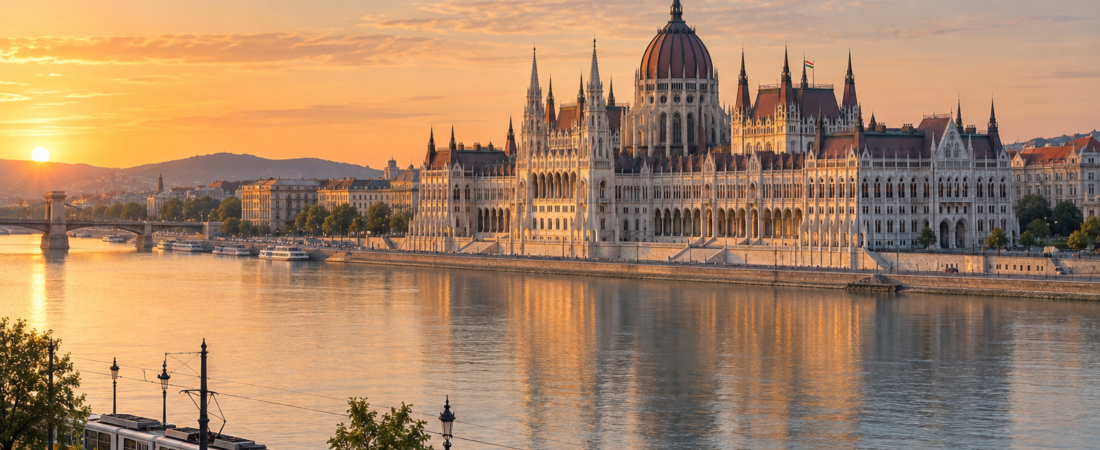
Budapest combines dramatic architecture, thermal baths, historic neighbourhoods and lively restaurants along one of Europe’s most famous rivers.
Hungary’s capital is divided by the Danube into Buda and Pest. Hilly Buda contains the Castle District and panoramic viewpoints, while flatter Pest has the Parliament Building, major shopping streets, nightlife districts and many of the city’s restaurants.
This Budapest travel guide explains the best attractions, neighbourhoods, transport options, local food and practical information for planning a first visit.
Why Visit Budapest?
Budapest offers an appealing mixture of grand landmarks, affordable experiences and distinctive local culture.
Visitors can explore historic streets in the morning, relax in a thermal bath during the afternoon and watch the illuminated riverfront after sunset. Many important sights are close enough to combine on foot, while an extensive public-transport network connects the wider city.
Budapest is particularly known for:
- The Hungarian Parliament Building
- Buda Castle and Castle Hill
- Historic thermal baths
- Danube river views
- Ornate cafés and market halls
- Ruin bars and nightlife
- Art Nouveau and nineteenth-century architecture
- Hungarian food and wine
Three or four days provide enough time for a strong introduction, although a longer stay allows for museums, quieter neighbourhoods and day trips.
Understanding Buda and Pest
Budapest developed through the unification of Buda, Óbuda and Pest in 1873.
Buda occupies the western side of the Danube. It is hillier, quieter and home to the Castle District, Fisherman’s Bastion, Matthias Church and several residential areas.
Pest occupies the eastern side. It contains the Parliament Building, St Stephen’s Basilica, the Jewish Quarter, Andrássy Avenue, Heroes’ Square and most of the central nightlife.
Several bridges connect the two sides. The Széchenyi Chain Bridge is the most famous, although other crossings may be more convenient depending on your route.
Top Tours & Experiences in Budapest
Discover popular Budapest tours and experiences. Check current availability, ratings and prices before you book.
Affiliate disclosure: If you book through these links, we may earn a commission from Viator. This does not increase the price you pay.
Top Attractions in Budapest
1. Hungarian Parliament Building
The Hungarian Parliament Building dominates the Pest bank of the Danube and is one of the city’s defining landmarks.
Its Gothic Revival exterior can be admired from Kossuth Lajos Square or from across the river in Buda. The riverside view is particularly attractive around sunrise and after the building is illuminated at night.
Interior access is available through guided visits. Tours can sell out, so reserve through the official visitor service and check current identification and security requirements before arriving.
2. Buda Castle
Buda Castle stands above the Danube on Castle Hill.
The palace complex contains the Hungarian National Gallery, Budapest History Museum and National Széchényi Library. Visitors can also walk through the surrounding courtyards and enjoy views over Pest.
The wider Castle District deserves several hours. Walking uphill is possible, while public transport provides an easier alternative.
3. Fisherman’s Bastion
Fisherman’s Bastion is a neo-Romanesque terrace offering panoramic views of the Parliament Building, Danube and Pest skyline.
Some sections can be explored freely, while particular upper terraces may require admission during designated periods. Early morning usually provides a quieter experience and softer light for photography.
4. Matthias Church
Matthias Church stands beside Fisherman’s Bastion and is recognised by its colourful tiled roof.
The building has played an important role in Hungarian history and hosted royal coronations. An admission ticket is normally required to see its decorated interior.
Opening arrangements can change for religious services and events, so consult the current schedule before visiting.
5. Széchenyi Chain Bridge
The Széchenyi Chain Bridge connects central Pest with the lower part of Castle Hill.
Walking across provides memorable views in both directions. From the bridge, visitors can see the Parliament Building, Buda Castle and other landmarks lining the Danube.
The bridge is especially atmospheric after sunset when the surrounding riverfront is illuminated.
6. St Stephen’s Basilica
St Stephen’s Basilica is one of the most prominent religious buildings in Budapest.
Its interior contains decorative mosaics, marble details and significant religious relics. Visitors can also access a panoramic terrace near the dome for elevated views across Pest.
Admission arrangements differ between the church, treasury and panoramic area. Check current tickets and opening hours before travelling.
7. Shoes on the Danube Bank
The Shoes on the Danube Bank memorial commemorates people murdered beside the river during the Second World War.
The installation consists of iron shoes positioned near the Parliament Building. It is an open public memorial rather than a conventional attraction.
Visitors should approach the site quietly and respectfully.
8. Great Market Hall
The Great Market Hall is Budapest’s best-known covered market.
Its ground floor contains produce, spices, meat and packaged foods, while upper areas include prepared meals and souvenir stalls. Paprika products are particularly prominent.
Browsing is free, but prices vary significantly between stalls. Visit earlier in the day for the widest selection and check opening hours because the market does not operate continuously throughout the week.
9. Heroes’ Square
Heroes’ Square marks the northeastern end of Andrássy Avenue.
The monumental space contains the Millennium Monument and statues representing important figures from Hungarian history. It is bordered by the Museum of Fine Arts and Hall of Art.
The square can be combined with City Park, Vajdahunyad Castle and Széchenyi Thermal Bath.
10. City Park
City Park provides green space behind Heroes’ Square.
Visitors can walk around the lake, see Vajdahunyad Castle and continue to several museums and family attractions. Some outdoor areas are free, although individual institutions charge admission.
The park works well as a relaxed half-day destination, particularly during spring and autumn.
11. Széchenyi Thermal Bath
Széchenyi is one of Budapest’s most recognisable thermal-bath complexes.
Its indoor and outdoor pools occupy an elaborate neo-Baroque building in City Park. Services and pool availability may vary, and admission categories depend on the day and facilities selected.
Bring appropriate swimwear and check whether towels, lockers and other essentials are included in your chosen ticket.
12. Gellért Hill
Gellért Hill rises above the Danube on the Buda side and offers broad views across the city.
Paths lead towards the Citadella and Liberty Statue, although renovation projects can temporarily affect access. Check current conditions before planning a specific walking route.
The hill is steep in places, so comfortable shoes and drinking water are recommended.
13. The Jewish Quarter
District VII contains important Jewish heritage sites alongside cafés, restaurants and nightlife.
The Dohány Street Synagogue is the district’s most famous landmark. Other significant locations include the Rumbach Street Synagogue and Kazinczy Street Synagogue.
Many religious and cultural sites have separate admission arrangements and may close for services or Jewish holidays.
14. Andrássy Avenue
Andrássy Avenue connects the city centre with Heroes’ Square.
The boulevard is lined with historic villas, cultural institutions and luxury shops. The Hungarian State Opera House is one of its most impressive buildings.
Visitors can walk the avenue or travel beneath it on Metro Line M1, continental Europe’s oldest underground railway.
15. Margaret Island
Margaret Island lies in the Danube between Buda and Pest.
The largely traffic-free island includes gardens, walking paths, historic ruins, recreational facilities and open lawns. It provides a welcome break from intensive sightseeing.
Walking around the island is free, while some attractions and seasonal activities charge separately.
Budapest’s Thermal Baths
Budapest’s thermal-bath tradition draws from Roman, Ottoman and later European influences.
Széchenyi is the largest and most recognisable option for many first-time visitors. Other well-known facilities include Rudas, Lukács and Gellért, although services may be affected by renovation or maintenance periods.
Bath rules differ between complexes. Before visiting, confirm:
- Opening hours
- Pool availability
- Age restrictions
- Swimwear requirements
- Whether advance booking is recommended
- Locker, cabin and towel arrangements
- Any gender-specific or event-specific sessions
Allow at least two or three hours for a relaxed visit.
Best Neighbourhoods for Visitors
District V: Belváros-Lipótváros
District V is convenient for first-time visitors who want to stay near the Danube, Parliament Building and central shopping streets.
It is highly walkable and well connected but can be more expensive than districts farther from the centre.
District I: Castle District
The Castle District is suitable for historic surroundings, river views and quieter evenings.
The main disadvantage is the hilly terrain. Nightlife and restaurant choices are also more limited than in central Pest.
District VI: Terézváros
District VI surrounds Andrássy Avenue and the Hungarian State Opera House.
It offers convenient public transport and straightforward access to both the centre and City Park.
District VII: Erzsébetváros
District VII is a lively choice for restaurants, cafés and nightlife.
The central Jewish Quarter can remain noisy late into the evening. Travellers seeking quiet accommodation should inspect recent guest reviews and choose streets away from the busiest bars.
District IX: Ferencváros
Inner District IX provides access to the Great Market Hall, Danube and several cultural venues.
It can offer better value than the most central streets while remaining connected by tram and metro.
Getting Around Budapest
Budapest has an extensive network of metros, trams, buses and trolleybuses.
The city centre is walkable, but public transport saves time when travelling between Castle Hill, City Park and outer districts. Tram routes along the Danube also provide scenic journeys.
Tickets and passes are available through official machines, sales points and the BudapestGO application. Requirements differ between paper, mobile and time-based products.
Always confirm whether your ticket needs validation. Ticket inspections are common, and an unvalidated ticket may be treated as invalid.
Travelling From Budapest Airport
Budapest Ferenc Liszt International Airport is connected to the centre by public transport.
The 100E Airport Express runs directly towards central Budapest and uses a special airport fare. An ordinary single ticket is generally not sufficient for this service.
The 200E bus connects the airport with the wider public-transport network and can be combined with Metro Line M3. This route may be economical for travellers using an eligible pass or standard network tickets.
Check the official journey planner before travelling because fares, stops and operating arrangements can change.
What to Eat in Budapest
Hungarian cuisine is filling and frequently flavoured with paprika, onions and sour cream.
Popular dishes and snacks include:
- Gulyás, a soup containing meat and vegetables
- Chicken paprikash
- Pörkölt meat stew
- Stuffed cabbage
- Lángos fried dough
- Fisherman’s soup
- Dobos cake
- Kürtőskalács, commonly called chimney cake
- Strudel and other pastries
Central tourist areas contain both excellent restaurants and overpriced establishments. Review menus before sitting down and check whether service is already included.
Currency and Payments
Hungary uses the Hungarian forint rather than the euro.
Cards are widely accepted in hotels, restaurants, shops and many attractions, but carrying a small amount of local currency can be useful.
When a payment terminal or cash machine offers to convert a transaction into your home currency, compare the exchange rate carefully. Paying in forints and allowing your own bank to perform the conversion may provide a better rate.
Use bank-operated cash machines where practical and review withdrawal fees before confirming a transaction.
Best Time to Visit Budapest
Spring and autumn usually provide comfortable conditions for walking and sightseeing.
Summer brings long days, outdoor events and busy riverside areas, but temperatures can become hot and major attractions may be crowded.
Winter is cold and daylight hours are shorter. However, thermal baths, indoor museums and seasonal markets can make the city appealing during this period.
Reserve accommodation early for major festivals, public holidays and New Year celebrations.
Suggested Three-Day Budapest Itinerary
Day One: Central Pest
Visit the Parliament Building area, Shoes on the Danube Bank, St Stephen’s Basilica and Andrássy Avenue. Spend the evening beside the Danube or exploring central Pest.
Day Two: Buda and the Castle District
Cross the Chain Bridge and explore Buda Castle, Fisherman’s Bastion and Matthias Church. Continue towards Gellért Hill if access and weather conditions permit.
Day Three: City Park and the Jewish Quarter
Begin at Heroes’ Square and explore City Park. Reserve time for Széchenyi Thermal Bath before visiting the Jewish Quarter for dinner.
Typical Budapest Travel Costs
Budapest can suit budget, mid-range and luxury travellers.
Accommodation is generally most expensive in the historic centre and during busy weekends or major events. Staying near a metro or tram line outside the most popular streets may reduce costs without making sightseeing difficult.
Other expenses depend heavily on whether you visit thermal baths, museums, paid viewpoints and evening venues. Free walks, parks and public riverfronts can balance the cost of ticketed attractions.
Set separate allowances for:
- Accommodation
- Airport transfers
- Local public transport
- Food and drinks
- Thermal-bath admission
- Museums and historic interiors
- River cruises or evening entertainment
Safety and Common Mistakes
Budapest is generally manageable for visitors, but standard urban precautions remain important.
Keep valuables secure on crowded transport and around major attractions. Use licensed taxis or established booking services, and check restaurant menus before ordering.
Common mistakes include:
- Assuming Hungary uses the euro
- Boarding transport without validating the correct ticket
- Using an ordinary ticket on the 100E Airport Express
- Reserving too little time for Castle Hill
- Visiting thermal baths without checking current rules
- Accepting poor exchange rates from conversion services
- Staying in the nightlife district without considering noise
- Attempting to cover distant attractions entirely on foot
Accessibility
Central Pest is relatively flat, but kerbs, older buildings and uneven pavements can create difficulties.
Castle Hill and Gellért Hill involve steep gradients. Public transport, lifts or taxis may be preferable for visitors with limited mobility.
Accessibility varies between historic attractions and thermal baths. Contact individual venues before travelling to confirm step-free entrances, lifts, accessible changing facilities and companion policies.
Day Trips From Budapest
Budapest can also serve as a base for exploring nearby destinations.
Popular options include:
- Szentendre for colourful streets, galleries and museums
- The Danube Bend for riverside scenery and historic towns
- Gödöllő for its royal palace
- Eger for historic architecture, wine and its castle
- Lake Balaton for seasonal lakeside activities
Travel times and transport frequency vary, so check current rail or bus schedules before departure.
Practical Budapest Travel Tips
- Reserve Parliament tours through the authorised ticket service.
- Validate transport tickets according to their specific rules.
- Allow extra time for security checks at major attractions.
- Carry swimwear if you plan to visit a thermal bath.
- Wear comfortable shoes for cobbled streets and hills.
- Pay in Hungarian forints when possible.
- Group attractions by neighbourhood to reduce travel time.
- Check opening hours around public and religious holidays.
- Book popular restaurants and baths during busy periods.
- Confirm renovation work before visiting the Citadella or other major sites.
Final Thoughts
Budapest rewards visitors with monumental architecture, historic streets, distinctive food and a thermal-bath culture unlike that of most European capitals.
First-time visitors should prioritise the Parliament Building, Castle District, Fisherman’s Bastion, St Stephen’s Basilica and at least one thermal bath. Leave time to walk beside the Danube after sunset, when the city’s illuminated skyline is at its most memorable.
Book Your Budapest Experiences
Ready to start planning? Compare popular Budapest tours and activities, check current prices and availability, and book the experiences that suit your trip.
Affiliate disclosure: If you book through these links, we may earn a commission from Viator. This does not increase the price you pay.
Explore more places through our destinations page or browse our complete collection of itineraries.