
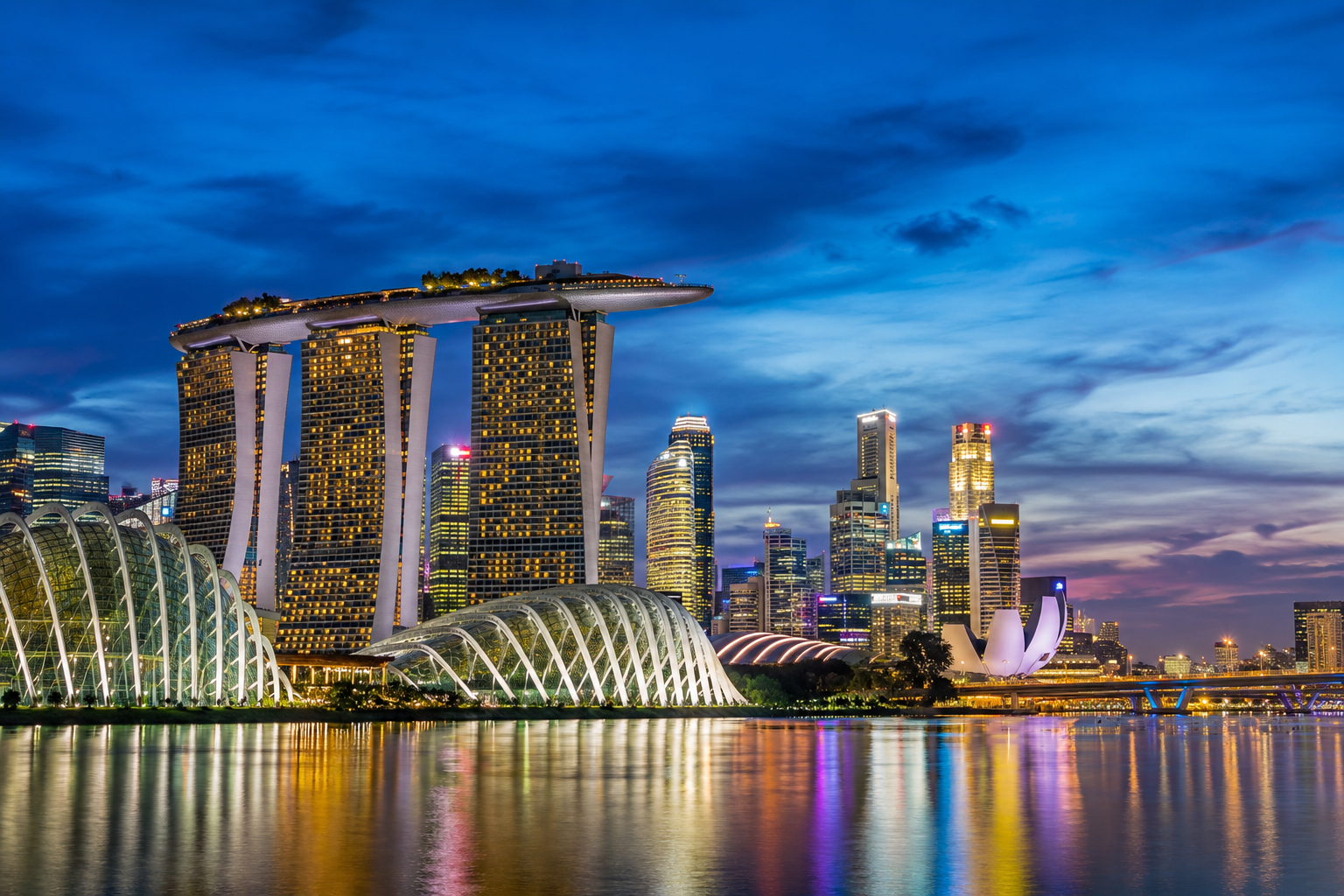
Singapore combines futuristic architecture, multicultural neighbourhoods, tropical gardens, excellent public transport and one of Asia’s most diverse food cultures. Its compact size and clear infrastructure make it especially suitable for first-time visitors, families, solo travellers and short stopovers.
This complete Singapore travel guide covers the city’s essential attractions, the best neighbourhoods, current transport options, food, approximate costs and practical advice for planning your visit.
Price note: All prices in this article are approximate and were checked at the time of publication. Prices may change.
Why Visit Singapore?
Singapore offers an unusual combination of modern city attractions and accessible nature. You can walk beside the Marina Bay skyline, explore Chinese, Malay and Indian heritage districts, eat at a hawker centre and finish the day beneath the illuminated Supertrees.
The city is particularly rewarding for travellers interested in:
- Modern architecture and skyline views
- Gardens, wildlife and nature reserves
- Chinese, Malay, Indian and Peranakan heritage
- Hawker food and internationally recognised dining
- Family-friendly attractions
- Shopping and entertainment
- Clean, efficient public transport
- Safe and accessible urban sightseeing
English is widely used, visitor attractions are generally well organised and signs are easy to understand.
Top Tours & Experiences in Singapore
Discover popular Singapore tours and experiences. Check current availability, ratings and prices before you book.
Affiliate disclosure: If you book through these links, we may earn a commission from Viator. This does not increase the price you pay.
Essential Singapore Information
Country: Republic of Singapore
Currency: Singapore dollar (SGD)
Languages: English, Malay, Mandarin and Tamil
Recommended stay: 3 to 5 days
Main airport: Singapore Changi Airport
Climate: Tropical, warm and humid throughout the year
Time zone: Singapore Standard Time, UTC+8
Electricity: Type G 3-pin plugs
Singapore is both a city and an independent country. Although it is geographically compact, its attractions extend from central Marina Bay to Sentosa, northern wetlands and coastal parks.
Top Attractions in Singapore
1. Gardens by the Bay
Gardens by the Bay is one of Singapore’s most recognisable attractions. It combines free outdoor landscapes with ticketed conservatories and elevated viewpoints.
The main areas include:
- Supertree Grove
- Flower Dome
- Cloud Forest
- Floral Fantasy
- OCBC Skyway
- Supertree Observatory
- Outdoor themed gardens
- Bay East Garden
The outdoor gardens and Supertree Grove have free general admission. The official schedule currently lists Supertree Grove as open from approximately 5:00 a.m. to 2:00 a.m., although the Supertree lights are switched off later at night.
The Flower Dome and Cloud Forest currently operate from approximately 9:00 a.m. to 9:00 p.m., with earlier last-admission times. Individual attractions close on scheduled maintenance days.
Ticket combinations change according to seasonal exhibitions. The currently advertised non-resident package combining the Flower Dome, Cloud Forest’s featured experience, Floral Fantasy’s featured experience and shuttle service is approximately S$58 for an adult. Check the official ticket page to see whether a smaller or different package is available for your dates.
Garden Rhapsody
Garden Rhapsody is the free evening light-and-sound show at Supertree Grove. Shows generally take place twice each evening, but timings and programmes can change.
Arrive early, particularly on weekends and holidays, and check the official event calendar on the day of your visit.
Nearest MRT: Bayfront
2. Marina Bay
The Marina Bay waterfront brings together many of Singapore’s best-known landmarks. A self-guided walk can include:
- Marina Bay Sands
- Merlion Park
- Esplanade
- Helix Bridge
- ArtScience Museum
- The Fullerton area
- Financial-district skyline
- Gardens by the Bay
Walking around the bay is free. The full circuit is long, so first-time visitors may prefer to complete it in sections.
Early morning offers cooler conditions and fewer people. Evening provides illuminated skyline views and easy access to the Spectra light-and-water show outside Marina Bay Sands.
Museums, observation decks and other indoor attractions charge separately.
3. Merlion Park
Merlion Park contains Singapore’s famous half-lion, half-fish symbol. It also provides one of the classic views across Marina Bay towards Marina Bay Sands.
There is no admission fee. The viewing area can become crowded in the evening, so sunrise or early morning is better for quieter photographs.
The Merlion occasionally closes for maintenance. Check current notices if seeing it is particularly important to your trip.
Nearest MRT: Raffles Place
4. Singapore Botanic Gardens
Singapore Botanic Gardens is a UNESCO World Heritage Site containing lakes, tropical plant collections, heritage trees, lawns and walking routes.
The main gardens are free and officially open from approximately 5:00 a.m. until midnight daily. Individual indoor spaces and specialised gardens follow their own schedules.
The gardens are extensive. Two useful entrances are:
- Tanglin Gate: Convenient for heritage landscapes
- Bukit Timah Gate: Beside Botanic Gardens MRT
- Nassim Gate: Useful for the National Orchid Garden
- Gallop Extension: Best for additional nature and heritage spaces
Morning is the most comfortable time for walking.
National Orchid Garden
The National Orchid Garden is a paid attraction inside the Botanic Gardens. Its official standard admission currently costs approximately:
- Adults: S$15
- Seniors aged 60 and above: S$3
- Students with qualifying identification: S$3
- Children below 12: Free
It operates approximately 8:30 a.m.–7:00 p.m., with final ticket sales and entry at 6:00 p.m.
Nearest MRT: Botanic Gardens or Napier, depending on your route
5. Chinatown
Singapore’s Chinatown combines conserved shophouses, temples, markets, museums, cafés and hawker food.
Important places include:
- Buddha Tooth Relic Temple
- Sri Mariamman Temple
- Thian Hock Keng Temple
- Chinatown Complex
- Maxwell Food Centre
- Pagoda Street
- South Bridge Road
- Ann Siang Hill
- Telok Ayer
Walking through the neighbourhood is free. Religious sites generally allow respectful visitors, but access can be restricted during ceremonies.
Dress appropriately, keep your voice low and follow photography rules.
Nearest MRT: Chinatown, Maxwell or Telok Ayer
6. Little India
Little India is one of Singapore’s most colourful and energetic neighbourhoods. Serangoon Road and surrounding streets contain flower-garland stalls, textile shops, restaurants, jewellery businesses and Hindu temples.
Highlights include:
- Sri Veeramakaliamman Temple
- House of Tan Teng Niah
- Little India Arcade
- Tekka Centre
- Indian Heritage Centre
- Campbell Lane
Exploring the public streets is free. The area becomes particularly atmospheric during cultural festivals, but it can also become much more crowded.
Nearest MRT: Little India or Jalan Besar
7. Kampong Gelam
Kampong Gelam is associated with Singapore’s Malay and Muslim heritage. The area combines historic streets with textile shops, restaurants, cafés, murals and independent businesses.
Key places include:
- Sultan Mosque
- Bussorah Street
- Arab Street
- Haji Lane
- Muscat Street
- Gelam Gallery
Visitors may enter Sultan Mosque outside prayer times when public access is available. Wear respectful clothing and follow instructions from mosque staff.
Haji Lane becomes lively later in the day. Visit in the morning for quieter photography or in the evening for cafés and nightlife.
Nearest MRT: Bugis or Nicoll Highway
8. Sentosa Island
Sentosa is a resort island containing beaches, hotels, family attractions and entertainment.
Popular attractions include:
- Universal Studios Singapore
- Singapore Oceanarium
- Adventure Cove Waterpark
- Skyline Luge
- Cable-car rides
- Siloso Beach
- Palawan Beach
- Tanjong Beach
- Fort Siloso
- Sensoryscape
Individual attraction tickets vary significantly, so check official prices and opening schedules before travelling.
Getting to Sentosa
The Sentosa Express runs from VivoCity and currently costs approximately S$4 for entry from the mainland. Travel on the Sentosa Express within the island is free.
The official schedule currently lists first and last services at approximately 7:00 a.m. and midnight.
Walking into Sentosa through the Sentosa Boardwalk is free. Sentosa’s public beaches also have free general access.
Nearest mainland MRT: HarbourFront
9. Jewel Changi Airport
Jewel Changi Airport is a shopping and entertainment complex connected to the airport terminals. Its centrepiece is the HSBC Rain Vortex surrounded by the Shiseido Forest Valley.
General entry to Jewel, the Forest Valley and Rain Vortex viewing areas is free. Some upper-level attractions, activities and experiences require tickets.
The Rain Vortex normally follows different operating hours on weekdays and weekends. Maintenance or airport arrangements can affect its operation, so check Jewel’s official schedule before making a special journey.
Jewel can be visited when arriving, departing or during a separate trip from the city. Allow enough time to complete immigration, baggage and airport procedures.
10. Singapore River
The Singapore River connects historic districts with modern dining and nightlife areas.
A walking route can pass through:
- Boat Quay
- Clarke Quay
- Robertson Quay
- Cavenagh Bridge
- Anderson Bridge
- Asian Civilisations Museum exterior
- Fullerton waterfront
The public river walk is free. River cruises, restaurants and bars are optional paid experiences.
Walk during the evening for illuminated buildings and cooler conditions.
11. Fort Canning Park
Fort Canning Park combines landscaped gardens, colonial history, archaeological sites and former military structures on a hill near central Singapore.
Visitors can see heritage markers, old fortifications and the popular Fort Canning Tree Tunnel without an admission charge.
The park involves slopes and steps. Wear comfortable footwear and carry water.
Nearest MRT: Fort Canning, Dhoby Ghaut or Bras Basah
12. National Museum of Singapore
The National Museum introduces visitors to Singapore’s history and development. Its galleries, temporary exhibitions and programmes cover the country’s social, cultural and political story.
Admission charges and free-entry eligibility differ for Singapore residents and international visitors. Exhibitions may also have separate prices.
Check the museum’s official website for current galleries, maintenance closures, operating hours and ticket options before visiting.
Nearest MRT: Bencoolen, Bras Basah or Dhoby Ghaut
13. National Gallery Singapore
National Gallery Singapore occupies the former Supreme Court and City Hall buildings. It contains a major collection of Southeast Asian art and impressive restored interiors.
The public areas and ticketed galleries follow different access arrangements. Admission prices vary by residency, age and exhibition.
Even if you do not enter every gallery, the surrounding Civic District provides a worthwhile architecture and heritage walk.
Nearest MRT: City Hall
14. East Coast Park
East Coast Park stretches along Singapore’s southeastern coastline. It offers beaches, lawns, cycling paths, barbecue areas and food centres.
General park access is free. Bicycle rental, water activities, reserved barbecue facilities and food cost extra.
Swimming conditions vary, so follow official safety signs and do not enter the water during storms.
The park is not directly beside most MRT stations, but buses and taxis provide connections.
15. Southern Ridges
The Southern Ridges connect several parks through forest paths, elevated walkways and bridges.
Important sections include:
- Mount Faber Park
- Henderson Waves
- Telok Blangah Hill Park
- Forest Walk
- HortPark
- Kent Ridge Park
The complete route is lengthy, but visitors can select a shorter section. Henderson Waves is the best-known architectural highlight.
Access is free. Start early, carry water and avoid exposed paths during thunderstorms.
Where to Stay in Singapore
Singapore’s efficient MRT network means you do not need to stay directly beside Marina Bay. A well-connected neighbourhood can provide better value while keeping journeys simple.
Marina Bay
Marina Bay is best for skyline views, luxury hotels and walking access to major landmarks.
Best for: Short luxury stays, first-time sightseeing and special occasions
Consider: Hotels are generally expensive.
Chinatown
Chinatown combines heritage, hawker food and central transport.
Best for: Food lovers, couples and travellers seeking a central cultural neighbourhood
Consider: Some rooms in older buildings are compact.
Bugis and Kampong Gelam
Bugis offers useful MRT connections, shopping and access to Kampong Gelam.
Best for: First-time visitors, food and cultural sightseeing
Consider: Streets around nightlife areas can be noisy.
Little India
Little India provides colourful streets, restaurants and generally better-value accommodation than Marina Bay.
Best for: Budget-conscious visitors and Indian food
Consider: The neighbourhood remains busy and energetic.
Orchard Road
Orchard Road is Singapore’s main shopping district, with modern hotels and several MRT stations.
Best for: Shopping, families and comfortable hotels
Consider: It has less heritage atmosphere than Chinatown or Kampong Gelam.
Singapore River
Clarke Quay, Boat Quay and Robertson Quay provide restaurants, river walks and nightlife.
Best for: Couples, dining and evening entertainment
Consider: Accommodation near nightlife can be noisy.
Sentosa
Sentosa is practical for families planning to spend several days at the island’s attractions and beaches.
Best for: Resorts, beaches and family entertainment
Consider: City-centre sightseeing takes longer.
Compare these neighbourhoods in our detailed guide to where to stay in Singapore.
Getting Around Singapore
Singapore’s MRT and bus systems are clean, extensive and generally straightforward.
MRT
The MRT is normally the fastest way to travel between central neighbourhoods and major attractions.
Services generally operate from early morning until around midnight, but first and last train times vary by station and day. Check the official journey planner when travelling very early or late.
Important visitor stations include:
- Bayfront for Marina Bay Sands and Gardens by the Bay
- Raffles Place for Merlion Park
- Chinatown and Maxwell for Chinatown
- Little India for Little India
- Bugis for Kampong Gelam
- HarbourFront for Sentosa
- Botanic Gardens and Napier for Singapore Botanic Gardens
- Changi Airport for airport connections
Public Buses
Buses reach neighbourhoods and attractions not directly beside MRT stations. They are particularly useful for East Coast Park, parts of the Southern Ridges and local residential areas.
Tap in when boarding and tap out when leaving using the same accepted card or device.
Contactless Payment
Eligible foreign-issued contactless bank cards and mobile wallets can be used for public transport. Overseas cards may incur administrative charges or bank fees.
Use the same physical card or mobile device at the entrance and exit. A card stored in a mobile wallet is treated differently from the physical version of that card.
Singapore Tourist Pass
The Singapore Tourist Pass provides unlimited travel on eligible basic bus, MRT and LRT services.
Current pass prices are approximately:
- 1 day: S$17
- 2 days: S$24
- 3 days: S$29
- 4 days: S$37
- 5 days: S$45
Multi-day passes must be used on consecutive days. Calculate your likely journeys before purchasing because ordinary contactless fares may cost less for a light sightseeing schedule.
Taxis and Ride-Hailing
Taxis and recognised ride-hailing applications are useful for luggage, late-night travel and places requiring multiple public-transport transfers.
Prices vary with distance, time, booking fees, surcharges and demand. Use official taxi stands or established applications.
Travelling From Changi Airport
MRT
The MRT connects Changi Airport with the wider railway network. Most city-centre journeys require a transfer.
It is economical but less convenient with substantial luggage or after the final train.
Public Bus
Public buses connect the terminals with different parts of Singapore. They are inexpensive but usually slower than the MRT.
Taxi or Ride-Hailing
Taxis and private-hire vehicles provide direct hotel transfers. The final fare depends on destination, time and applicable surcharges.
Late-Night Arrivals
Public transport does not run throughout the night. Check your arrival time against the final MRT and bus services before choosing your transfer.
Best Time to Visit Singapore
Singapore remains warm, humid and rainy throughout the year. There is no reliably cool or completely dry season.
February to April can offer a reasonable balance for sightseeing, but showers remain possible. December and January are often wetter under the Northeast Monsoon.
Hotel demand may rise during:
- Chinese New Year
- School holidays
- National Day events
- Singapore Grand Prix
- Christmas and New Year
- Major conventions and concerts
Outdoor attractions are generally most comfortable in the morning and late afternoon.
For a detailed month-by-month comparison, read our guide to the best time to visit Singapore.
Food to Try in Singapore
Singapore’s food reflects Chinese, Malay, Indian, Peranakan and international influences.
Popular dishes include:
- Hainanese chicken rice: Poached or roasted chicken with fragrant rice
- Laksa: Spicy coconut noodle soup
- Satay: Grilled skewers served with peanut sauce
- Char kway teow: Stir-fried flat rice noodles
- Nasi lemak: Coconut rice with savoury accompaniments
- Roti prata: Crisp flatbread served with curry
- Bak kut teh: Peppery or herbal pork-rib soup
- Chilli crab: Crab in a rich sweet and savoury sauce
- Kaya toast: Toast with coconut-and-egg jam
- Ice kacang: Shaved-ice dessert with colourful toppings
Hawker centres provide an accessible and relatively affordable introduction to local food.
Popular choices include:
- Maxwell Food Centre
- Chinatown Complex Food Centre
- Lau Pa Sat
- Tekka Centre
- Old Airport Road Food Centre
- Tiong Bahru Market
- Newton Food Centre
- East Coast Lagoon Food Village
Check prices before ordering seafood sold by weight. Confirm the total cost, preparation method and portion size.
Return your tray and used dishes to the appropriate collection station after eating.
How Expensive Is Singapore?
Singapore accommodation and major ticketed attractions can be expensive, but public transport, hawker meals and free attractions help control the total budget.
A traveller can reduce costs by:
- Staying near an MRT station outside Marina Bay
- Eating regularly at hawker centres
- Using public transport
- Walking into Sentosa through the Boardwalk
- Exploring free gardens, parks and neighbourhoods
- Selecting only a few priority paid attractions
- Carrying a refillable water bottle
- Booking accommodation early
Our complete Singapore travel budget provides sample costs for budget, mid-range and luxury trips.
Suggested 3-Day Singapore Itinerary
Day 1: Marina Bay and Gardens by the Bay
Begin at Merlion Park, walk along the Marina Bay waterfront and cross the Helix Bridge. Visit a museum or observation deck if desired, then continue to Gardens by the Bay.
Explore the outdoor gardens and selected ticketed attractions before watching Garden Rhapsody in the evening.
Day 2: Cultural Neighbourhoods
Start in Chinatown with its temples, conserved streets and hawker centres. Continue to Little India, then finish in Kampong Gelam around Sultan Mosque, Arab Street and Haji Lane.
Day 3: Nature or Sentosa
Visit Singapore Botanic Gardens in the morning. Spend the afternoon on Sentosa’s beaches and attractions, or choose the Southern Ridges, Orchard Road or a museum.
Follow our detailed 3 days in Singapore itinerary for a more complete route.
Free Things to Do in Singapore
Singapore offers many free experiences, including:
- Gardens by the Bay’s outdoor gardens
- Garden Rhapsody
- Marina Bay waterfront
- Merlion Park
- Singapore Botanic Gardens
- Fort Canning Park
- Chinatown
- Little India
- Kampong Gelam
- Haji Lane
- Sentosa’s beaches
- Southern Ridges
- Henderson Waves
- East Coast Park
- Jewel Changi Airport’s public areas
- Jurong Lake Gardens
- Sungei Buloh Wetland Reserve
Transport, food and optional attractions still cost extra. Discover more possibilities in our guide to the best free things to do in Singapore.
Practical Singapore Travel Tips
Carry an Umbrella
Rain can develop quickly in any month. A compact umbrella also provides shade during strong sunshine.
Drink Tap Water
Singapore’s tap water is generally suitable for drinking. Carry a refillable bottle to reduce cost and single-use plastic.
Expect Strong Air Conditioning
Shopping centres, trains and museums can feel cold compared with outdoor temperatures. Carry a lightweight layer if you are sensitive to air conditioning.
Follow Local Rules
Pay attention to signs concerning smoking, food and drinks, protected areas, public transport and pedestrian behaviour.
Rules can differ by location. Follow current official notices rather than relying on exaggerated lists shared online.
Dress Respectfully at Religious Sites
Cover your shoulders and knees when requested. Remove shoes before entering designated areas and avoid visiting during private ceremonies.
Use Pedestrian Crossings
Cross roads at designated points and follow signals. Traffic drives on the left.
Keep Some Cash
Cards are widely accepted, but some hawker stalls and small businesses may not accept every foreign payment method.
Check Entry Requirements
Passport, visa and electronic-arrival requirements depend on nationality and can change. Verify them through Singapore’s Immigration & Checkpoints Authority before departure.
Protect Yourself From Heat
Use sunscreen, take shaded breaks and drink water regularly. Avoid strenuous exposed walks during the hottest part of the day.
Frequently Asked Questions
How many days are enough for Singapore?
3 days cover Marina Bay, Gardens by the Bay and the principal cultural neighbourhoods. Four or five days allow more time for Sentosa, museums, nature reserves and local districts.
Is Singapore suitable for first-time visitors?
Yes. English is widely used, public transport is well organised and major attractions have clear visitor information.
Is Singapore expensive?
Accommodation and paid attractions can be expensive, but hawker food, public transport and numerous free experiences make it possible to control costs.
Can visitors use the MRT easily?
Yes. Stations provide clear maps and signage. Remember to tap in and out using the same card or mobile device.
Is Singapore walkable?
Individual districts are walkable, but the tropical heat and sudden rain can make long routes tiring. Combine walking with MRT and buses.
Is Singapore safe?
Singapore is generally considered a safe destination, but normal travel precautions still apply. Protect valuables, use legitimate transport and follow local laws.
Is tap water safe to drink?
Singapore’s tap water is generally suitable for direct consumption.
What should visitors wear?
Lightweight, breathable clothing is appropriate outdoors. Carry a light layer for air-conditioned places and modest clothing for religious sites.
Final Thoughts
Singapore is easy to navigate, but careful planning helps control costs and prevents the tropical climate from becoming exhausting.
Group attractions geographically, use the MRT and buses, schedule outdoor walks for the morning or evening and balance paid landmarks with free parks and neighbourhoods.
Beyond Marina Bay, allow time for Chinatown, Little India, Kampong Gelam and Singapore’s hawker centres. These areas reveal the cultural variety that makes the city much more than a modern stopover destination.
Book Your Singapore Experiences
Ready to start planning? Compare popular Singapore tours and activities, check current prices and availability, and book the experiences that suit your trip.
Affiliate disclosure: If you book through these links, we may earn a commission from Viator. This does not increase the price you pay.
Explore more places through our destinations page or browse our complete collection of itineraries.